
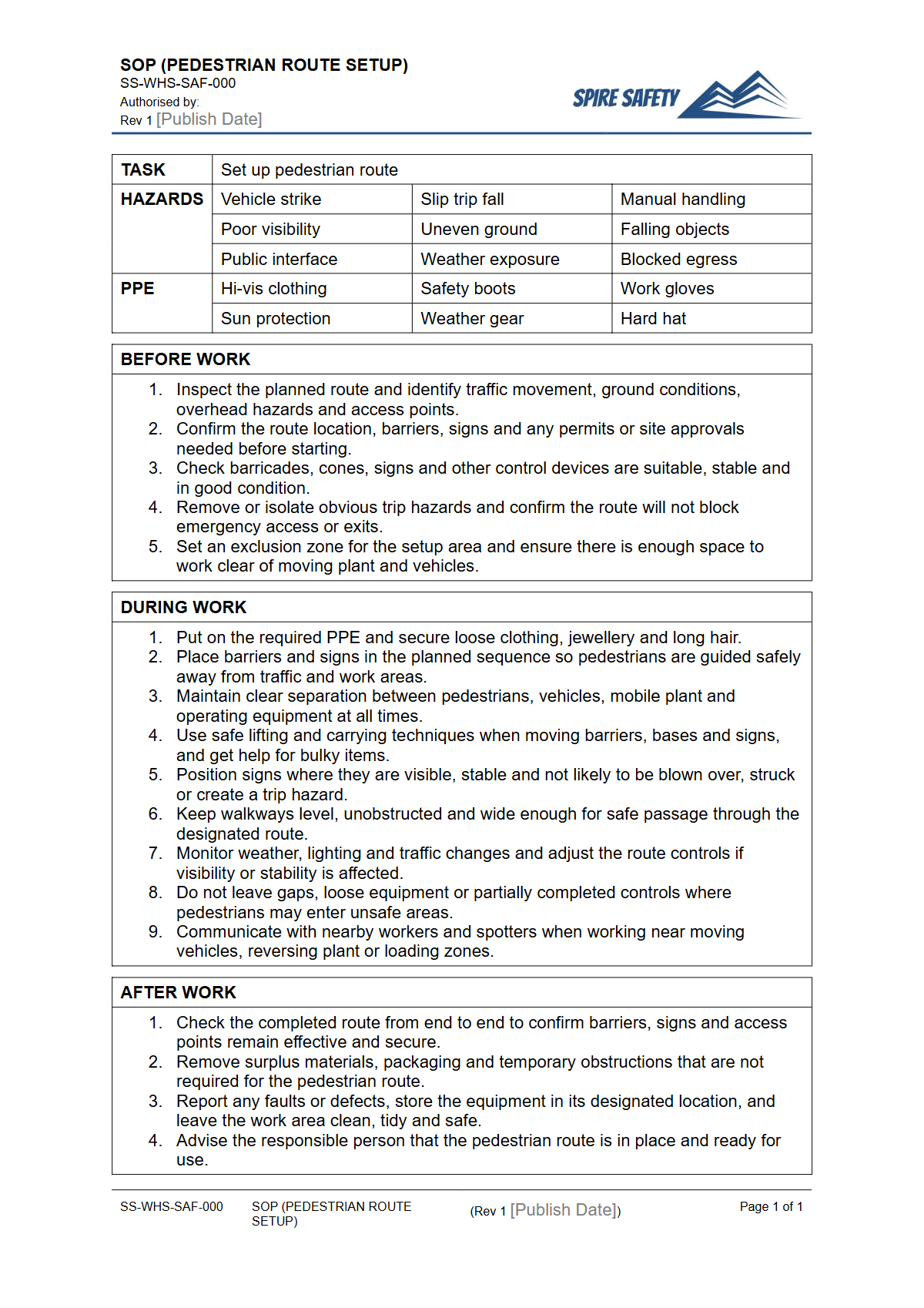
Free Safe Operating Procedure (Pedestrian Route Setup) Template
Clearly define and manage pedestrian movement in your workplace to prevent collisions and injuries. Download our free Safe Operating Procedure template now.
Free Safe Operating Procedure (Pedestrian Route Setup) Template
DOCX • 126 KB + PDF
Updated Oct 2026
No signup required
Purpose of the Free Safe Operating Procedure (Pedestrian Route Setup) Template
Managing the interaction between pedestrians and vehicles is a critical WHS responsibility. This free Safe Operating Procedure (Pedestrian Route Setup) template provides a structured framework for establishing and maintaining safe pedestrian pathways in your workplace.
Its primary purpose is to help your organisation systematically identify hazards, assess risks, and implement effective control measures to prevent collisions, trips, and other incidents. Using an SOP ensures a consistent approach to pedestrian safety, clearly communicates expectations to all workers and visitors, and demonstrates a proactive commitment to risk management.
It serves as a key document within broader WHS management systems, formalising your processes for controlling a significant workplace hazard.
Video walkthrough
How to use the Free Safe Operating Procedure (Pedestrian Route Setup) Template
This document is a starting point designed to be adapted to your specific operational needs. To use this Safe Operating Procedure for Pedestrian Route Setup, download the DOCX file and customise it with your site-specific information.
This includes details about your workplace layout, the types of vehicles and mobile plant in use, designated walkway locations, crossing points, and any unique environmental hazards. We strongly advise that you consult with your workers, supervisors, and health and safety representatives during this customisation process, as they have firsthand knowledge of the risks involved.
Once finalised, the SOP should be approved by management and used as a basis for training all relevant personnel.
Important Note on Customisation
This is a template only. The responsibility to create a comprehensive and effective safe system of work rests with the Person Conducting a Business or Undertaking (PCBU).
You must adapt this document to reflect the specific hazards, equipment, and conditions of your workplace. Spire Safety assumes no liability for the use or misuse of this template.
Relying on this template without proper customisation will not ensure your compliance with WHS legislation.
Key Elements for Your Pedestrian Route SOP
When customising your SOP, ensure it addresses the core components of a safe pedestrian management plan. Your procedure should detail the use of physical barriers like guardrails or bollards to create positive separation from traffic.
Specify requirements for high-visibility line marking, clear and unambiguous signage (including speed limits and pedestrian crossing signs), and adequate lighting for all routes, especially those used at night or in poor weather conditions. The plan must also outline procedures for safely managing intersections where pedestrian and vehicle paths cross.
For areas with specific machinery, such as those covered by a Telehandler SOP, the pedestrian plan must integrate seamlessly to manage the unique risks posed by that equipment.
When to Implement or Review This SOP
A Safe Operating Procedure for pedestrian routes should be developed and implemented before any work begins at a new site or in a newly configured work area. It is also essential to review and update the SOP in several key situations: after any incident or near-miss involving a pedestrian and a vehicle, when there are significant changes to the workplace layout or traffic flow, or when new types of vehicles or mobile plant are introduced.
Regular reviews, typically conducted annually, are also a crucial part of maintaining its effectiveness. These reviews can be timed to coincide with scheduled WHS compliance audits to ensure ongoing alignment with legal duties and best practices.
Who Should Use a Pedestrian Route SOP?
This procedure is intended for use by anyone with responsibility for workplace safety and site management. This includes WHS Managers, Project Managers, Site Supervisors, Warehouse Managers, and Construction Foremen.
They are responsible for developing, implementing, and enforcing the SOP. However, the document is for everyone on site.
All workers, operators, contractors, and visitors must be made aware of the pedestrian management plan through induction and ongoing training. Workers operating heavy equipment, for which you might have a specific SOP for grader use, must be particularly aware of their responsibilities in shared zones.
Effective implementation relies on everyone understanding and adhering to the established routes and rules.
By implementing a thorough plan, you can significantly reduce the risk of serious injury in your workplace. If you require further guidance on hazard identification or risk control, our WHS consulting services can provide expert assistance. For more templates and safety documents, browse our complete free WHS resources library.
Common mistakes
Common mistakes to avoid
- Assuming painted lines alone provide adequate protection for pedestrians.
- Forgetting to include visitor and contractor access routes in the management plan.
- Failing to consult with workers and supervisors who use the routes daily.
- Not providing adequate lighting for outdoor, early morning, or night-time routes.
Legal references
Legal considerations
The following legal requirements may be relevant to this type of work.
- Work Health and Safety Act (Harmonised) — Provides the primary duties for protecting workers and other people from work health and safety risks.
- Work Health and Safety Regulations (Harmonised) — Sets out requirements supporting the management of workplace hazards and risks.
The following codes may be relevant to this type of work.
- Managing WHS Risks Code of Practice — Provides practical guidance on identifying hazards, assessing risks and applying effective controls.
- Work Health and Safety Consultation, Cooperation and Coordination Code of Practice — Provides practical guidance on consulting workers and coordinating with other duty holders.
- Managing the Work Environment and Facilities Code of Practice — Provides practical guidance on safe work environments, workplace facilities and related controls.
Did you know
Separation is Key
The most effective control for preventing vehicle-pedestrian collisions is physically separating them using barriers, guardrails, or purpose-built walkways.
Australian Statistics
According to Safe Work Australia, from 2003 to 2015, 36% of worker fatalities involving vehicles were pedestrians hit by a moving object, highlighting the critical need for effective traffic management.
FAQ
Frequently asked questions
01What is the main purpose of a pedestrian route SOP?
02Do I need a pedestrian route SOP for a small warehouse?
03What should be included in training for a pedestrian route setup SOP?
04How often should we review our pedestrian route SOP?
Share this resource
Free Safe Operating Procedure (Pedestrian Route Setup) Template
Browse Categories
How To Use It
- 1Download and open in Word or PDF.
- 2Replace the placeholders with your business details.
- 3Get it reviewed by a WHS specialist before rollout.
Need it customised?
Our WHS consultants can adapt this template to your site, run a gap analysis, or audit what you already have in place.
Book a Free Consultation WHS consulting servicesor call 1300 156 382
Related templates
- Free Safe Operating Procedure (Penetrometer) Template
- Free Safe Operating Procedure (Peristaltic Pump) Template
- Free Safe Operating Procedure (Personal Alarm Testing) Template
- Free Safe Operating Procedure (Personnel Hoist) Template
- Free Safe Operating Procedure (Pesticide Mixing) Template
- Free Safe Operating Procedure (Pet Bedding Cleaning) Template