
Free Safe Operating Procedure (Patient Locker Cleaning) Template
Establish clear, safe protocols for cleaning patient lockers in healthcare settings. Download our free Safe Operating Procedure template to get started.
Free Safe Operating Procedure (Patient Locker Cleaning) Template
DOCX • 126 KB + PDF
Updated Oct 2026
No signup required
Purpose of the Free Safe Operating Procedure (Patient Locker Cleaning) Template
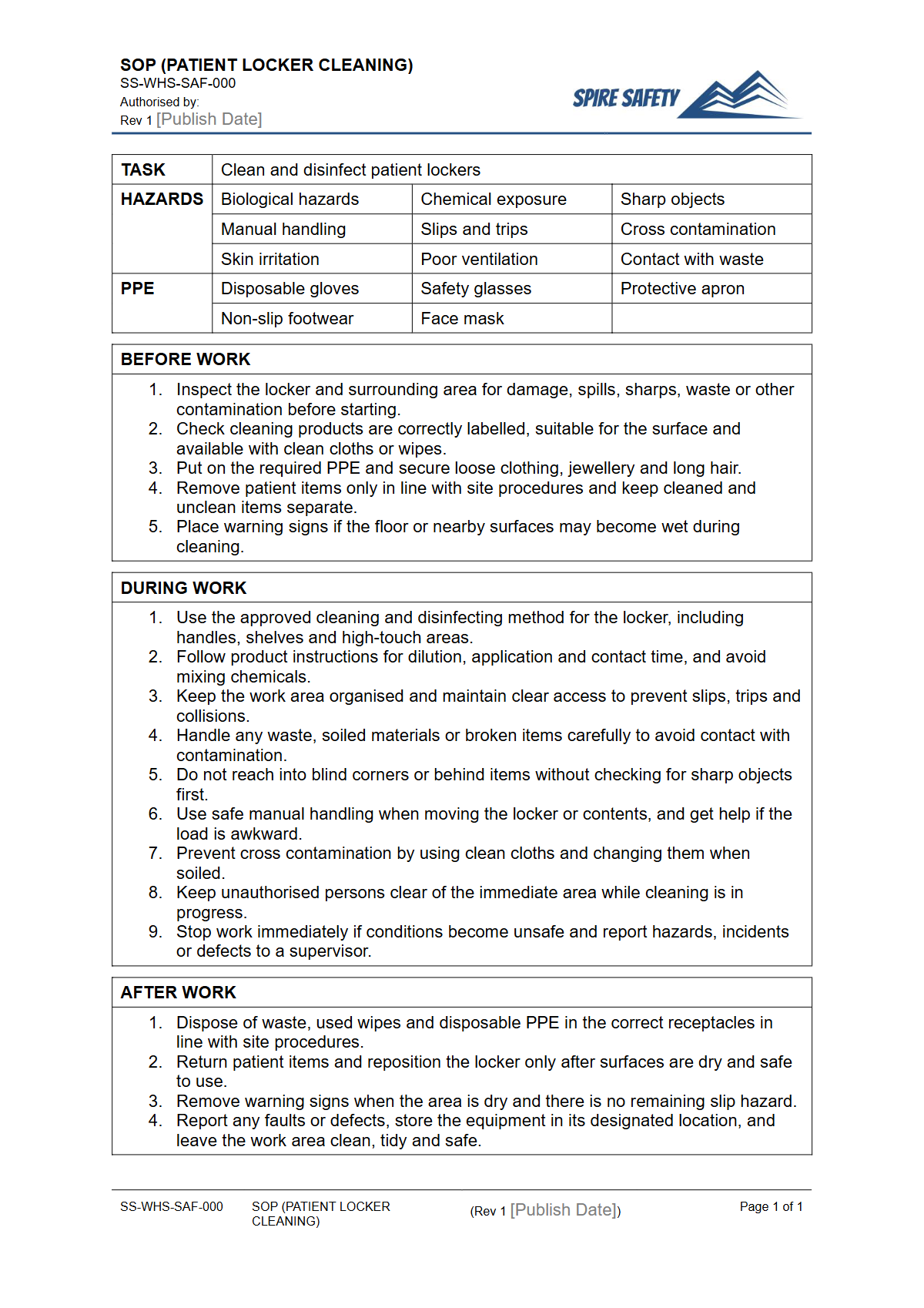
This Free Safe Operating Procedure (Patient Locker Cleaning) Template provides a structured framework for healthcare and aged care facilities to document the process for cleaning and disinfecting patient lockers. Proper cleaning protocols are essential for infection control, preventing cross-contamination, and ensuring a safe environment for patients, staff, and visitors.
This document outlines the key steps, hazards, and control measures required for the task.
The primary purpose of this Safe Operating Procedure is to minimise health and safety risks associated with cleaning tasks in a clinical or care environment. It helps organisations define a consistent, step-by-step method for cleaning and disinfection, addressing hazards such as exposure to biological materials, hazardous chemicals, and musculoskeletal injuries from manual tasks. Implementing a formal SOP ensures all workers follow the same safe work method, which is a key component of effective WHS management systems.
Video walkthrough
How to use the Free Safe Operating Procedure (Patient Locker Cleaning) Template
This template is provided in an editable DOCX format for easy customisation. To use it effectively, you must adapt the content to reflect the specific context of your facility.
This includes identifying the exact cleaning agents used, the type of personal protective equipment (PPE) available, your facility’s emergency procedures, and any site-specific hazards. We have populated the document with common steps and considerations, but it is your responsibility to ensure the final SOP is accurate and relevant to your workplace.
A PDF version is also available for straightforward printing and distribution.
Your customisation should include:
- The specific names of approved disinfectants and cleaning chemicals.
- Required dilution ratios and contact times for disinfectants.
- Step-by-step instructions for donning and doffing PPE.
- Procedures for managing waste and disposing of used cloths and PPE.
- Emergency contact details and first aid response for chemical exposure.
- Training requirements and competency assessment criteria.
When to use this Safe Operating Procedure
This Safe Operating Procedure should be used whenever a patient locker requires cleaning and disinfection. This typically occurs upon a patient's discharge or transfer, or as part of a scheduled terminal cleaning routine for a room or ward.
It should also be initiated if a locker becomes visibly soiled or following a known contamination event. Regular, documented cleaning is a critical part of an organisation's overall infection prevention and control program, helping to break the chain of infection and maintain hygiene standards.
Who should use this Safe Operating Procedure
This SOP is intended for all personnel responsible for environmental cleaning in a healthcare or aged care setting. This includes cleaners, environmental services staff, and patient care assistants who may be assigned these duties.
Supervisors and managers should use it to train new staff, conduct competency assessments, and monitor adherence to safety protocols. WHS professionals and infection control practitioners can also use this template as a basis for developing or refining facility-wide cleaning procedures as part of a broader risk management strategy.
Integrating SOPs into Your Safety System
Key risks during patient locker cleaning include chemical exposure from disinfectants, ergonomic strains from awkward postures, and biological hazards from contaminated surfaces. This SOP guides you in documenting control measures such as selecting appropriate PPE, ensuring adequate ventilation, using correct manual handling techniques, and following manufacturer's instructions.
These principles apply to many specialised cleaning tasks, and you may find our Safe Operating Procedure for deep fryer cleaning useful for documenting similar processes in kitchen environments.
Simply having a documented procedure is not enough; staff must be trained on its contents. Training should cover hazard identification, the correct use of cleaning agents and PPE, and emergency response.
A record of training should be maintained for all relevant employees. Ongoing competency can be confirmed through direct observation, and regular reviews of procedures can be informed by periodic WHS compliance auditing to ensure practice aligns with policy.
A single SOP is part of a larger safety framework. If you require assistance in developing or implementing these broader systems to align your practices with industry standards, you may wish to engage specialist WHS consulting services.
For more templates and safety guides covering a wide range of industries and tasks, browse our complete free WHS resources library. We offer a variety of documents to help you build a safer workplace.
Common mistakes
Common mistakes to avoid
- Using incorrect or non-approved cleaning chemicals for a healthcare environment.
- Failing to allow sufficient contact time for disinfectants to work effectively.
- Not changing gloves and cleaning cloths between rooms, leading to cross-contamination.
- Neglecting to train staff on the specific procedures and hazards involved in the task.
Legal references
Legal considerations
The following legal requirements may be relevant to this type of work.
- Work Health and Safety Act (Harmonised) — Provides the primary duties for protecting workers and other people from work health and safety risks.
- Work Health and Safety Regulations (Harmonised) — Sets out requirements supporting the management of workplace hazards and risks.
The following codes may be relevant to this type of work.
- Managing WHS Risks Code of Practice — Provides practical guidance on identifying hazards, assessing risks and applying effective controls.
- Work Health and Safety Consultation, Cooperation and Coordination Code of Practice — Provides practical guidance on consulting workers and coordinating with other duty holders.
- Managing the Work Environment and Facilities Code of Practice — Provides practical guidance on safe work environments, workplace facilities and related controls.
Did you know
Contact Time is Critical
For a disinfectant to be effective, it must remain wet on a surface for a specific duration known as 'contact time'. Wiping a surface dry immediately after applying a disinfectant can render the process ineffective against pathogens.
Healthcare-Associated Infections (HAIs)
The Australian Commission on Safety and Quality in Health Care estimates that around 165,000 healthcare-associated infections occur in Australia each year. Standardised cleaning procedures are a primary defence against the spread of these infections.
FAQ
Frequently asked questions
01What should be included in a patient locker cleaning SOP?
02Why is a specific SOP for cleaning patient lockers necessary in healthcare?
03How often should patient lockers be cleaned?
04What personal protective equipment (PPE) is needed for cleaning patient lockers?
Share this resource
Free Safe Operating Procedure (Patient Locker Cleaning) Template
Browse Categories
How To Use It
- 1Download and open in Word or PDF.
- 2Replace the placeholders with your business details.
- 3Get it reviewed by a WHS specialist before rollout.
Need it customised?
Our WHS consultants can adapt this template to your site, run a gap analysis, or audit what you already have in place.
Book a Free Consultation WHS consulting servicesor call 1300 156 382
Related templates
- Free Safe Operating Procedure (Payoff Reel) Template
- Free Safe Operating Procedure (Pedestal Drill Operation) Template
- Free Safe Operating Procedure (Pedestrian Route Setup) Template
- Free Safe Operating Procedure (Penetrometer) Template
- Free Safe Operating Procedure (Peristaltic Pump) Template
- Free Safe Operating Procedure (Personal Alarm Testing) Template