
Free Safe Operating Procedure (Patient Bed Cleaning) Template
Download our free Safe Operating Procedure (Patient Bed Cleaning) Template to formalise your infection control processes and minimise risks. Get your DOCX now.
Free Safe Operating Procedure (Patient Bed Cleaning) Template
DOCX • 126 KB + PDF
Updated Oct 2026
No signup required
Purpose of the Free Safe Operating Procedure (Patient Bed Cleaning) Template
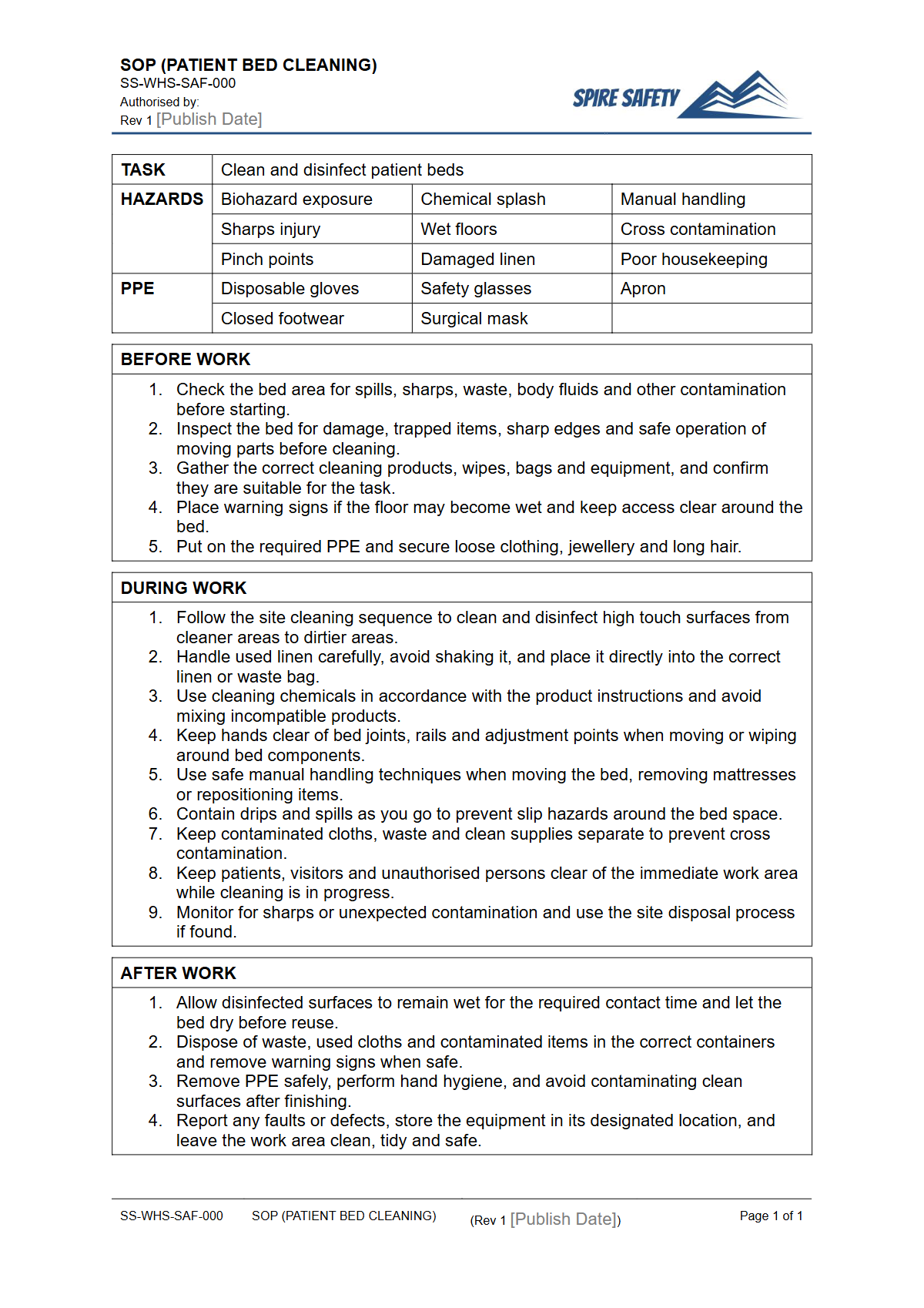
The primary purpose of this Safe Operating Procedure (Patient Bed Cleaning) Template is to provide a clear, step-by-step guide for employees. It ensures that every bed turnover or routine clean is performed consistently and to a high standard.
This helps in minimising the risk of healthcare-associated infections (HAIs), managing exposure to hazardous cleaning chemicals, and preventing musculoskeletal injuries from improper manual handling techniques. Formalising the procedure also provides a basis for training new staff and a reference for competency assessments.
Video walkthrough
How to use the Free Safe Operating Procedure (Patient Bed Cleaning) Template
To effectively use this free Safe Operating Procedure (Patient Bed Cleaning) Template, download the DOCX file and adapt it to your specific workplace environment. This foundational document is aligned with Australian WHS principles, but it is not a complete, ready-to-use solution.
You must customise this template with your site-specific details, including the exact types of beds used, the approved cleaning and disinfectant products, required Personal Protective Equipment (PPE), and emergency procedures. Involving your cleaning staff and a WHS representative in the customisation process ensures the SOP is practical and reflects actual work practices.
Once finalised, the SOP should be formally approved and made easily accessible to all relevant workers.
A well-defined SOP is a cornerstone of a proactive safety culture, forming an essential part of your organisation's broader WHS management system. Documenting safe processes demonstrates a commitment to meeting your duty of care obligations for both workers and patients.
When to use a Patient Bed Cleaning SOP
A Patient Bed Cleaning SOP should be consulted every time a patient bed and its immediate environment require cleaning. This includes several key scenarios:
- Terminal Cleaning: After a patient is discharged, transferred, or passes away, to prepare the room for the next occupant.
- Routine Daily Cleaning: For occupied beds, focusing on high-touch surfaces to reduce microbial load.
- Infectious Cleaning: Following specific protocols after a patient with a known or suspected infectious disease has occupied the bed, often requiring different PPE and disinfectants.
It should also be used as a primary document during staff training and regular competency evaluations. Regular reviews, often as part of a WHS compliance audit, ensure the procedure remains current with best practices and regulatory changes.
Who should use this Safe Operating Procedure
This Safe Operating Procedure is intended for all personnel responsible for environmental services and patient room cleaning in settings such as hospitals, aged care homes, clinics, and rehabilitation centres. This includes:
- Environmental Services Staff / Cleaners
- Patient Care Assistants (PCAs) or Aides (where cleaning is part of their duties)
- Nurses or other clinical staff who may be involved in cleaning processes
- Supervisors and Managers responsible for training and overseeing cleaning staff
If you need assistance in tailoring this document or developing a suite of SOPs for your facility, our expert WHS consulting team can provide tailored support. Clear procedures are a best-practice activity in any sector where hygiene and safety are paramount, applying similar hazard control principles to tasks as varied as healthcare cleaning and food service, such as those in our free Safe Operating Procedure for deep fryer operation.
By implementing a robust SOP for patient bed cleaning, your organisation demonstrates a commitment to health and safety excellence. This not only protects people but also strengthens your operational and clinical governance frameworks.
You can find many other helpful documents and templates in our comprehensive free WHS resources library to support your safety goals.
Common mistakes
Common mistakes to avoid
- Using the wrong cleaning agents for the surface type, which can cause damage or be ineffective.
- Skipping high-touch points like bed rails, call bells, and remote controls.
- Not allowing sufficient contact time for disinfectants to kill pathogens effectively.
- Failing to perform hand hygiene before and after the cleaning process or when changing PPE.
Legal references
Legal considerations
The following legal requirements may be relevant to this type of work.
- Work Health and Safety Act (Harmonised) — Provides the primary duties for protecting workers and other people from work health and safety risks.
- Work Health and Safety Regulations (Harmonised) — Sets out requirements supporting the management of workplace hazards and risks.
The following codes may be relevant to this type of work.
- Managing WHS Risks Code of Practice — Provides practical guidance on identifying hazards, assessing risks and applying effective controls.
- Work Health and Safety Consultation, Cooperation and Coordination Code of Practice — Provides practical guidance on consulting workers and coordinating with other duty holders.
- Managing the Work Environment and Facilities Code of Practice — Provides practical guidance on safe work environments, workplace facilities and related controls.
Did you know
A Critical Defence
According to the Australian Commission on Safety and Quality in Health Care, about 165,000 healthcare-associated infections (HAIs) occur in Australia each year. Thorough environmental cleaning is a critical and evidence-based strategy for preventing many of these infections.
FAQ
Frequently asked questions
01What is the main purpose of a patient bed cleaning SOP?
02How often should patient beds be cleaned according to a SOP?
03Who is responsible for writing and updating a patient bed cleaning SOP?
04Does this template cover cleaning for infectious patients?
Share this resource
Free Safe Operating Procedure (Patient Bed Cleaning) Template
Browse Categories
How To Use It
- 1Download and open in Word or PDF.
- 2Replace the placeholders with your business details.
- 3Get it reviewed by a WHS specialist before rollout.
Need it customised?
Our WHS consultants can adapt this template to your site, run a gap analysis, or audit what you already have in place.
Book a Free Consultation WHS consulting servicesor call 1300 156 382
Related templates
- Free Safe Operating Procedure (Patient Belongings Move) Template
- Free Safe Operating Procedure (Patient Hoist) Template
- Free Safe Operating Procedure (Patient Locker Cleaning) Template
- Free Safe Operating Procedure (Payoff Reel) Template
- Free Safe Operating Procedure (Pedestal Drill Operation) Template
- Free Safe Operating Procedure (Pedestrian Route Setup) Template