
Free Safe Operating Procedure (Patient Hoist) Template
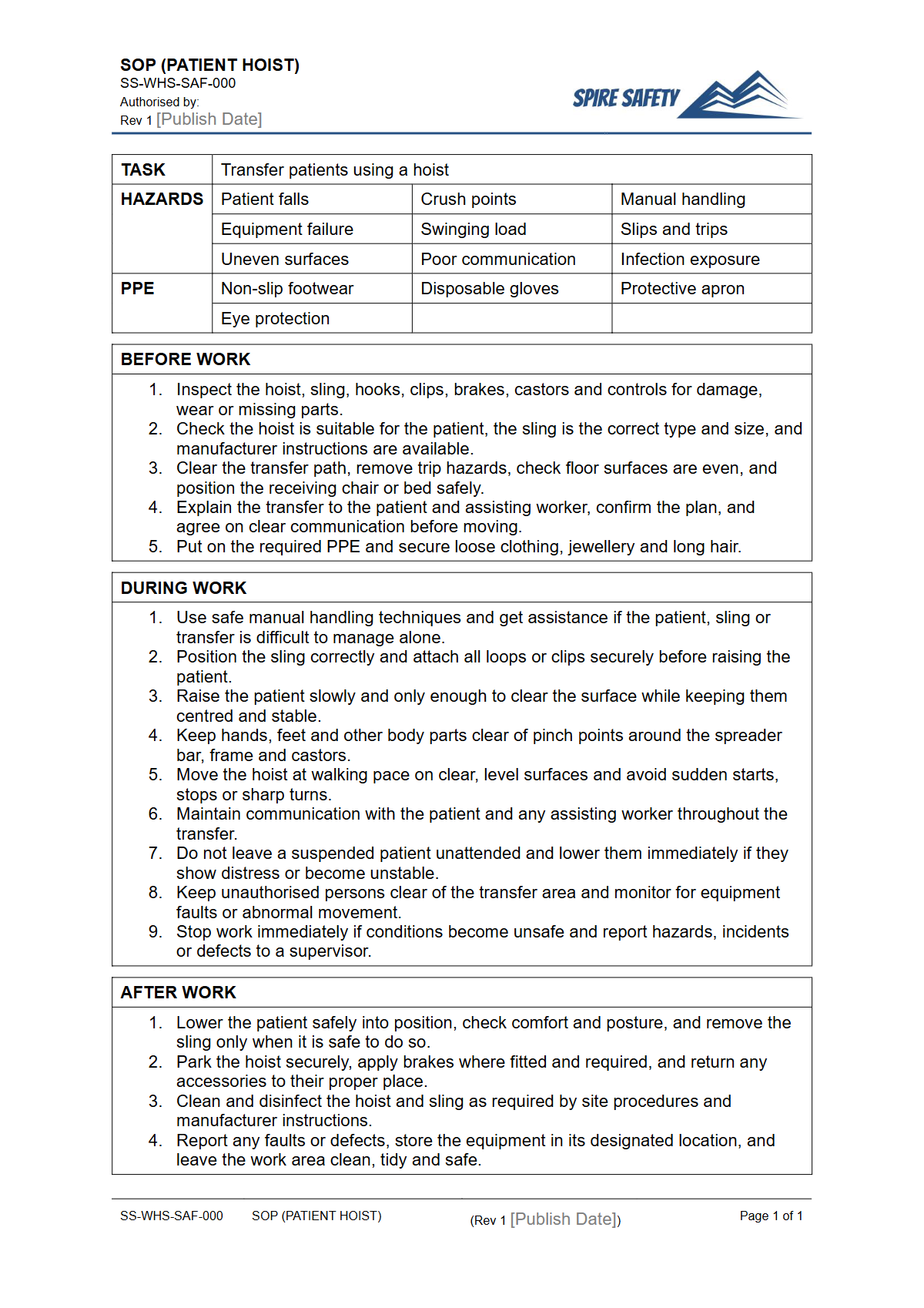
Download our free Safe Operating Procedure (Patient Hoist) template. This customisable DOCX and PDF helps formalise your patient handling processes.
Free Safe Operating Procedure (Patient Hoist) Template
DOCX • 126 KB + PDF
Updated Oct 2026
No signup required
Purpose of the Free Safe Operating Procedure (Patient Hoist) Template
This Free Safe Operating Procedure (Patient Hoist) Template provides a structured starting point for documenting the safe use of patient lifting equipment in your workplace. Using a patient hoist correctly is critical for preventing musculoskeletal injuries to both healthcare workers and patients.
An SOP is a key administrative control measure that outlines a logical sequence of steps to perform a task safely. It serves as a vital tool for training, competency assessment, and incident investigation.
Integrating this SOP into your broader safety framework helps demonstrate a commitment to a safe work environment. Formalising procedures for high-risk tasks like patient handling is a fundamental component of effective WHS management systems, ensuring consistency and clarity for all staff members involved.
Video walkthrough
How to use the Free Safe Operating Procedure (Patient Hoist) Template
This document is a template and must be customised to reflect your specific workplace environment. Download the DOCX file and adapt it to the makes and models of patient hoists you use, the types of slings available, your facility's layout, and your unique patient handling policies.
You should consult directly with healthcare staff, carers, and other end-users during the drafting and review process to ensure the procedure is practical and reflects actual workflows.
Important: We have provided a comprehensive framework, but you must add site-specific details, such as emergency contacts, specific hoist weight limits, and internal reporting procedures. This customisation is essential for the SOP to be effective and relevant to your organisation.
Key Elements of a Patient Hoist Safe Operating Procedure
A robust SOP for patient hoists should cover several critical stages of operation. Our template guides you through documenting these phases:
- Pre-Operational Checks: Detailing what to inspect before each use, such as the condition of the sling, hoist frame, castors, and battery level. This ensures the equipment is fit for purpose before the task begins.
- Task Planning: Outlining the need for a patient risk assessment, confirming the patient's weight is within the hoist's safe working load (SWL), and ensuring the environment is clear of obstacles.
- Step-by-Step Operating Instructions: Providing clear, unambiguous instructions for positioning the hoist and sling, performing the lift and transfer, and lowering the patient safely. This section should be detailed enough for a new but trained operator to follow. While this SOP covers patient hoists, safe procedures are vital for all workplace equipment, from clinical devices to general plant like an air compressor.
- Post-Operational Care: Instructions for cleaning the equipment, charging batteries, and storing the hoist and slings correctly to maintain their condition and ensure they are ready for the next use.
When to use a Patient Hoist SOP
A Patient Hoist SOP should be used whenever a mechanical lifting device is required for moving a patient. This includes routine transfers from a bed to a chair, for bathing, or in any situation where manual lifting would pose an unacceptable risk.
The SOP should be a readily accessible document in clinical areas and used as the primary reference for training new staff and for refresher courses for existing employees.
The document should also be reviewed periodically as part of your safety management cycle. Regular reviews, typically annually or after an incident, ensure the procedure remains current with equipment changes, new techniques, or updates in best practice.
These reviews can form part of a broader program of WHS compliance auditing to verify the effectiveness of your safety controls.
Who should use it
This Safe Operating Procedure template is designed for use by a range of personnel within healthcare, aged care, disability support, and community care settings. Key users include:
- WHS Managers and Coordinators: To establish a standardised, documented procedure as part of the overall safety system.
- Facility Managers and Team Leaders: To implement the procedure, train their teams, and supervise the safe use of patient hoists.
- Nurses, Carers, and Support Workers: As a practical, step-by-step guide to follow during their daily tasks, ensuring they and their patients are kept safe.
- Training Personnel: To use as a foundational document for competency-based training and assessment programs. The principles of documenting safe work methods are universal, and you can find many other examples in our free WHS resources library.
While the focus is on patient care, the core principles of documenting a safe process are applicable to many types of machinery. Similar structured procedures are essential for tasks involving heavy equipment, as detailed in our FREE Telehandler SOP Template.
Common mistakes
Common mistakes to avoid
- Using the wrong size or type of sling for the patient or the specific transfer.
- Failing to perform a thorough pre-use inspection of the hoist and sling.
- Moving the hoist too quickly or making sharp turns with a patient in the sling.
- Not ensuring the hoist's legs are in the correct position for maximum stability.
Legal references
Legal considerations
The following legal requirements may be relevant to this type of work.
- Work Health and Safety Act (Harmonised) — Provides the primary duties for protecting workers and other people from work health and safety risks.
- Work Health and Safety Regulations (Harmonised) — Sets out requirements supporting the management of workplace hazards and risks.
The following codes may be relevant to this type of work.
- Managing WHS Risks Code of Practice — Provides practical guidance on identifying hazards, assessing risks and applying effective controls.
- Work Health and Safety Consultation, Cooperation and Coordination Code of Practice — Provides practical guidance on consulting workers and coordinating with other duty holders.
- Managing the Work Environment and Facilities Code of Practice — Provides practical guidance on safe work environments, workplace facilities and related controls.
Did you know
Manual Task Injuries
In Australia, injuries from hazardous manual tasks, including lifting and moving people, are a leading cause of serious workers' compensation claims in the healthcare and social assistance industry.
FAQ
Frequently asked questions
01What is the difference between a Safe Work Method Statement (SWMS) and a Safe Operating Procedure (SOP)?
02How many people are required to operate a patient hoist?
03Do I need a specific SOP for each type of patient hoist?
04What training is required to use a patient hoist?
Share this resource
Free Safe Operating Procedure (Patient Hoist) Template
Browse Categories
How To Use It
- 1Download and open in Word or PDF.
- 2Replace the placeholders with your business details.
- 3Get it reviewed by a WHS specialist before rollout.
Need it customised?
Our WHS consultants can adapt this template to your site, run a gap analysis, or audit what you already have in place.
Book a Free Consultation WHS consulting servicesor call 1300 156 382
Related templates
- Free Safe Operating Procedure (Patient Locker Cleaning) Template
- Free Safe Operating Procedure (Payoff Reel) Template
- Free Safe Operating Procedure (Pedestal Drill Operation) Template
- Free Safe Operating Procedure (Pedestrian Route Setup) Template
- Free Safe Operating Procedure (Penetrometer) Template
- Free Safe Operating Procedure (Peristaltic Pump) Template