
Free Safe Operating Procedure (Patient Belongings Move) Template
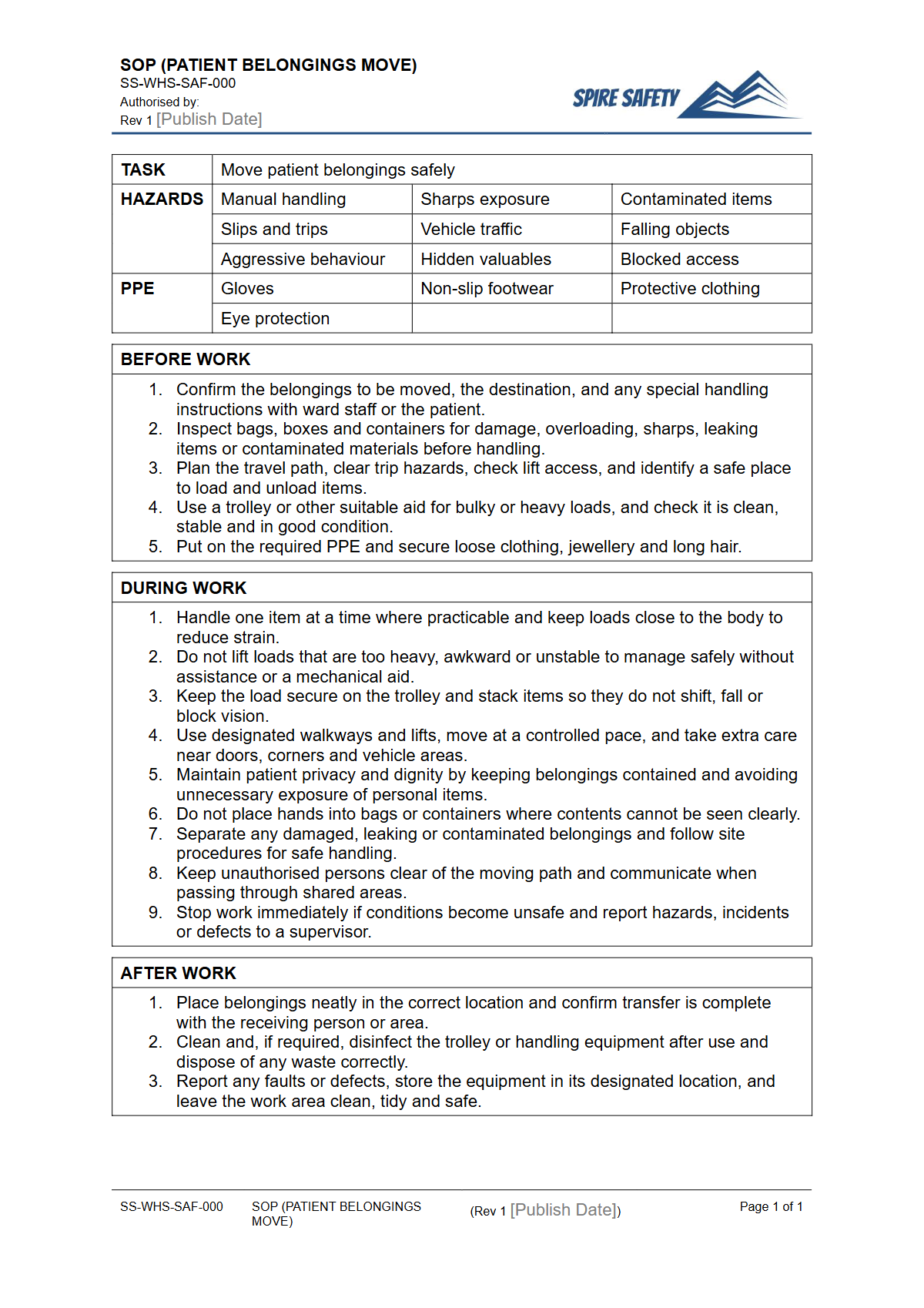
Download our free Safe Operating Procedure template for moving patient belongings. This customisable document helps formalise your safety processes.
Free Safe Operating Procedure (Patient Belongings Move) Template
DOCX • 126 KB + PDF
Updated Oct 2026
No signup required
Purpose of the Free Safe Operating Procedure (Patient Belongings Move) Template
Moving a patient's personal belongings is a common task in healthcare and aged care settings, but it carries significant work health and safety risks. Our Free Safe Operating Procedure (Patient Belongings Move) Template provides a structured framework for managing these risks effectively.
This document helps your organisation formalise procedures to prevent manual handling injuries, minimise the risk of infection, and ensure patient property is handled with care and respect, reducing instances of loss or damage.
A documented SOP demonstrates a commitment to systematic safety management. It ensures all staff members follow a consistent, safe process for handling patient property during admission, transfers, and discharge.
Integrating this procedure is a key part of developing more comprehensive WHS management systems that protect both your employees and the people in your care.
Video walkthrough
How to use the Free Safe Operating Procedure (Patient Belongings Move) Template
This template is provided in both DOCX and PDF formats for your convenience. The DOCX file is fully editable, allowing you to tailor the content to the unique circumstances of your facility.
It is crucial to adapt the document to reflect your specific workflows, the types of belongings commonly handled, the storage facilities available, and your state or territory's WHS regulations.
Important: This document is a template and must be customised to your specific workplace. We are not your PCBU.
You must adapt this SOP to reflect your site-specific hazards, control measures, equipment, and legal obligations. Worker consultation is a mandatory part of this customisation process. Once finalised, the SOP should be used as a basis for staff training and its effectiveness should be checked through regular WHS compliance auditing.
When to use it
This Safe Operating Procedure should be implemented and followed whenever staff are required to handle, transport, or store a patient's personal property. Key situations include:
- During patient admission to a ward or facility.
- When a patient is transferred between different wards, rooms, or healthcare facilities.
- Upon patient discharge.
- When securing the belongings of an incapacitated or unaccompanied patient.
- During an emergency situation or ward evacuation that requires moving patient property.
Who should use it
This SOP is intended for all personnel who may come into contact with patient belongings as part of their duties. This includes, but is not limited to:
- Nurses and Nursing Assistants
- Patient Care Assistants (PCAs)
- Porters and Wardspersons
- Allied Health Professionals
- Ward Clerks or administrative staff responsible for inventory.
Supervisors, managers, and WHS personnel should also use this document to guide training, conduct competency assessments, and investigate any incidents related to the task.
Key Elements of the SOP
Our template provides a clear structure to build your procedure upon, covering critical safety components.
Hazard Identification
The template prompts you to identify task-specific hazards. These often include musculoskeletal injuries from lifting heavy or awkward bags, exposure to biological contaminants on personal items, and trip hazards created by property left in walkways.
Risk Control Measures
It includes sections for outlining control measures designed to mitigate identified risks. Examples include mandating the use of ergonomic trolleys, requiring PPE like gloves, and implementing robust inventory and labelling systems. The principles of identifying hazards and controls apply across all workplace procedures, from patient care to workshop tasks covered by a FREE Circular Saw SOP (Safe Operating Procedure) Template.
Step-by-Step Procedure
The document provides a logical sequence for the task, which you can adapt. This covers everything from communicating with the patient and completing an inventory list to securely transporting, storing, and documenting the return of the property.
This procedure addresses manual risks, which differ from those managed in an automated process like a conveyer system SOP, highlighting the need for task-specific analysis.
Integrating the SOP into Your Safety System
A Safe Operating Procedure is most effective when it is a living document integrated into your broader safety framework. It should not be a file that just sits on a shelf.
Use this SOP as a tool for staff inductions, annual refresher training, and toolbox talks. It should also be reviewed and updated after any incident or near-miss, or whenever a process changes.
For organisations seeking tailored support to embed these documents effectively, exploring professional WHS consulting can provide strategic direction.
Using this template gives you a solid foundation for creating a robust, practical, and effective procedure for moving patient belongings. For more templates covering a wide variety of tasks, browse our complete free WHS resources library.
Common mistakes
Common mistakes to avoid
- Failing to customise the template to reflect the specific facility, ward, and patient population.
- Neglecting to train all relevant staff on the final, approved procedure and verify their understanding.
- Skipping the risk assessment step and simply filling in the template without proper hazard analysis.
- Using unsecured, undocumented, or inappropriate locations for storing patient belongings.
Legal references
Legal considerations
The following legal requirements may be relevant to this type of work.
- Work Health and Safety Act (Harmonised) — Provides the primary duties for protecting workers and other people from work health and safety risks.
- Work Health and Safety Regulations (Harmonised) — Sets out requirements supporting the management of workplace hazards and risks.
The following codes may be relevant to this type of work.
- Managing WHS Risks Code of Practice — Provides practical guidance on identifying hazards, assessing risks and applying effective controls.
- Work Health and Safety Consultation, Cooperation and Coordination Code of Practice — Provides practical guidance on consulting workers and coordinating with other duty holders.
- Managing the Work Environment and Facilities Code of Practice — Provides practical guidance on safe work environments, workplace facilities and related controls.
Did you know
A High-Risk Industry
The healthcare and social assistance industry has one of the highest rates of serious workers' compensation claims in Australia, with body stressing (hazardous manual tasks) being a primary cause of injury.
Duty of Care for Property
In Australia, healthcare facilities that take possession of patient property are considered 'bailees', giving them a legal duty of care to protect those belongings from loss or damage until they are returned.
FAQ
Frequently asked questions
01What are the main risks when moving patient belongings?
02Is this SOP template enough to be compliant with WHS laws?
03How often should a Safe Operating Procedure for moving patient belongings be reviewed?
04Who is responsible for training staff on this SOP?
Share this resource
Free Safe Operating Procedure (Patient Belongings Move) Template
Browse Categories
How To Use It
- 1Download and open in Word or PDF.
- 2Replace the placeholders with your business details.
- 3Get it reviewed by a WHS specialist before rollout.
Need it customised?
Our WHS consultants can adapt this template to your site, run a gap analysis, or audit what you already have in place.
Book a Free Consultation WHS consulting servicesor call 1300 156 382
Related templates
- Free Safe Operating Procedure (Patient Hoist) Template
- Free Safe Operating Procedure (Patient Locker Cleaning) Template
- Free Safe Operating Procedure (Payoff Reel) Template
- Free Safe Operating Procedure (Pedestal Drill Operation) Template
- Free Safe Operating Procedure (Pedestrian Route Setup) Template
- Free Safe Operating Procedure (Penetrometer) Template