
Free Safe Operating Procedure (Pastry Roller) Template
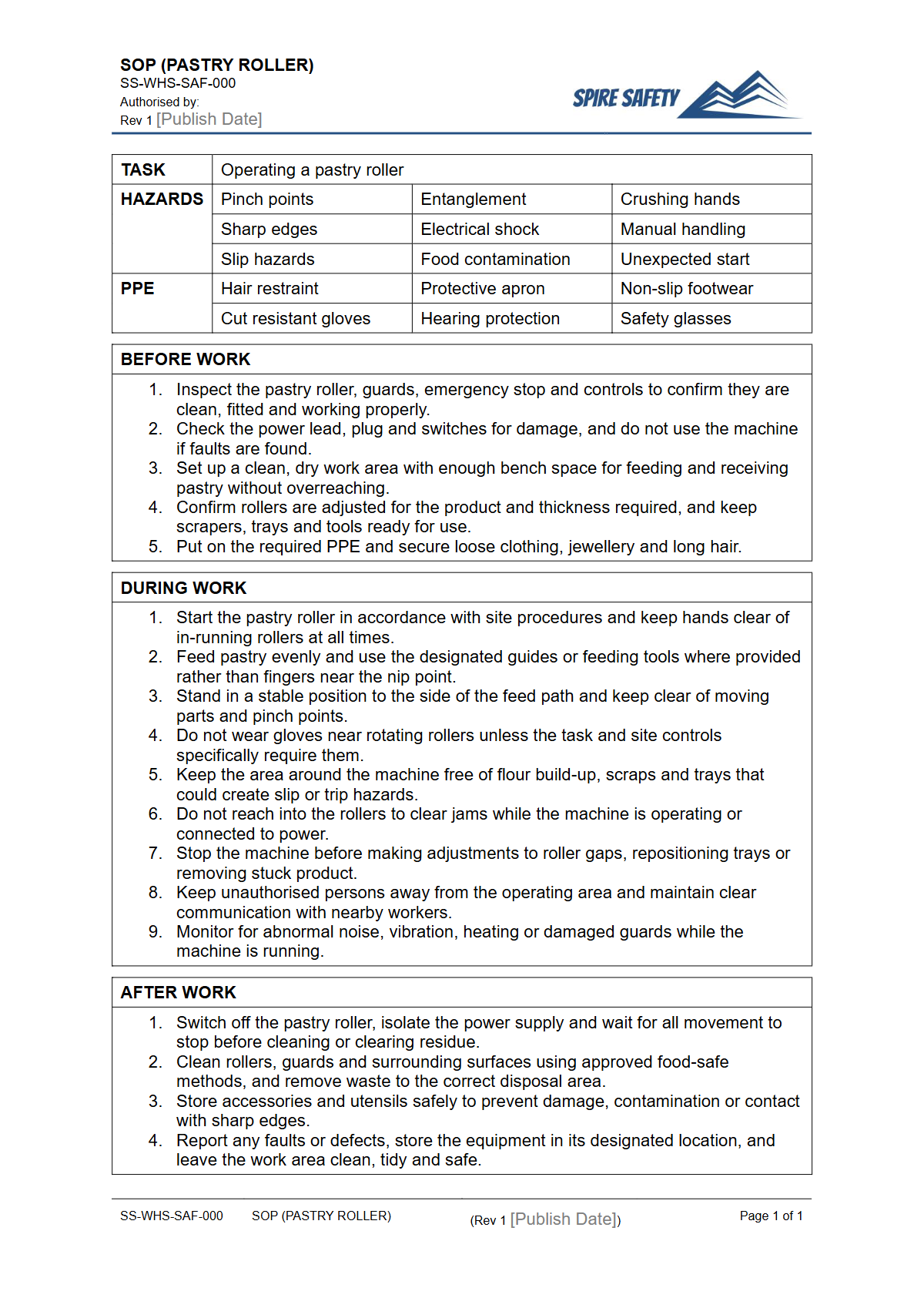
Download our free Safe Operating Procedure for pastry rollers to outline clear, step-by-step instructions for safe operation and cleaning.
Free Safe Operating Procedure (Pastry Roller) Template
DOCX • 126 KB + PDF
Updated Oct 2026
No signup required
Purpose of the Free Safe Operating Procedure (Pastry Roller) Template
Operating a pastry roller, or dough sheeter, requires precision and a strict adherence to safety protocols. This free Safe Operating Procedure (Pastry Roller) template provides a structured document for outlining the risks and control measures associated with this common piece of kitchen and bakery equipment.
By formally documenting the required steps for pre-operational checks, operation, cleaning, and maintenance, you establish a clear, consistent standard for all users. A documented SOP is a critical tool for preventing injuries from moving parts, such as entanglement or crushing, and ensures food safety standards are maintained through proper sanitation procedures.
Implementing robust SOPs is a fundamental part of demonstrating due diligence and forms a key component of effective comprehensive WHS management systems. This template helps your business systematically manage the risks associated with pastry rollers, protecting both your employees and your organisation.
Video walkthrough
How to use the Free Safe Operating Procedure (Pastry Roller) Template
This template is designed to be a comprehensive starting point. To use it effectively, download the DOCX file and adapt it to the specific context of your workplace.
It is crucial to incorporate details about the make and model of your equipment, your specific work environment, the types of dough being processed, and any unique site hazards. Walk through the steps outlined in the template while observing the task being performed to ensure it accurately reflects your operational reality.
Please note: This template provides a solid foundation based on Australian WHS principles. However, to be effective, we require that you customise it with your specific workplace details, including the make and model of your pastry roller, unique environmental factors, and internal procedures.
A generic procedure that doesn't match your exact equipment and processes will not be effective in controlling risks. Similarly, kitchens often feature a range of specialised equipment, each requiring its own procedure, such as a deep fryer SOP.
When to use this Safe Operating Procedure
A Safe Operating Procedure for a pastry roller should be a living document, integrated into several key moments in your operational workflow. It is not a document to be filed away and forgotten.
Use it during the induction and training of new kitchen hands, bakers, or apprentices to ensure they learn the correct, safe method from day one. It should also be used for periodic refresher training for experienced staff to prevent complacency and bad habits from forming.
The SOP is an essential reference before performing routine cleaning or maintenance tasks, as these activities often present different hazards compared to normal operation. It should be readily accessible near the equipment for quick reference.
If your pastry roller is part of a larger production line, you may need to integrate this procedure with others, like a Conveyer System SOP, to manage risks across the entire process.
Who should use this Safe Operating Procedure
This document is intended for a range of personnel within a food service or production environment. The primary users are the operators themselves—the chefs, bakers, and kitchen staff who use the pastry roller daily.
They rely on the SOP for step-by-step guidance on safe and efficient operation. Supervisors and managers use the SOP as a tool for training, monitoring performance, and conducting workplace inspections.
They are responsible for ensuring the procedure is followed correctly and remains up to date.
Safety officers and WHS committees will use the SOP as part of their risk management activities, including risk assessments and incident investigations. By involving all these stakeholders in the development and review of the procedure, you create a stronger safety culture and a more effective document.
For complex operational environments or for assistance in developing a full suite of SOPs, seeking professional WHS consulting can provide expert guidance and ensure your documentation aligns with best practice.
This template is just one of many documents available to help you build a safer workplace. We encourage you to explore our complete free WHS resources library for a wide range of checklists, templates, and guides covering various industries and safety topics.
Common mistakes
Common mistakes to avoid
- Failing to use or bypassing installed safety guards and interlocks.
- Wearing loose clothing, long sleeves, watches, or jewellery that can get caught in the rollers.
- Attempting to clear a dough jam or scrape rollers while the machine is still powered on.
- Neglecting the lock-out tag-out procedure before conducting cleaning or maintenance.
Legal references
Legal considerations
The following legal requirements may be relevant to this type of work.
- Work Health and Safety Act (Harmonised) — Provides the primary duties for protecting workers and other people from work health and safety risks.
- Work Health and Safety Regulations (Harmonised) — Sets out requirements supporting the management of workplace hazards and risks.
The following codes may be relevant to this type of work.
- Managing WHS Risks Code of Practice — Provides practical guidance on identifying hazards, assessing risks and applying effective controls.
- Work Health and Safety Consultation, Cooperation and Coordination Code of Practice — Provides practical guidance on consulting workers and coordinating with other duty holders.
- Managing the Work Environment and Facilities Code of Practice — Provides practical guidance on safe work environments, workplace facilities and related controls.
Did you know
Entanglement Risk
Contact with moving parts of machinery is a significant cause of serious injury in the food production industry. Safety guards, emergency stops, and lock-out tag-out procedures outlined in an SOP are the most critical defences against entanglement.
FAQ
Frequently asked questions
01What are the main hazards of using a pastry roller?
02How often should a Pastry Roller SOP be reviewed?
03Is specific training required to operate a pastry roller?
04Can this SOP be used for different types of dough sheeters?
Share this resource
Free Safe Operating Procedure (Pastry Roller) Template
Browse Categories
How To Use It
- 1Download and open in Word or PDF.
- 2Replace the placeholders with your business details.
- 3Get it reviewed by a WHS specialist before rollout.
Need it customised?
Our WHS consultants can adapt this template to your site, run a gap analysis, or audit what you already have in place.
Book a Free Consultation WHS consulting servicesor call 1300 156 382
Related templates
- Free Safe Operating Procedure (Path Edge Trimming) Template
- Free Safe Operating Procedure (Patient Bed Cleaning) Template
- Free Safe Operating Procedure (Patient Belongings Move) Template
- Free Safe Operating Procedure (Patient Hoist) Template
- Free Safe Operating Procedure (Patient Locker Cleaning) Template
- Free Safe Operating Procedure (Payoff Reel) Template