
Free Safe Operating Procedure (Parts Washer) Template
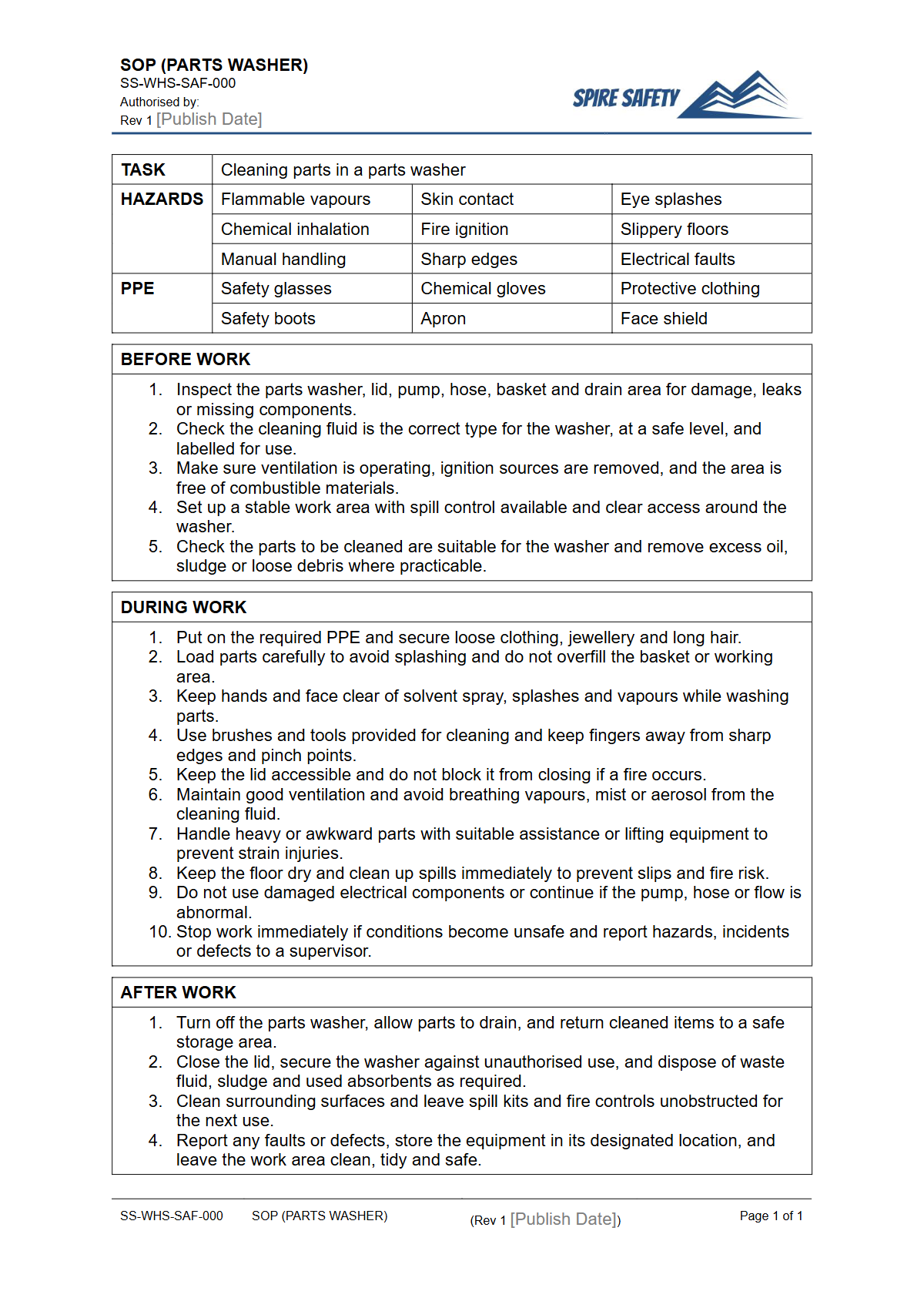
Download our free Safe Operating Procedure (Parts Washer) template to manage risks associated with solvent and aqueous parts washers. Customise your DOCX today.
Free Safe Operating Procedure (Parts Washer) Template
DOCX • 126 KB + PDF
Updated Oct 2026
No signup required
Purpose of the Free Safe Operating Procedure (Parts Washer) Template
Operating a parts washer, whether solvent-based or aqueous, introduces specific workplace hazards that must be controlled. This free Safe Operating Procedure (Parts Washer) template provides a structured starting point for your business to document risks and outline clear, step-by-step instructions for safe use. It is designed to help you establish a consistent process for pre-operational checks, operation, cleaning, and maintenance, forming a critical component of your overall WHS management systems.
The document prompts you to consider hazards such as chemical exposure (inhalation, skin contact), fire and explosion (from flammable solvents), electrical shock, and ergonomic strains. By formally documenting control measures like correct personal protective equipment (PPE), ventilation requirements, and emergency procedures, you can effectively train workers and demonstrate your commitment to providing a safe working environment.
Video walkthrough
How to use the Free Safe Operating Procedure (Parts Washer) Template
This template is available in both an easily editable DOCX format and a print-ready PDF. To make it effective, you must adapt its contents to the specific make and model of parts washer in your workshop, the types of cleaning agents used, and your unique operational context.
Generic procedures are insufficient for managing site-specific risks.
Important: We have provided a comprehensive framework, but you must consult the manufacturer's instructions, Safety Data Sheets (SDS) for your specific chemicals, and conduct a site-specific risk assessment. If you require assistance in tailoring this document or developing other safety procedures, our WHS consulting team can provide expert guidance.
Customisation is not just recommended; it is essential for the document to be a useful tool for managing health and safety.
When to use this Safe Operating Procedure
A parts washer SOP should be a living document, integrated into your daily operations. It is particularly crucial in several key scenarios:
- Induction and Training: Use the SOP as a core training tool for any new worker required to operate the parts washer.
- Refresher Training: Periodically review the SOP with existing staff to reinforce safe work habits and introduce any procedural updates.
- Risk Assessments: Refer to the SOP when conducting or reviewing a workplace risk assessment related to workshop activities.
- Incident Investigation: If an incident or near-miss occurs involving the parts washer, the SOP serves as a baseline to evaluate whether procedures were followed.
- Procedural Changes: Update the SOP whenever a new type of cleaning solvent is introduced, the equipment is modified, or work processes change.
Who should use it
Responsibility for using and maintaining this Safe Operating Procedure extends across multiple roles within an organisation:
- Workers/Operators: Must understand and strictly follow the step-by-step procedures outlined in the SOP during daily use.
- Supervisors and Managers: Are responsible for ensuring workers are trained on the SOP, that procedures are being followed correctly, and for conducting periodic reviews and updates. They often use similar documents, like our Free Air Compressor SOP Template, to manage other workshop equipment.
- Persons Conducting a Business or Undertaking (PCBUs): Have the primary duty of care to ensure safe systems of work are provided and maintained, making the implementation of effective SOPs a key part of their legal obligations.
By defining procedures for common workshop equipment, from parts washers to power tools, you create a safer and more organised work environment. For instance, processes for handheld tools can be formalised using our FREE Circular Saw SOP Template. You can find more templates like these in our free WHS resources library to build a comprehensive safety documentation system.
Common mistakes
Common mistakes to avoid
- Using flammable liquids (like petrol) in a parts washer not designed for them.
- Neglecting to wear appropriate chemical-resistant gloves and eye protection.
- Using the parts washer in a poorly ventilated area, leading to vapour inhalation.
- Failing to consult the Safety Data Sheet (SDS) for the specific cleaning chemical being used.
Legal references
Legal considerations
The following legal requirements may be relevant to this type of work.
- Work Health and Safety Act (Harmonised) — Provides the primary duties for protecting workers and other people from work health and safety risks.
- Work Health and Safety Regulations (Harmonised) — Sets out requirements supporting the management of workplace hazards and risks.
The following codes may be relevant to this type of work.
- Managing WHS Risks Code of Practice — Provides practical guidance on identifying hazards, assessing risks and applying effective controls.
- Work Health and Safety Consultation, Cooperation and Coordination Code of Practice — Provides practical guidance on consulting workers and coordinating with other duty holders.
- Managing the Work Environment and Facilities Code of Practice — Provides practical guidance on safe work environments, workplace facilities and related controls.
Did you know
Aqueous vs. Solvent
Aqueous (water-based) parts washers are becoming more popular as a safer alternative to traditional solvent-based units. They reduce fire risk and worker exposure to volatile organic compounds (VOCs).
The Fusible Link
Many solvent-based parts washers have a lid held open by a 'fusible link'. This link is designed to melt in the event of a fire, causing the lid to slam shut and smother the flames.
FAQ
Frequently asked questions
01What chemicals are used in a parts washer?
02Is a parts washer SOP a legal requirement in Australia?
03What is the most important PPE for using a solvent parts washer?
04How often should I change the fluid in a parts washer?
Share this resource
Free Safe Operating Procedure (Parts Washer) Template
Browse Categories
How To Use It
- 1Download and open in Word or PDF.
- 2Replace the placeholders with your business details.
- 3Get it reviewed by a WHS specialist before rollout.
Need it customised?
Our WHS consultants can adapt this template to your site, run a gap analysis, or audit what you already have in place.
Book a Free Consultation WHS consulting servicesor call 1300 156 382
Related templates
- Free Safe Operating Procedure (Passenger Lift) Template
- Free Safe Operating Procedure (Passenger Ramp Setup) Template
- Free Safe Operating Procedure (Passenger Stairs) Template
- Free Safe Operating Procedure (Pastry Roller) Template
- Free Safe Operating Procedure (Path Edge Trimming) Template
- Free Safe Operating Procedure (Patient Bed Cleaning) Template