
Free Safe Operating Procedure (Passenger Lift) Template
Document the safe use of passenger lifts in your workplace with our customisable template. Download your free Safe Operating Procedure to get started.
Free Safe Operating Procedure (Passenger Lift) Template
DOCX • 126 KB + PDF
Updated Oct 2026
No signup required
Purpose of the Free Safe Operating Procedure (Passenger Lift) Template
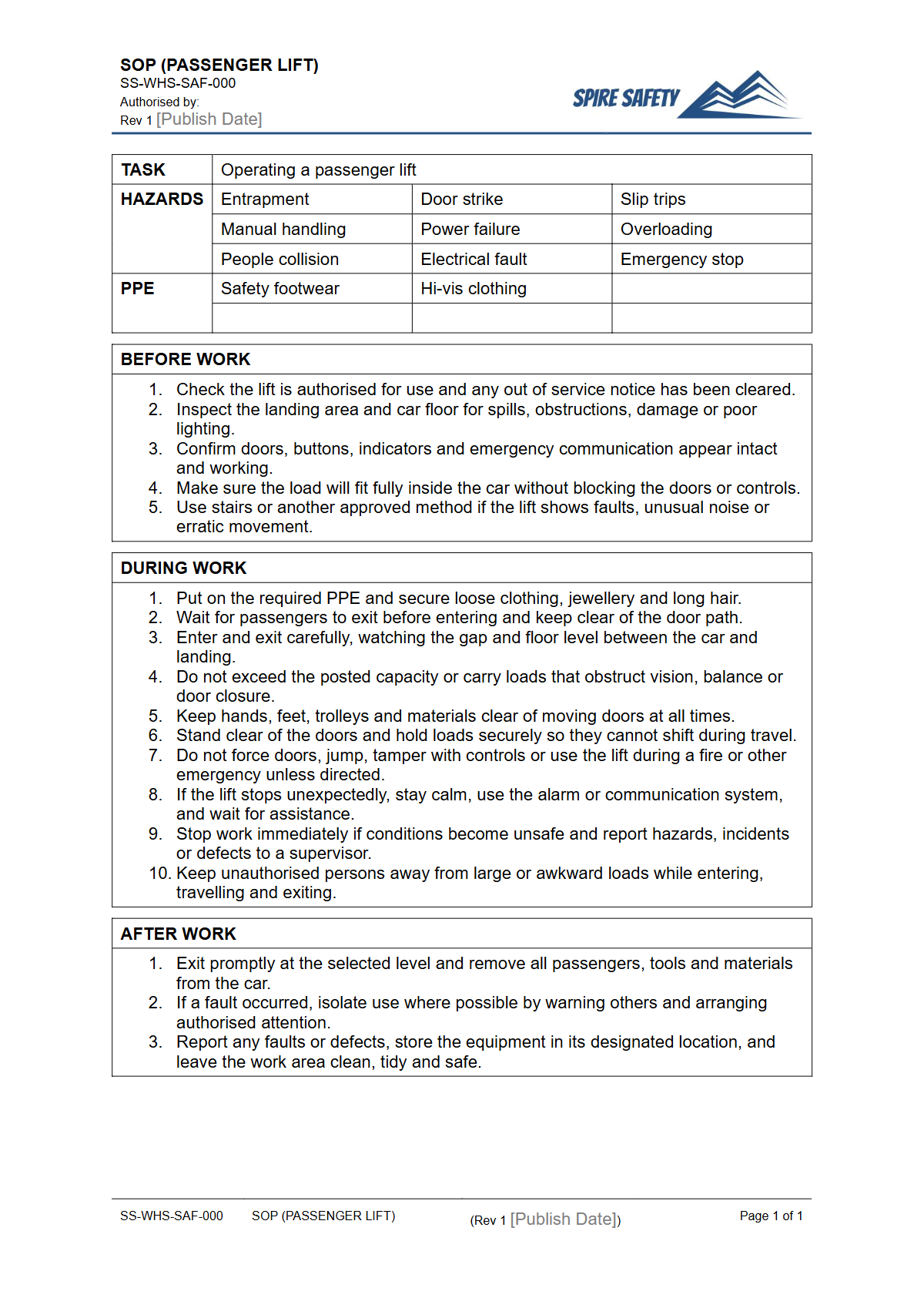
A passenger lift is a common piece of plant in many Australian workplaces, from office buildings to multi-level construction sites. This Free Safe Operating Procedure (Passenger Lift) Template provides a structured starting point for documenting the required steps for safe use, helping your organisation meet its work health and safety obligations.
A formal SOP standardises operator and passenger behaviour, assists in training, and acts as a critical control measure to prevent incidents such as entrapment, falls, or equipment misuse. It forms a vital part of risk management by clearly outlining expectations for everyone interacting with the lift.
Implementing clear, written procedures is a cornerstone of any functional safety framework. An SOP for equipment like a passenger lift should be integrated into your organisation's broader WHS management system to ensure it is properly managed, reviewed, and communicated to all relevant personnel.
Video walkthrough
How to use the Free Safe Operating Procedure (Passenger Lift) Template
This resource is available for download in both DOCX and PDF formats. The DOCX file is fully editable, allowing you to tailor the content to your specific operational needs.
To use the template effectively, you must review and modify each section to align with the make, model, and unique features of the passenger lifts at your workplace. This is not a one-size-fits-all document; it is a foundation for you to build upon.
Important: This is a template and must be customised. We have developed it to serve as a comprehensive starting point, but you must adapt it to the specific equipment, environment, and policies of your worksite to ensure its relevance and effectiveness.
This includes adding site-specific emergency contacts, load limits, and maintenance schedules.
The document guides you through outlining pre-start checks, safe operating steps, shutdown procedures, and emergency responses. When documenting procedures for various types of machinery, maintaining a consistent format can improve user comprehension. For another example of a machinery-specific procedure, you can reference our free Conveyer System SOP template.
When to use it
A Safe Operating Procedure for a passenger lift should be a living document used in daily operations. Key applications include:
- Worker and Visitor Induction: As a training tool for new employees, contractors, or visitors to ensure they understand how to use the lift safely.
- Routine Operations: As a quick reference guide for all users to reinforce correct operating protocols and weight limits.
- Emergency Drills: To practice and validate procedures for events like power failures or passenger entrapment.
- Incident Investigations: As a baseline to determine if non-compliance with the established procedure contributed to an incident or near miss.
Who should use it
Various roles within an organisation have a responsibility to create, implement, or follow this SOP:
- Persons Conducting a Business or Undertaking (PCBUs): To fulfil their primary duty of care by providing a safe work environment and safe systems of work.
- WHS Managers and Safety Officers: For developing, implementing, and reviewing safety documentation as part of the overall safety management system.
- Building and Facilities Managers: To manage the day-to-day safety, maintenance, and compliance of lifts under their control.
- Workers and other users: As the definitive guide on how to use the lift correctly and what to do in an emergency.
The effectiveness and implementation of SOPs are often evaluated as part of a regular WHS compliance audit, making it essential that the document is current and actively used.
Elements of an Effective Passenger Lift SOP
To be effective, your customised SOP should be clear, concise, and comprehensive. Key sections to develop include:
- Pre-Operational Checks: A checklist of items to verify before general use, such as ensuring the emergency alarm and phone are functional, interior lighting is working, and door sensors operate correctly.
- Operating Instructions: Step-by-step guidance on pressing call buttons, respecting maximum load capacities (both weight and person-count), keeping doorways clear, and reporting any unusual noises or faults immediately.
- Emergency Procedures: Detailed and actionable steps for passengers and first responders in case of entrapment, power failure, fire, or other emergencies. This should include key contact numbers.
- Maintenance and Inspection: A section referencing the required maintenance schedule as per the manufacturer's recommendations and Australian Standards, including who is responsible for organising and recording these activities. The principles of documenting procedures apply to all plant; for other common equipment, you might require a document like our Free Air Compressor SOP.
By thoroughly completing these sections, you create a robust document that enhances safety and clarifies responsibility. For more document templates and safety guides, you can browse our complete free WHS resources library.
Common mistakes
Common mistakes to avoid
- Failing to customise the template for the specific make and model of the lift.
- Neglecting to include detailed emergency procedures, especially for entrapment.
- Not providing practical training to workers in addition to the written procedure.
- Forgetting to schedule and document regular reviews and updates to the SOP.
Legal references
Legal considerations
The following legal requirements may be relevant to this type of work.
- Work Health and Safety Act (Harmonised) — Provides the primary duties for protecting workers and other people from work health and safety risks.
- Work Health and Safety Regulations (Harmonised) — Sets out requirements supporting the management of workplace hazards and risks.
The following codes may be relevant to this type of work.
- Managing WHS Risks Code of Practice — Provides practical guidance on identifying hazards, assessing risks and applying effective controls.
- Work Health and Safety Consultation, Cooperation and Coordination Code of Practice — Provides practical guidance on consulting workers and coordinating with other duty holders.
- Managing the Work Environment and Facilities Code of Practice — Provides practical guidance on safe work environments, workplace facilities and related controls.
Did you know
A Vertical Pioneer
The first passenger elevator with a safety device (to prevent it from falling if the cable broke) was demonstrated by Elisha Otis in 1854. This invention paved the way for the construction of skyscrapers.
Lift vs. Elevator
In Australian and British English, the term 'lift' is standard. The word 'elevator' is predominantly used in North American English, but both refer to the same vertical transport equipment.
FAQ
Frequently asked questions
01What should be included in a passenger lift emergency procedure?
02How often should a Safe Operating Procedure for a lift be reviewed?
03Is a passenger lift considered 'plant' under WHS law?
04Can I use a passenger lift to move heavy equipment or goods?
Share this resource
Free Safe Operating Procedure (Passenger Lift) Template
Browse Categories
How To Use It
- 1Download and open in Word or PDF.
- 2Replace the placeholders with your business details.
- 3Get it reviewed by a WHS specialist before rollout.
Need it customised?
Our WHS consultants can adapt this template to your site, run a gap analysis, or audit what you already have in place.
Book a Free Consultation WHS consulting servicesor call 1300 156 382
Related templates
- Free Safe Operating Procedure (Passenger Ramp Setup) Template
- Free Safe Operating Procedure (Passenger Stairs) Template
- Free Safe Operating Procedure (Pastry Roller) Template
- Free Safe Operating Procedure (Path Edge Trimming) Template
- Free Safe Operating Procedure (Patient Bed Cleaning) Template
- Free Safe Operating Procedure (Patient Belongings Move) Template