
Free Safe Operating Procedure (Passenger Ramp Setup) Template
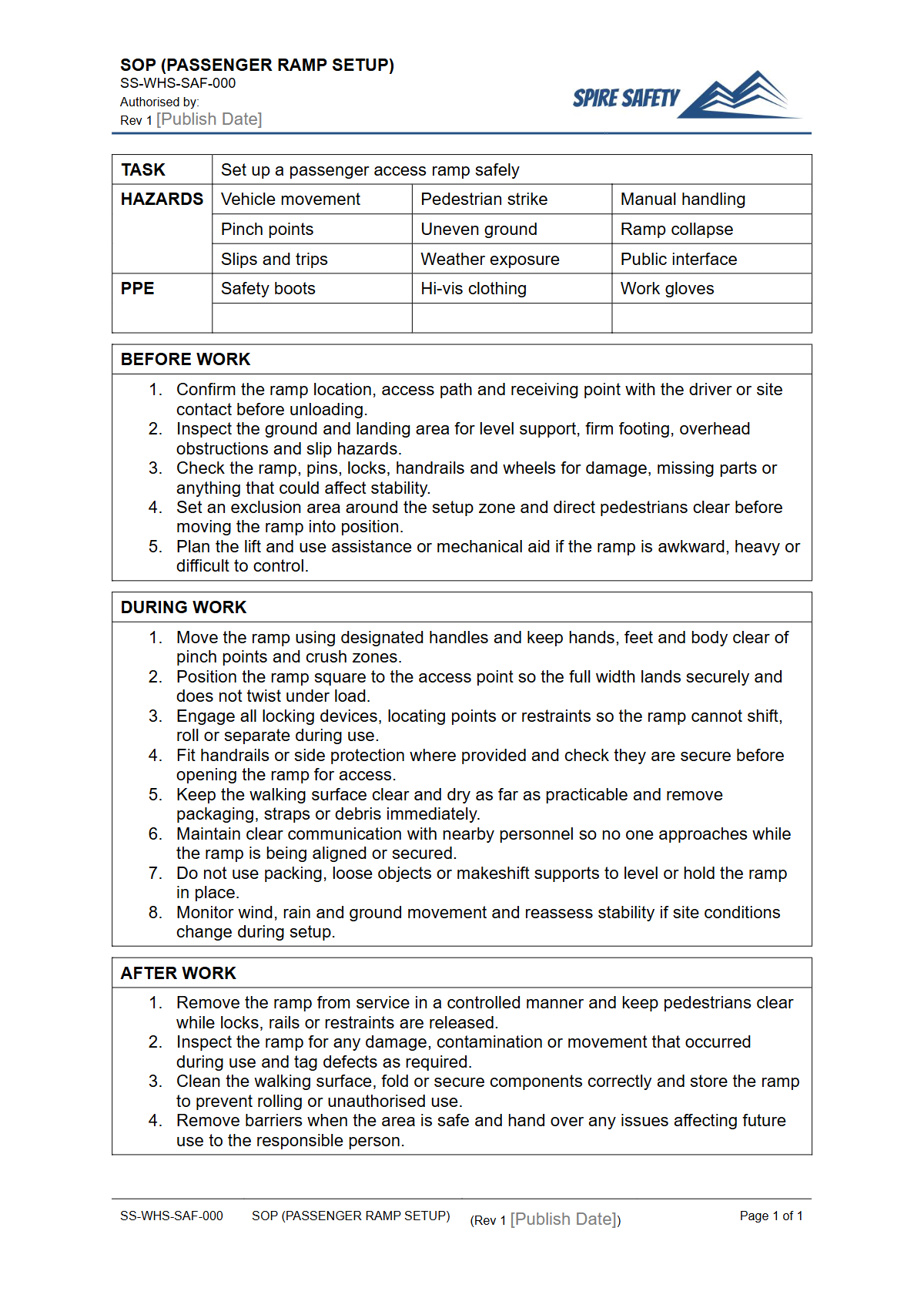
Download our free Safe Operating Procedure (Passenger Ramp Setup) template. This structured document helps you define safe work practices for setting up ramps.
Free Safe Operating Procedure (Passenger Ramp Setup) Template
DOCX • 126 KB + PDF
Updated Oct 2026
No signup required
Purpose of the Free Safe Operating Procedure (Passenger Ramp Setup) Template
Setting up passenger ramps, whether for vehicles, aircraft, or building access, involves significant risks if not performed correctly. This free Safe Operating Procedure (Passenger Ramp Setup) Template provides a structured framework for documenting the required steps to ensure worker and public safety.
By formalising your process, you can minimise hazards like slips, trips, falls, and musculoskeletal injuries from hazardous manual tasks. A documented SOP is a critical tool for training staff, ensuring consistent and safe work practices, and demonstrating due diligence in managing workplace risks.
Implementing clear, repeatable procedures is a cornerstone of proactive safety management. This SOP serves as a foundational document that can be integrated into your broader WHS management systems, helping to create a safer environment for everyone.
It outlines responsibilities, equipment checks, and the sequence of actions required for the safe deployment and removal of portable passenger ramps.
Video walkthrough
How to use the Free Safe Operating Procedure (Passenger Ramp Setup) Template
This template is available for download as a DOCX file for easy customisation and a PDF for straightforward printing and distribution. To use it effectively, you must adapt its contents to your specific operational context.
Review each section and add, remove, or modify information to align with the exact type of ramps you use, the vehicles or structures they connect to, your site conditions, and your organisation's specific safety protocols.
Important Customisation Note
It is crucial to remember that this is a template, not a finished document. We have provided a solid framework aligned with Australian WHS principles, but you must adapt the content to reflect the unique hazards and controls of your workplace.
This includes specifying the make and model of equipment, detailing site-specific environmental factors, and referencing your internal policies. The final document should be a true representation of how work is safely conducted at your location.
While this SOP focuses on passenger ramps, your operations may involve other specialised equipment. For example, in a transport hub, you may also require a conveyor system SOP for baggage handling processes.
When to use a Safe Operating Procedure
A Safe Operating Procedure for passenger ramp setup should be used consistently as part of your daily operations. It is not a document to be filed away and forgotten. It should be actively used in several key situations:
- Worker Training: Use the SOP as a primary training document for new employees and as a basis for refresher training for existing staff to ensure they are competent in the task.
- Pre-Task Briefings: Supervisors can use the SOP during toolbox talks or pre-start meetings to review the correct procedure and any site-specific hazards before work begins.
- Risk Assessments: The steps outlined in the SOP are essential inputs when conducting or reviewing a risk assessment for the task.
- Incident Investigations: In the event of an incident or near miss, the SOP provides a benchmark against which actual work practices can be compared to identify any procedural deviations.
Regularly reviewing your procedures is vital for maintaining a safe workplace. An SOP is a key piece of evidence examined during formal WHS compliance auditing to verify that safe systems of work are documented and implemented.
Who should use it
This SOP is designed for use by multiple roles within an organisation. A person conducting a business or undertaking (PCBU) has the primary duty of care to ensure safe systems of work are in place. Other key users include:
- Managers and Supervisors: Responsible for implementing the SOP, providing adequate training, and ensuring workers follow the outlined procedures.
- WHS/HSE Advisors: Responsible for developing, reviewing, and updating the SOP in consultation with workers and management.
- Workers: The individuals who physically set up and dismantle the ramps. They must be trained on the SOP and are responsible for following it every time they perform the task.
In environments with diverse equipment, such as airports or large venues, it's common to manage multiple SOPs. Your safety library might include this procedure alongside a free Telehandler SOP template for ground support equipment used in the same area.
Key elements of a robust ramp setup SOP
A comprehensive SOP for passenger ramp setup goes beyond just the physical steps. Our template prompts you to consider the entire work cycle to ensure all risks are managed. Key sections include:
- Required PPE: Specifies personal protective equipment like high-visibility clothing, gloves, and safety footwear.
- Pre-Operational Checks: A checklist to verify the ramp is free from damage, clean, and that the setup area is stable, level, and clear of obstructions.
- Step-by-Step Procedure: A logical sequence for safely positioning, unfolding, and securing the ramp to the vehicle or landing point. This includes checking the gradient is not too steep.
- Post-Setup Verification: Actions to confirm the ramp is stable, secure, and will not shift under load before allowing passenger use.
- Packing Away Procedure: Safe steps for removing, folding, and stowing the ramp after use.
Proper maintenance is also critical for safety. While not part of the setup task itself, your overall system should include procedures for routine equipment servicing, which may involve tools covered by a separate air compressor SOP for tyre inflation or cleaning.
Common mistakes
Common mistakes to avoid
- Failing to inspect the ground surface for stability and levelness before deploying the ramp.
- Using a ramp at a gradient that is too steep for safe use, creating a risk of slips or runaway wheelchairs.
- Not properly securing the ramp at both the top and bottom transition points, allowing it to shift during use.
- Neglecting regular inspections for structural damage, wear on anti-slip surfaces, or faults in locking mechanisms.
Legal references
Legal considerations
The following legal requirements may be relevant to this type of work.
- Work Health and Safety Act (Harmonised) — Provides the primary duties for protecting workers and other people from work health and safety risks.
- Work Health and Safety Regulations (Harmonised) — Sets out requirements supporting the management of workplace hazards and risks.
The following codes may be relevant to this type of work.
- Managing WHS Risks Code of Practice — Provides practical guidance on identifying hazards, assessing risks and applying effective controls.
- Work Health and Safety Consultation, Cooperation and Coordination Code of Practice — Provides practical guidance on consulting workers and coordinating with other duty holders.
- Managing the Work Environment and Facilities Code of Practice — Provides practical guidance on safe work environments, workplace facilities and related controls.
Did you know
The Gradient Matters
According to Australian Standard AS 1428.1, the maximum allowable gradient for a ramp to provide unassisted wheelchair access is 1:14. For steeper gradients, such as those used for assisted access, other specific requirements apply.
Slips, Trips and Falls
Slips, trips, and falls are a leading cause of serious workplace injuries in Australia. A wet, damaged, or improperly secured ramp significantly increases this risk for both workers and the public.
FAQ
Frequently asked questions
01What is a Safe Operating Procedure for passenger ramp setup?
02Who is responsible for creating a passenger ramp SOP?
03How often should a passenger ramp SOP be reviewed?
04Does this template cover all types of passenger ramps?
Share this resource
Free Safe Operating Procedure (Passenger Ramp Setup) Template
Browse Categories
How To Use It
- 1Download and open in Word or PDF.
- 2Replace the placeholders with your business details.
- 3Get it reviewed by a WHS specialist before rollout.
Need it customised?
Our WHS consultants can adapt this template to your site, run a gap analysis, or audit what you already have in place.
Book a Free Consultation WHS consulting servicesor call 1300 156 382
Related templates
- Free Safe Operating Procedure (Passenger Stairs) Template
- Free Safe Operating Procedure (Pastry Roller) Template
- Free Safe Operating Procedure (Path Edge Trimming) Template
- Free Safe Operating Procedure (Patient Bed Cleaning) Template
- Free Safe Operating Procedure (Patient Belongings Move) Template
- Free Safe Operating Procedure (Patient Hoist) Template