
Free Safe Operating Procedure (Park Path Cleaning) Template
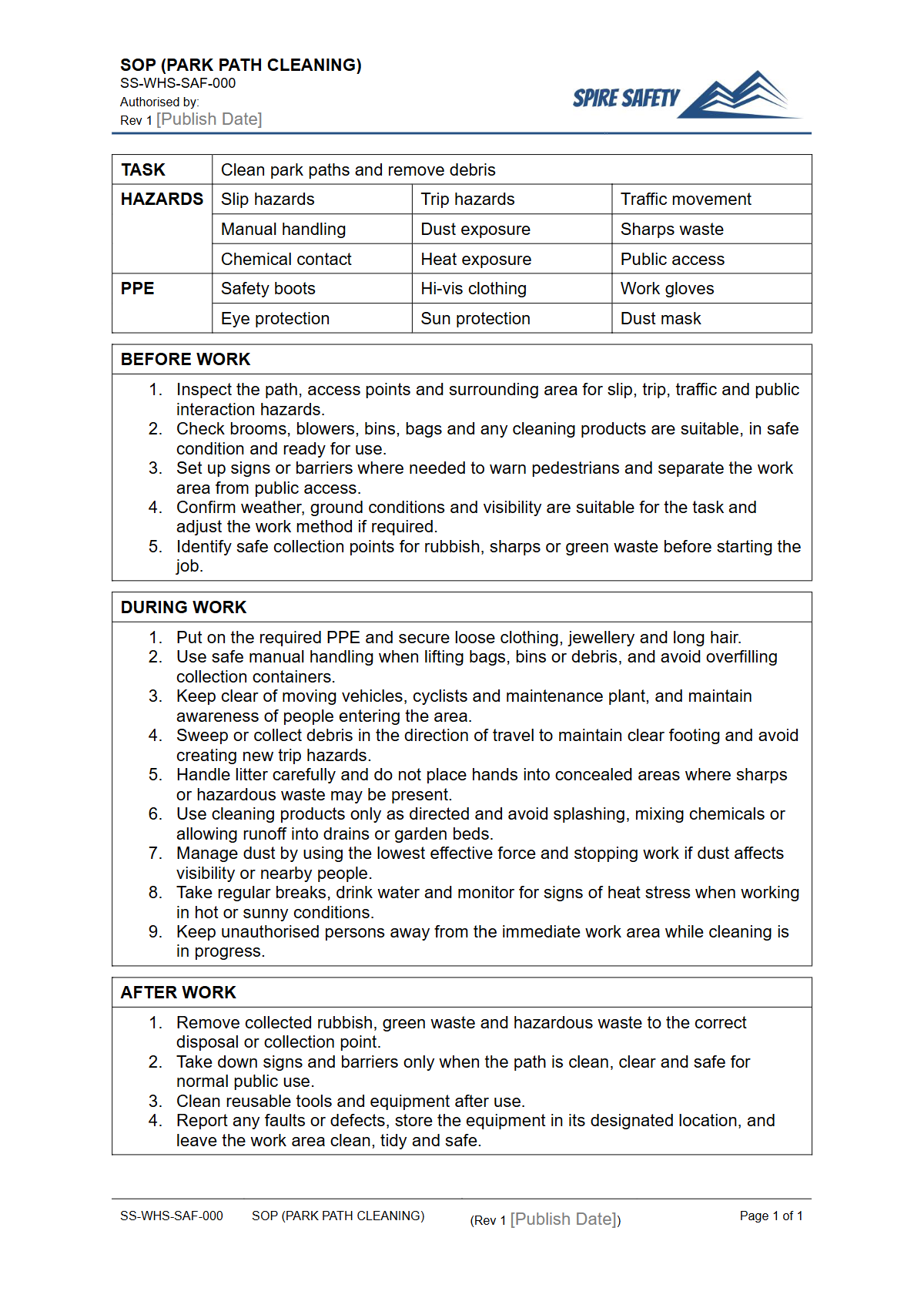
Download our free Safe Operating Procedure (SOP) for park path cleaning. This DOCX and PDF template helps you outline safe work practices and manage risks.
Free Safe Operating Procedure (Park Path Cleaning) Template
DOCX • 126 KB + PDF
Updated Oct 2026
No signup required
Purpose of the Free Safe Operating Procedure (Park Path Cleaning) Template
Maintaining clean and accessible park paths is essential for public safety and enjoyment. This task, however, involves various hazards that must be managed.
Our Free Safe Operating Procedure (Park Path Cleaning) Template provides a structured starting point for organisations to document the required safety measures for this common maintenance activity. This SOP template helps you formalise procedures for tasks like pressure washing, sweeping, leaf blowing, and removing moss or debris, ensuring a consistent approach to safety for every job.
Using a standardised procedure helps you meet your duties under Australian WHS laws by systematically identifying hazards and implementing control measures. It serves as a vital tool for worker training, competency assessment, and demonstrating due diligence.
A well-developed SOP clarifies responsibilities, outlines emergency responses, and promotes a positive safety culture within your team.
Video walkthrough
How to use the Free Safe Operating Procedure (Park Path Cleaning) Template
This template is provided in both DOCX and PDF formats for your convenience. To use it effectively, download the DOCX file and adapt it to the specific context of your workplace.
A generic document is not sufficient for compliance; it must reflect your unique operational realities.
Important: We cannot stress this enough: you must customise this document to detail the specific equipment (e.g., brand and model of pressure washer or blower), cleaning agents, path types, and environmental conditions at your worksite. The foundation of a strong SOP is a thorough, site-specific risk assessment.
Involve your workers in the customisation process—their direct experience is invaluable for identifying practical hazards and effective controls. This collaborative approach also improves worker buy-in and adherence to the finalised procedure.
When to use a Park Path Cleaning SOP
A Safe Operating Procedure for park path cleaning should be developed and implemented before any workers undertake the task. It is a foundational document that forms part of your overall safety management system.
It should be used as a primary reference for training new employees, refreshing the knowledge of existing staff, and conducting toolbox talks before a shift. The SOP is also a critical piece of evidence during safety inspections or WHS compliance auditing, demonstrating that you have a formal process for managing operational risks.
Who should use this template
This SOP template is designed for Persons Conducting a Business or Undertaking (PCBUs), managers, supervisors, and health and safety representatives. It is particularly relevant for local councils, grounds maintenance contractors, landscaping companies, and facilities management services responsible for public spaces.
Workers who perform path cleaning should be trained on the final, customised SOP and have easy access to it for reference. Integrating specific SOPs into your broader WHS management systems ensures a cohesive and systematic approach to workplace safety across all operations.
Key Hazards and Controls
Park path cleaning presents several common hazards. Your SOP should detail how to control them:
- Slips, Trips & Falls: Wet surfaces, trailing hoses, uneven ground, and debris are significant risks. Controls include using non-slip footwear, displaying prominent 'wet surface' warning signs for the public, and maintaining good housekeeping.
- Manual Tasks: Lifting heavy equipment, repetitive sweeping, and awkward postures can lead to musculoskeletal injuries. Controls include using ergonomic equipment, providing training on safe lifting techniques, and rotating tasks among workers.
- Noise: Equipment like leaf blowers and pressure washers can generate hazardous noise levels. Your SOP should specify the required hearing protection and outline exposure time limits. If you use pneumatic equipment, our free Air Compressor SOP template provides additional relevant guidance.
- Chemicals: Cleaning agents, moss killers, or herbicides can pose risks. Your SOP must reference the relevant Safety Data Sheets (SDS), specify required PPE (e.g., gloves, eye protection), and outline first aid measures.
- Public Interaction: Working in public spaces requires managing the interface between your work area and pedestrians or cyclists. Controls include barrier-taping work zones and scheduling work during low-traffic periods where feasible.
Review and Improvement
An SOP is a living document. It should be reviewed regularly—at least annually, or whenever there is a change in equipment, chemicals, or procedures.
It must also be reviewed after any incident or near-miss to incorporate learnings and prevent recurrence. This continuous improvement cycle is a core principle of effective WHS management.
For related tasks involving material distribution, such as applying grit or salt, you may find our free Spreader SOP template a useful reference.
By implementing a clear, detailed, and customised SOP, you provide workers with the information they need to perform their duties safely and efficiently. For more procedural documents covering different types of equipment and tasks, please browse our complete free WHS resources library.
Common mistakes
Common mistakes to avoid
- Using a generic template without customising it for specific equipment and site conditions.
- Failing to consult with workers who perform the path cleaning tasks.
- Not providing adequate training on the finalised SOP to all relevant staff.
- Treating the SOP as a 'set and forget' document instead of reviewing it regularly or after an incident.
Legal references
Legal considerations
The following legal requirements may be relevant to this type of work.
- Work Health and Safety Act (Harmonised) — Provides the primary duties for protecting workers and other people from work health and safety risks.
- Work Health and Safety Regulations (Harmonised) — Sets out requirements supporting the management of workplace hazards and risks.
The following codes may be relevant to this type of work.
- Managing WHS Risks Code of Practice — Provides practical guidance on identifying hazards, assessing risks and applying effective controls.
- Work Health and Safety Consultation, Cooperation and Coordination Code of Practice — Provides practical guidance on consulting workers and coordinating with other duty holders.
- Managing the Work Environment and Facilities Code of Practice — Provides practical guidance on safe work environments, workplace facilities and related controls.
Did you know
Slips, Trips and Falls
Slips, trips and falls are a leading cause of serious, preventable workplace injuries in Australia, accounting for thousands of workers' compensation claims each year.
Equipment Noise
A standard petrol-powered leaf blower can produce noise levels over 100 decibels (dB), well above the 85 dB(A) exposure standard at which hearing protection becomes mandatory.
FAQ
Frequently asked questions
01What should a Safe Operating Procedure for park path cleaning include?
02How often should we review our park path cleaning SOP?
03Is an SOP legally required for cleaning park paths in Australia?
04Who is responsible for writing the SOP for path cleaning?
Share this resource
Free Safe Operating Procedure (Park Path Cleaning) Template
Browse Categories
How To Use It
- 1Download and open in Word or PDF.
- 2Replace the placeholders with your business details.
- 3Get it reviewed by a WHS specialist before rollout.
Need it customised?
Our WHS consultants can adapt this template to your site, run a gap analysis, or audit what you already have in place.
Book a Free Consultation WHS consulting servicesor call 1300 156 382
Related templates
- Free Safe Operating Procedure (Park Sign Cleaning) Template
- Free Safe Operating Procedure (Parking Bay Cleaning) Template
- Free Safe Operating Procedure (Parts Washer) Template
- Free Safe Operating Procedure (Passenger Lift) Template
- Free Safe Operating Procedure (Passenger Ramp Setup) Template
- Free Safe Operating Procedure (Passenger Stairs) Template