
Free Safe Operating Procedure (Park Gate Maintenance) Template
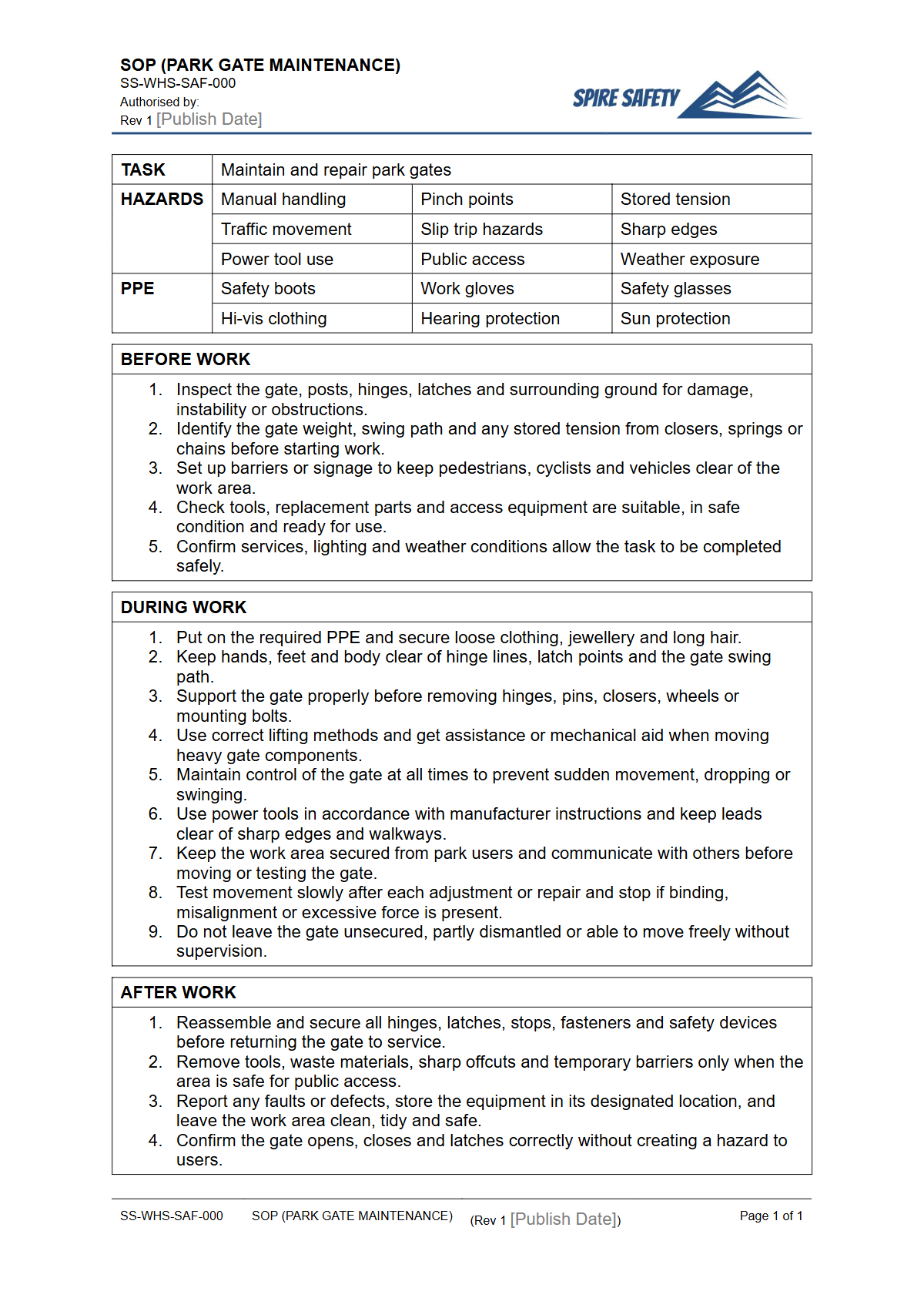
Download our free Safe Operating Procedure template for park gate maintenance. This customisable guide helps formalise your safety processes and reduce risk.
Free Safe Operating Procedure (Park Gate Maintenance) Template
DOCX • 126 KB + PDF
Updated Oct 2026
No signup required
Purpose of the Free Safe Operating Procedure (Park Gate Maintenance) Template
This free Safe Operating Procedure (Park Gate Maintenance) template provides a structured framework for outlining the step-by-step process for safely performing maintenance on park gates, whether they are manual or automated. Park gate maintenance involves significant hazards, including crushing and shearing from moving parts, manual handling injuries from heavy components, electrical shock from automated systems, and risks associated with working in public spaces.
Using a formal SOP helps standardise your organisation's approach, ensuring every task is performed consistently and safely.
A well-developed SOP is a critical component of a compliant safety system. It demonstrates a commitment to managing risks, helps meet legal obligations under WHS legislation, and serves as a vital training tool for workers.
Formalising your procedures helps build a proactive safety culture and provides a clear reference point for everyone involved. This document forms a fundamental part of your overall WHS management systems, integrating practical tasks with broader safety objectives.
Video walkthrough
How to use the Free Safe Operating Procedure (Park Gate Maintenance) Template
Our template is designed as a starting point, structured to align with Australian WHS best practices. It includes sections for outlining hazards, required personal protective equipment (PPE), pre-start checks, operational steps, and shutdown procedures.
To use it effectively, you should download the DOCX file and adapt it to your specific circumstances. This involves identifying the unique types of gates, tools, and environmental conditions at your workplace.
Important: You must customise this template to your workplace. We have provided a comprehensive framework, but it is your responsibility to populate it with site-specific details, including the exact models of gates, tools used (such as those covered in a Free Air Compressor SOP), and unique environmental risks.
Effective SOPs are not generic; they are living documents that reflect the reality of the work being done. Always consult with the workers who perform the tasks when drafting and reviewing the procedure to ensure it is practical and effective.
When to use a Park Gate Maintenance SOP
A Safe Operating Procedure for park gate maintenance should be used consistently as a reference and a control measure. It is not a document to be filed away and forgotten.
It should be directly referenced before any scheduled or unscheduled maintenance task begins. It is also an essential resource during worker training, inductions for new staff, and regular toolbox talks to reinforce safe work habits.
Furthermore, the SOP should be reviewed and updated as part of any post-incident investigation or whenever a change is introduced, such as new equipment or a modification to the gate itself. For tasks involving heavy lifting of gate sections, you may need to consult other procedures, such as a FREE Telehandler SOP Template, if such equipment is used.
Who should use this Safe Operating Procedure
This SOP is intended for use by any person involved in the maintenance, inspection, or repair of park gates. This includes maintenance personnel, groundskeepers, park rangers, and contractors.
Supervisors and managers have a crucial role in ensuring the SOP is implemented, understood, and followed by their teams. They are responsible for providing adequate training and resources.
For a Person Conducting a Business or Undertaking (PCBU), having robust SOPs like this one is a key way to demonstrate due diligence in managing workplace risks. Regular reviews of its implementation may be part of your routine WHS compliance auditing schedule to ensure ongoing effectiveness.
If maintenance involves fabrication or modification of wooden components, workers should be trained on the safe use of relevant tools, which may be detailed in documents like our FREE Circular Saw SOP Template. By ensuring all relevant procedures are documented and accessible, you create a safer and more organised work environment. You can explore a wide range of similar documents in our free WHS resources library to build out your safety management system.
Common mistakes
Common mistakes to avoid
- Failing to de-energise and lock out automated gates before commencing maintenance.
- Using a generic template without customising it for specific gate types, power sources, and site hazards.
- Neglecting to consult with the workers who perform the maintenance when drafting or reviewing the SOP.
- Not providing specific training on the finalised procedure and assuming workers will read it on their own.
Legal references
Legal considerations
The following legal requirements may be relevant to this type of work.
- Work Health and Safety Act (Harmonised) — Provides the primary duties for protecting workers and other people from work health and safety risks.
- Work Health and Safety Regulations (Harmonised) — Sets out requirements supporting the management of workplace hazards and risks.
The following codes may be relevant to this type of work.
- Managing WHS Risks Code of Practice — Provides practical guidance on identifying hazards, assessing risks and applying effective controls.
- Work Health and Safety Consultation, Cooperation and Coordination Code of Practice — Provides practical guidance on consulting workers and coordinating with other duty holders.
- Managing the Work Environment and Facilities Code of Practice — Provides practical guidance on safe work environments, workplace facilities and related controls.
Did you know
Force and Speed
Automated gates can exert significant force, often over 500 Newtons. A properly functioning safety mechanism is critical to prevent crushing injuries, as this force is more than enough to cause serious harm.
Preventative Maintenance
Most gate-related incidents are linked to a lack of regular inspection and maintenance. Documenting and following an SOP helps ensure these preventative checks are not overlooked, reducing the risk of catastrophic failure.
FAQ
Frequently asked questions
01What are the main hazards involved in park gate maintenance?
02How often should a Safe Operating Procedure be reviewed?
03Does this SOP cover automated electric gates?
04Who is responsible for ensuring the park gate maintenance SOP is followed?
Share this resource
Free Safe Operating Procedure (Park Gate Maintenance) Template
Browse Categories
How To Use It
- 1Download and open in Word or PDF.
- 2Replace the placeholders with your business details.
- 3Get it reviewed by a WHS specialist before rollout.
Need it customised?
Our WHS consultants can adapt this template to your site, run a gap analysis, or audit what you already have in place.
Book a Free Consultation WHS consulting servicesor call 1300 156 382
Related templates
- Free Safe Operating Procedure (Park Path Cleaning) Template
- Free Safe Operating Procedure (Park Sign Cleaning) Template
- Free Safe Operating Procedure (Parking Bay Cleaning) Template
- Free Safe Operating Procedure (Parts Washer) Template
- Free Safe Operating Procedure (Passenger Lift) Template
- Free Safe Operating Procedure (Passenger Ramp Setup) Template