
Free Safe Operating Procedure (Park Furniture Repair) Template
Establish clear, safe work methods for repairing park and street furniture with our comprehensive template. Download this free resource to get started.
Free Safe Operating Procedure (Park Furniture Repair) Template
DOCX • 126 KB + PDF
Updated Oct 2026
No signup required
Purpose of the Free Safe Operating Procedure (Park Furniture Repair) Template
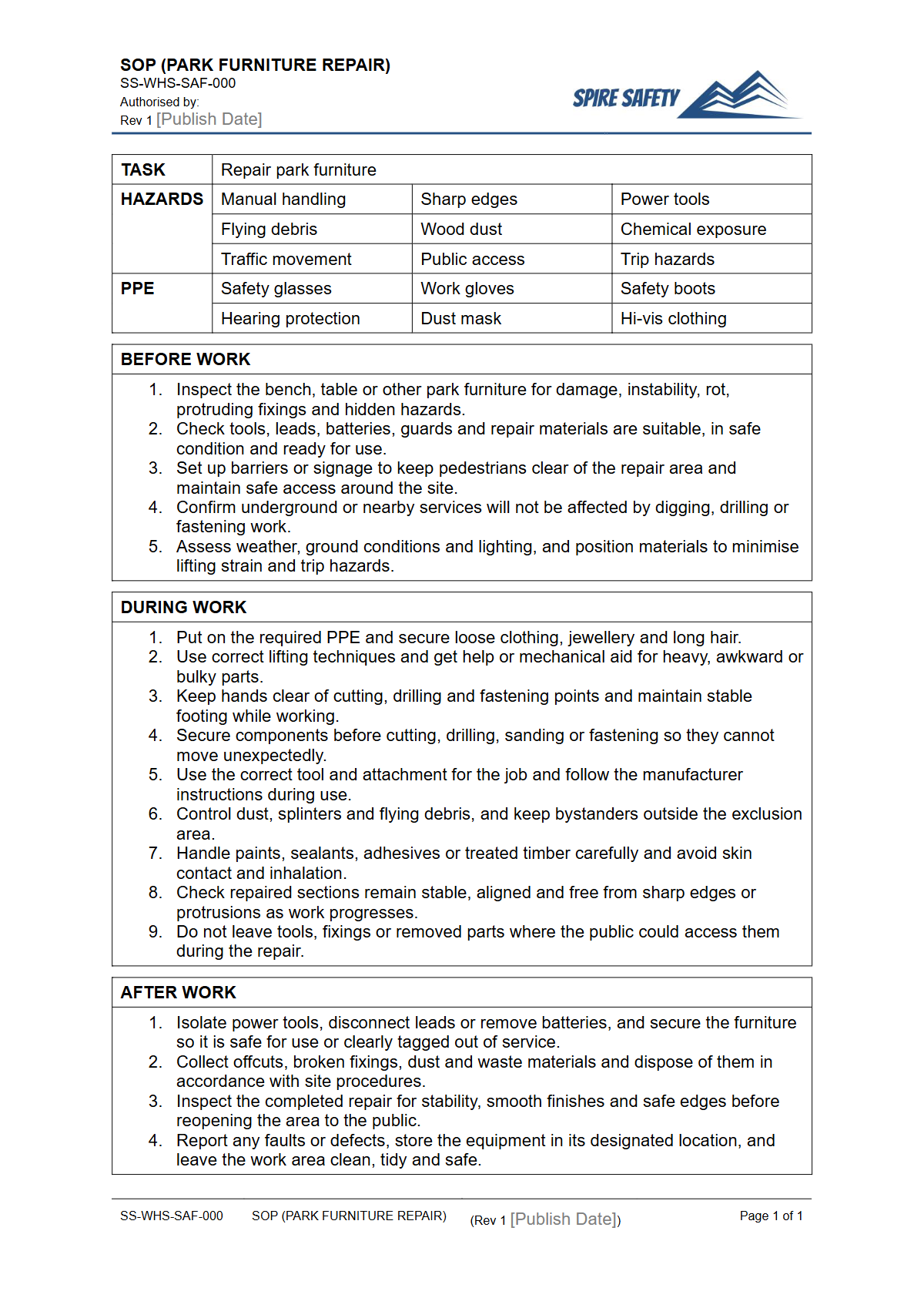
Repairing park and street furniture involves a range of hazards, from manual tasks and power tool use to interactions with the public. This Free Safe Operating Procedure (Park Furniture Repair) Template provides a structured starting point for documenting a safe system of work for these common maintenance activities.
Using a formalised SOP helps your organisation meet its primary duty of care under WHS legislation by clearly defining the safest way to perform the task, outlining potential hazards, and specifying the required control measures.
The document guides you through outlining pre-operational checks, step-by-step instructions for the repair process, and post-task clean-up procedures. It addresses common risks such as hazardous manual tasks, tool operation, chemical exposure (from paints, sealants, or cleaners), and environmental factors.
By standardising your approach, you can reduce the risk of injury, ensure consistency across your workforce, and provide a clear reference for training and supervision. This is a foundational element in building robust WHS management systems that protect both your workers and the public.
Video walkthrough
How to use the Free Safe Operating Procedure (Park Furniture Repair) Template
This Safe Operating Procedure is provided as a fully editable DOCX file, allowing for complete customisation, as well as a PDF for easy printing and distribution. To use it, simply download the file and begin populating the sections with information specific to your operational context.
This includes the exact types of furniture, the specific tools used, the chemicals approved for use, and the personal protective equipment (PPE) required for each stage of the repair.
IMPORTANT: This document is a template and must be customised to your specific workplace. The effectiveness of this SOP relies on it accurately reflecting your unique equipment, materials, environment, and personnel.
We strongly recommend that a competent person, such as a supervisor or WHS advisor, works with the operators who perform the task to complete the document. The final SOP should be reviewed and approved before implementation to ensure it provides effective risk control.
When to use this Safe Operating Procedure
This SOP should be used as a primary reference document for all park furniture repair tasks. It is a critical tool for inducting and training new workers or contractors assigned to these duties, ensuring they understand the established safe work method from day one.
It should also be readily available at the worksite (in digital or physical form) for operators to consult as needed. Supervisors can use it as a checklist to verify that work is being conducted correctly and that all safety controls, such as securing the work area from the public, are in place.
The SOP is also a valuable input for conducting a risk assessment or developing a Safe Work Method Statement (SWMS) if the repair work is classified as high-risk construction work. When using specific equipment like power saws during a repair, it should be used alongside equipment-specific instructions, such as those found in a FREE Circular Saw SOP Template. Regular review and updates, especially after an incident or when a new process is introduced, are essential to its continued relevance.
Who should use this document
This template is designed for use by a wide range of personnel involved in public space and facility maintenance. This includes local council maintenance crews, parks and gardens teams, and contractors engaged to repair or install street furniture.
WHS managers and advisors will find it a useful tool for standardising procedures across an organisation and demonstrating due diligence in managing workplace risks.
Supervisors and team leaders are key users, responsible for implementing the SOP, ensuring workers are trained on its contents, and monitoring its application in the field. When maintenance involves larger machinery, such as using pneumatic tools powered by a generator, operators should also consult the relevant equipment-specific procedure, like our Free Air Compressor SOP (Safe Operating Procedure) Template. For a broader overview of safety documentation, browse our complete free WHS resources library.
Ultimately, any worker tasked with repairing benches, tables, bins, or other park assets should be familiar with the contents of the completed SOP. It forms the basis for their training and is the authoritative guide for performing their work safely. Periodically confirming that procedures are being followed correctly is a key function of routine safety checks and formal WHS compliance auditing.
Common mistakes
Common mistakes to avoid
- Using the template as-is without customising it for the specific site, tools, and chemicals used.
- Failing to properly isolate the work area from vehicle and pedestrian traffic.
- Neglecting to check weather forecasts before starting work, leading to issues with power tools or finishes.
- Assuming workers have read the SOP without providing proper training and verifying their understanding.
Legal references
Legal considerations
The following legal requirements may be relevant to this type of work.
- Work Health and Safety Act (Harmonised) — Provides the primary duties for protecting workers and other people from work health and safety risks.
- Work Health and Safety Regulations (Harmonised) — Sets out requirements supporting the management of workplace hazards and risks.
The following codes may be relevant to this type of work.
- Managing WHS Risks Code of Practice — Provides practical guidance on identifying hazards, assessing risks and applying effective controls.
- Work Health and Safety Consultation, Cooperation and Coordination Code of Practice — Provides practical guidance on consulting workers and coordinating with other duty holders.
- Managing the Work Environment and Facilities Code of Practice — Provides practical guidance on safe work environments, workplace facilities and related controls.
Did you know
Manual Tasks are #1 Risk
Hazardous manual tasks, including lifting and sustained awkward postures common in furniture repair, are the leading cause of serious workers' compensation claims in Australia.
Public Liability
Slips, trips, and falls are a major source of public liability claims against councils and property managers. Establishing controlled, well-signed work zones during maintenance is a critical risk-reduction measure.
FAQ
Frequently asked questions
01What is the difference between an SOP and a SWMS for park furniture repair?
02Does this Safe Operating Procedure cover working in public spaces?
03What key hazards should I consider for park furniture repair?
04How often should our park furniture repair SOP be reviewed?
Share this resource
Free Safe Operating Procedure (Park Furniture Repair) Template
Browse Categories
How To Use It
- 1Download and open in Word or PDF.
- 2Replace the placeholders with your business details.
- 3Get it reviewed by a WHS specialist before rollout.
Need it customised?
Our WHS consultants can adapt this template to your site, run a gap analysis, or audit what you already have in place.
Book a Free Consultation WHS consulting servicesor call 1300 156 382
Related templates
- Free Safe Operating Procedure (Park Gate Maintenance) Template
- Free Safe Operating Procedure (Park Path Cleaning) Template
- Free Safe Operating Procedure (Park Sign Cleaning) Template
- Free Safe Operating Procedure (Parking Bay Cleaning) Template
- Free Safe Operating Procedure (Parts Washer) Template
- Free Safe Operating Procedure (Passenger Lift) Template