
Free Safe Operating Procedure (Parcel Cage Handling) Template
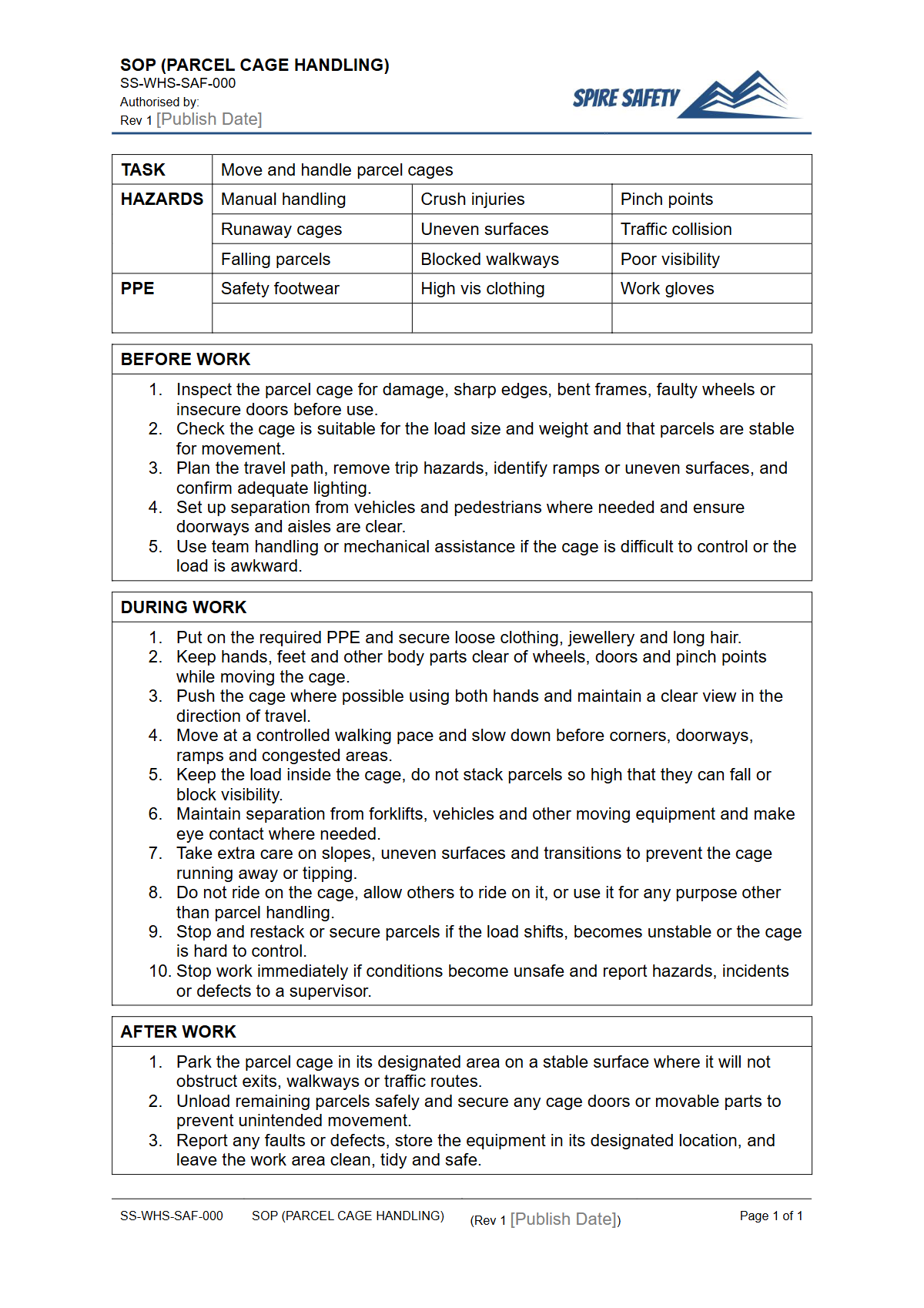
Formalise your procedures for moving parcel cages with our structured template. Download this free Safe Operating Procedure to help manage manual handling risks.
Free Safe Operating Procedure (Parcel Cage Handling) Template
DOCX • 126 KB + PDF
Updated Oct 2026
No signup required
Purpose of the Free Safe Operating Procedure (Parcel Cage Handling) Template
Handling parcel and freight cages is a common task in logistics, warehousing, transport, and retail environments. While routine, it carries significant risks if not managed correctly.
This free Safe Operating Procedure (Parcel Cage Handling) Template provides a structured framework for documenting the safest method to perform this task. Implementing a clear SOP helps your organisation meet its duty of care under Australian WHS laws by minimising the risk of workplace injuries.
A documented procedure ensures that every worker follows a consistent, pre-approved process, reducing guesswork and unsafe shortcuts. It is a critical component of a functional safety system, demonstrating that risks have been identified and control measures have been implemented.
This template helps formalise your approach to cage handling within your broader WHS management systems, providing a clear reference for training, supervision, and review.
Key Hazards in Parcel Cage Handling
Using this template helps you address common hazards associated with parcel cages, including:
- Musculoskeletal Disorders (MSDs): Injuries from pushing, pulling, and manoeuvring heavy or awkward cages, such as back strains, sprains, and shoulder injuries.
- Crush Injuries: Hands, feet, or limbs being caught between a cage and a fixed object (like a wall or vehicle) or between multiple cages.
- Struck-by Incidents: Workers being hit by a moving cage, particularly if it is unstable, overloaded, or moving too fast.
- Slips, Trips, and Falls: Caused by damaged cage wheels, poor housekeeping, or workers losing their footing while moving a cage.
Video walkthrough
How to use the Free Safe Operating Procedure (Parcel Cage Handling) Template
This resource is available as a DOCX file, which is fully editable in Microsoft Word or other compatible software, and as a PDF for easy printing and distribution. To use the template effectively, you must adapt its contents to your specific operational context.
This includes detailing the types of cages used, the work environment, the mechanical aids available (e.g., electric tugs), and the specific risk controls your workplace has implemented.
Important Note: This document provides a starting point based on general safety principles. We have provided a structured guide, but you must customise the content to reflect the unique equipment, processes, and risks present at your worksite.
A generic procedure is not sufficient; it must be made site-specific to be effective and support your safety obligations.
Consider integrating this procedure with related documents, such as our free Conveyer System SOP, to build a comprehensive set of safety documents for your warehouse or distribution centre. For tasks involving powered mobile plant to move loads, you might need a specific SOP for a telehandler or other relevant equipment.
When to use it
A Safe Operating Procedure for parcel cage handling should be a living document within your safety management system. It is used as a primary tool for training new employees, ensuring they learn the correct, safe method from day one.
It also serves as a critical refresher for experienced workers, reinforcing safe behaviour and communicating any changes to the procedure.
Furthermore, the SOP should be referenced during incident investigations to determine if procedural breaches contributed to the event. It is also a key document for review during safety inspections and WHS compliance auditing to verify that documented processes are being followed in practice.
Who should use it
The responsibility for this SOP is shared. Site Managers, Warehouse Managers, and WHS personnel are typically responsible for developing, customising, and authorising the procedure.
They must ensure it accurately reflects the task and incorporates effective, reasonably practicable risk controls.
Supervisors and Team Leaders are responsible for implementing the SOP, which includes providing training to workers and monitoring compliance on the floor. All employees and contractors tasked with handling parcel cages are the end-users.
They must be trained on the procedure, understand its requirements, and follow the specified steps every time they perform the task. If your team needs assistance with developing or implementing robust safety procedures, consider engaging professional WHS consulting services.
Common mistakes
Common mistakes to avoid
- Using a generic template without customising it for site-specific cages and layouts.
- Failing to train workers on the finalised SOP and keep records of that training.
- Overloading cages beyond their designated Safe Working Load (SWL).
- Not performing pre-use checks on the cage, particularly for damaged wheels, latches, or structural integrity.
Legal references
Legal considerations
The following legal requirements may be relevant to this type of work.
- Work Health and Safety Act (Harmonised) — Provides the primary duties for protecting workers and other people from work health and safety risks.
- Work Health and Safety Regulations (Harmonised) — Sets out requirements supporting the management of workplace hazards and risks.
The following codes may be relevant to this type of work.
- Managing WHS Risks Code of Practice — Provides practical guidance on identifying hazards, assessing risks and applying effective controls.
- Work Health and Safety Consultation, Cooperation and Coordination Code of Practice — Provides practical guidance on consulting workers and coordinating with other duty holders.
- Managing the Work Environment and Facilities Code of Practice — Provides practical guidance on safe work environments, workplace facilities and related controls.
Did you know
The "Power Zone"
For manual handling, the safest lifting zone is between mid-thigh and mid-chest height. Handling items outside this 'power zone' significantly increases stress on the spine and the risk of back injury.
Team Lifting Maths
When two people lift a load, they don't simply halve the individual effort. Due to the need for coordination, it's safer to assume the team's combined lifting capacity is about two-thirds of the sum of their individual safe capacities.
FAQ
Frequently asked questions
01What is the difference between a Safe Operating Procedure (SOP) and a Safe Work Method Statement (SWMS)?
02Is pushing or pulling a parcel cage better for manual handling?
03How often should our Parcel Cage Handling SOP be reviewed?
04Do we need an SOP if we only move cages a short distance?
Share this resource
Free Safe Operating Procedure (Parcel Cage Handling) Template
Browse Categories
How To Use It
- 1Download and open in Word or PDF.
- 2Replace the placeholders with your business details.
- 3Get it reviewed by a WHS specialist before rollout.
Need it customised?
Our WHS consultants can adapt this template to your site, run a gap analysis, or audit what you already have in place.
Book a Free Consultation WHS consulting servicesor call 1300 156 382
Related templates
- Free Safe Operating Procedure (Parcel Handover) Template
- Free Safe Operating Procedure (Parcel Staging) Template
- Free Safe Operating Procedure (Park Bench Cleaning) Template
- Free Safe Operating Procedure (Park Furniture Repair) Template
- Free Safe Operating Procedure (Park Gate Maintenance) Template
- Free Safe Operating Procedure (Park Path Cleaning) Template