
Free Safe Operating Procedure (Panini Press) Template
Establish clear safety guidelines for operating a commercial panini press with our free template. Download your customisable Safe Operating Procedure now.
Free Safe Operating Procedure (Panini Press) Template
DOCX • 126 KB + PDF
Updated Oct 2026
No signup required
Purpose of the Free Safe Operating Procedure (Panini Press) Template
Operating a commercial panini press, while routine in many cafes and restaurants, involves significant hazards such as severe burns, electrical shocks, and musculoskeletal strain. A Safe Operating Procedure (SOP) is a foundational document that formally outlines the safest way to perform this task.
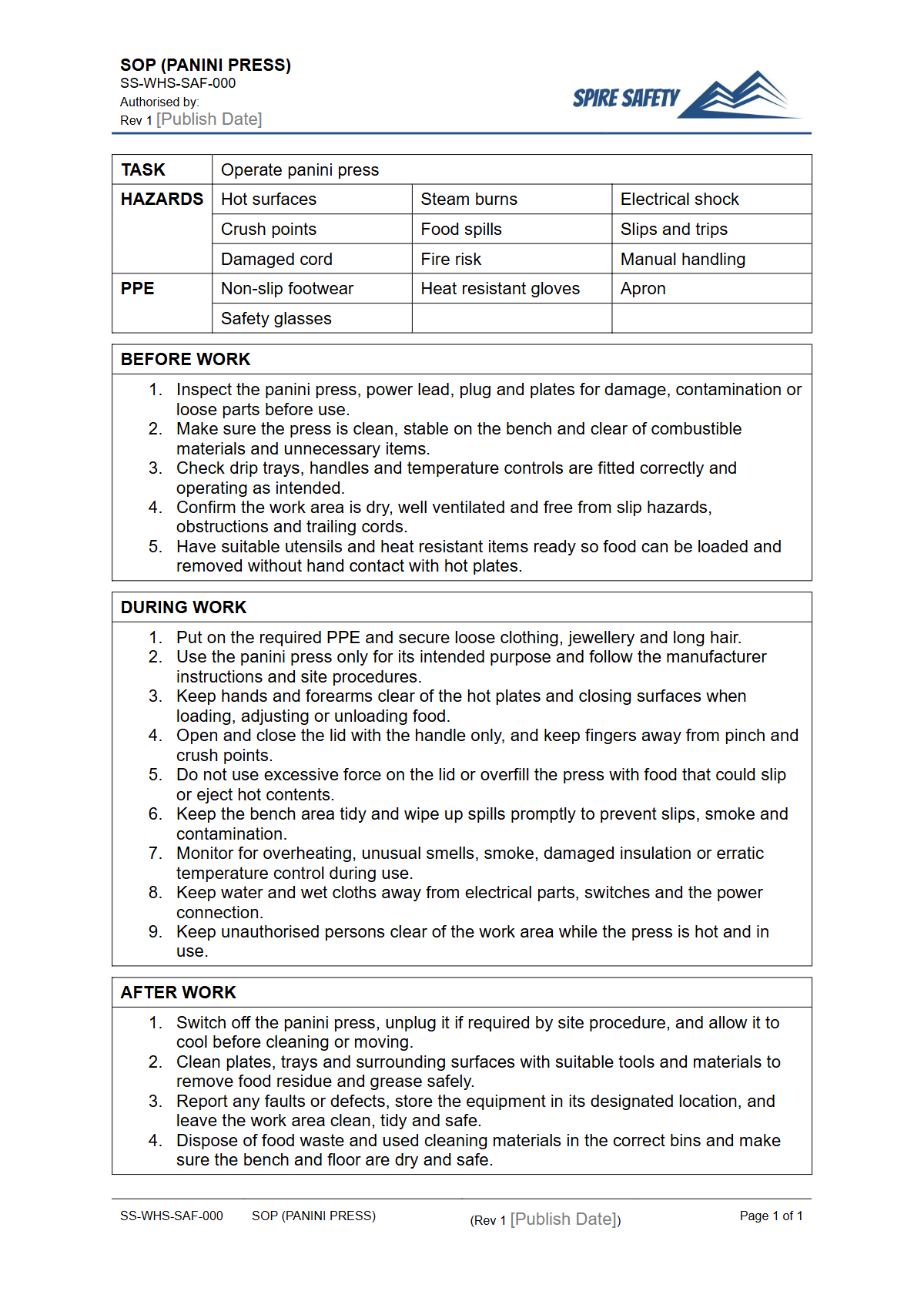
Our Free Safe Operating Procedure (Panini Press) Template provides a structured framework for you to document pre-operational checks, step-by-step operating instructions, and shutdown and cleaning protocols. Using a standardised SOP helps to ensure all workers, from new starters to experienced staff, use the equipment consistently and safely, reducing the risk of injury.
Implementing robust SOPs is a critical component of demonstrating due diligence and forms an essential part of your workplace safety framework. These documents provide clear instructions, serve as a vital tool for training and inductions, and are a cornerstone of effective WHS management systems. They help your organisation meet its primary duty of care by actively managing foreseeable risks associated with kitchen equipment.
Video walkthrough
How to use the Free Safe Operating Procedure (Panini Press) Template
This template is designed for ease of use. Simply download the DOCX file and open it in your preferred word processor.
The document is logically structured with clear headings for each stage of the panini press's use cycle: before operation, during operation, and after operation. You will find sections for detailing required Personal Protective Equipment (PPE), potential hazards, and emergency procedures.
It is crucial to recognise that this document is a starting point, not a final solution. We have provided a comprehensive framework aligned with Australian WHS principles.
However, you must customise this template to reflect the specific make and model of your panini press, your unique workplace environment, and any existing control measures you have in place. Just as safety procedures must be specific for high-risk tools like a circular saw in a workshop, the same level of detail is required for commercial kitchen appliances to ensure the SOP is effective and relevant.
When to use a Panini Press Safe Operating Procedure
A Panini Press SOP should be a living document, actively used in day-to-day operations. It is essential for:
- Worker Training and Induction: Use the SOP as a primary training resource to ensure new employees understand the correct and safe method for operating the equipment from day one.
- Refresher Training: Conduct periodic refresher training with existing staff to reinforce safe work practices and address any complacency.
- Risk Management: The SOP serves as a documented risk control measure for hazards associated with the panini press.
- Incident Investigation: Following an incident or near miss, the SOP should be reviewed to determine if the procedure was followed and if it needs to be updated to prevent a recurrence.
Regularly reviewing your SOPs is a key part of maintaining safety standards. This process ensures the procedures remain current with equipment condition and workplace practices, a process that can be validated through formal WHS compliance auditing.
Who should use it
This template is intended for use by anyone responsible for health and safety in a hospitality setting. This includes:
- Persons Conducting a Business or Undertaking (PCBUs): Business owners and directors can use this template to fulfil their duty of care to provide safe systems of work.
- Managers and Supervisors: Kitchen and venue managers are responsible for implementing the SOP, training staff, and ensuring compliance on the floor.
- Workers: The end-users of the SOP are the kitchen staff, chefs, and cooks who operate the panini press. They should be consulted during the customisation process to ensure the procedure is practical and reflects how the work is actually done.
Documenting safe work methods is a core part of a PCBU's responsibilities. The structured approach is similar to how procedures are managed for other common workplace equipment, such as an air compressor, ensuring a consistent approach to safety across the business.
The principle of documenting pre-start checks, operation, and shutdown is universal for machinery safety, promoting a consistent, safety-first mindset. This methodology is applicable whether managing a simple appliance or a more complex piece of equipment, as outlined in our Conveyer System SOP template. If you require assistance in developing or implementing SOPs across your organisation, engaging professional WHS consulting can help streamline your safety documentation and ensure it is fit for purpose.
Common mistakes
Common mistakes to avoid
- Using the generic template without customising it for the specific make and model of panini press.
- Failing to train all relevant workers on the contents of the final, customised SOP.
- Neglecting to include specific instructions for cleaning and maintenance, which often carry unique risks.
- Storing the completed SOP in an office where workers cannot easily access it for reference.
Legal references
Legal considerations
The following legal requirements may be relevant to this type of work.
- Work Health and Safety Act (Harmonised) — Provides the primary duties for protecting workers and other people from work health and safety risks.
- Work Health and Safety Regulations (Harmonised) — Sets out requirements supporting the management of workplace hazards and risks.
The following codes may be relevant to this type of work.
- Managing WHS Risks Code of Practice — Provides practical guidance on identifying hazards, assessing risks and applying effective controls.
- Work Health and Safety Consultation, Cooperation and Coordination Code of Practice — Provides practical guidance on consulting workers and coordinating with other duty holders.
- Managing the Work Environment and Facilities Code of Practice — Provides practical guidance on safe work environments, workplace facilities and related controls.
Did you know
A Hot Topic
According to Safe Work Australia data, burns are a leading cause of serious injury claims in the accommodation and food services industry, highlighting the critical need for clear procedures around hot equipment like panini presses.
Panini Origins
While the concept of pressing sandwiches is centuries old, the modern contact grill or panini press was patented in the 1970s. Its ability to heat quickly and cook evenly made it a global cafe staple.
FAQ
Frequently asked questions
01What are the main hazards of using a commercial panini press?
02Is this SOP template enough for my business to be WHS-aligned?
03How often should I review my Panini Press SOP?
04Who is responsible for creating and implementing the SOP?
Share this resource
Free Safe Operating Procedure (Panini Press) Template
Browse Categories
How To Use It
- 1Download and open in Word or PDF.
- 2Replace the placeholders with your business details.
- 3Get it reviewed by a WHS specialist before rollout.
Need it customised?
Our WHS consultants can adapt this template to your site, run a gap analysis, or audit what you already have in place.
Book a Free Consultation WHS consulting servicesor call 1300 156 382
Related templates
- Free Safe Operating Procedure (Pantry Shelf Cleaning) Template
- Free Safe Operating Procedure (Parcel Cage Handling) Template
- Free Safe Operating Procedure (Parcel Handover) Template
- Free Safe Operating Procedure (Parcel Staging) Template
- Free Safe Operating Procedure (Park Bench Cleaning) Template
- Free Safe Operating Procedure (Park Furniture Repair) Template