
Free Safe Operating Procedure (Pantry Shelf Cleaning) Template
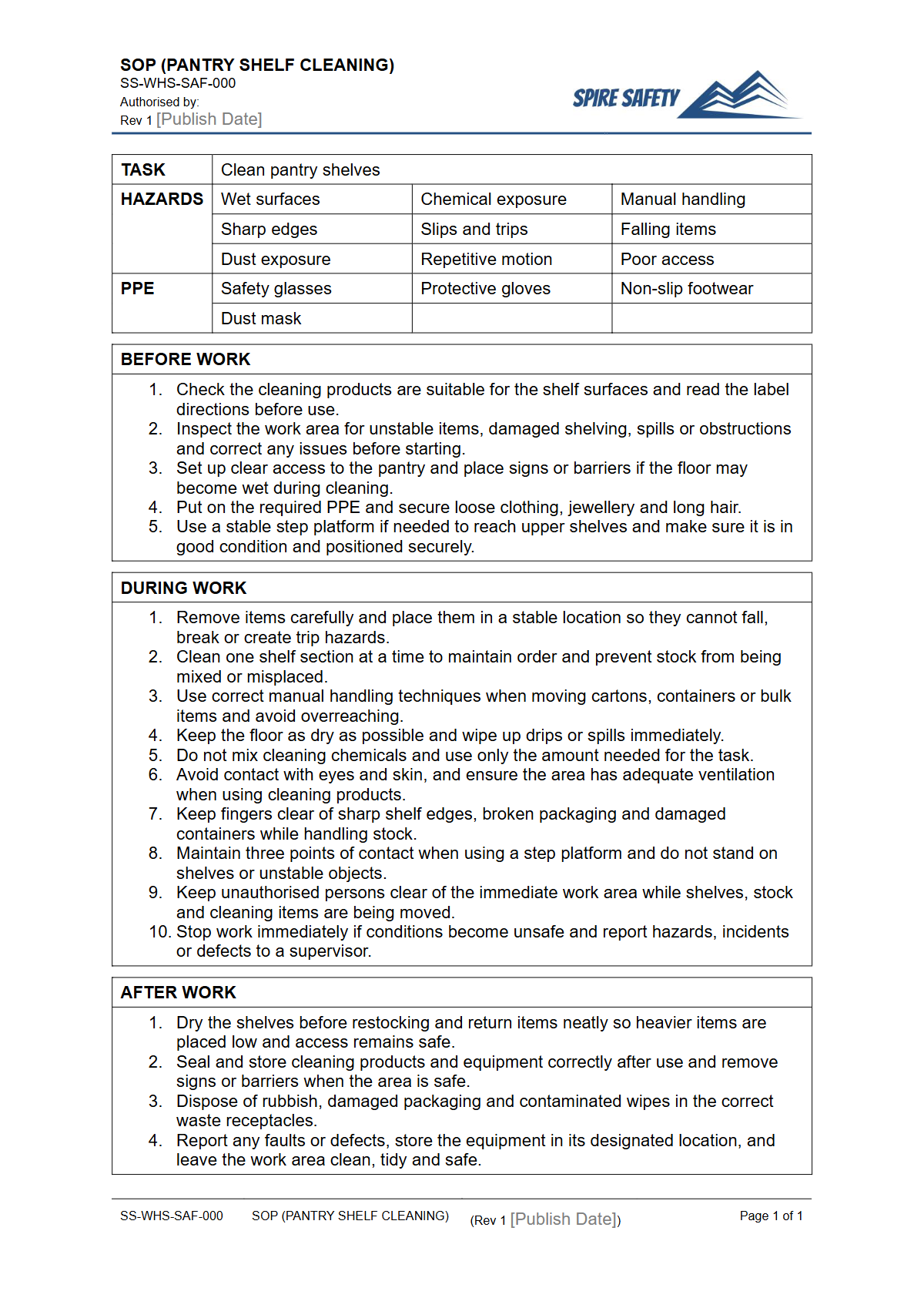
Download our free Safe Operating Procedure for pantry shelf cleaning. This template provides a solid foundation for documenting safe work practices.
Free Safe Operating Procedure (Pantry Shelf Cleaning) Template
DOCX • 126 KB + PDF
Updated Oct 2026
No signup required
Purpose of the Free Safe Operating Procedure (Pantry Shelf Cleaning) Template
Maintaining a clean and organised pantry is essential for hygiene and safety in any workplace, from office kitchens to commercial hospitality venues. This Free Safe Operating Procedure (Pantry Shelf Cleaning) Template provides a structured framework for documenting the required steps to perform this task safely and consistently.
Using an SOP helps to minimise common risks such as slips from spills, ergonomic strains from improper lifting or reaching, and exposure to cleaning chemicals. It creates a clear, repeatable process that reduces guesswork and enhances safety for all workers.
A well-drafted Safe Operating Procedure is a fundamental component of a safe system of work. It serves as a key training document and demonstrates a commitment to proactive risk management.
For tasks in a similar environment, such as cleaning kitchen equipment, a specific procedure is also crucial; for example, you can use a separate Safe Operating Procedure for deep fryer operation to manage its unique hazards.
Video walkthrough
How to use the Free Safe Operating Procedure (Pantry Shelf Cleaning) Template
This resource is available for download in both DOCX and PDF formats. The DOCX version is fully editable, allowing you to adapt it to your specific operational needs.
To use the template effectively, you should review each section and populate it with information relevant to your worksite, including the specific pantry layout, the types of shelves, the cleaning products in use, and your organisation's emergency contacts.
Important: This document is a template and must be customised to suit the specific hazards and control measures of your workplace. We provide this as a starting point, but you must conduct your own risk assessment and adapt the content to ensure it is relevant and effective for your environment.
Simply using this template without modification is not a substitute for a comprehensive safety management process.
Integrating the SOP into your safety framework
Once customised, the SOP should be integrated into your overall safety management practices. This involves training all relevant workers on the procedure, making it easily accessible in the work area, and including it in your induction program for new employees.
Properly managed procedures are a cornerstone of robust WHS management systems, ensuring that safety is embedded in daily operations.
When to use this Safe Operating Procedure
An SOP for pantry shelf cleaning should be used as a primary reference tool in several situations. It is essential for training new employees, ensuring they understand the established safe method from day one.
It should also be used for refresher training for existing staff to prevent complacency and reinforce correct practices. Workers should consult the SOP before commencing the cleaning task, especially if it is performed infrequently.
Furthermore, the document serves as a critical piece of evidence during safety inspections and WHS compliance audits to demonstrate that a formal process for managing risks is in place.
Who should use this document
This template is designed for a broad range of personnel across various industries. Primary users include:
- Kitchen hands, cleaners, and hospitality staff responsible for daily or weekly cleaning tasks.
- Facilities managers and maintenance teams overseeing workplace hygiene and upkeep.
- Work Health and Safety (WHS) officers, managers, and consultants responsible for developing and implementing safety documentation.
- Business owners and managers in sectors such as hospitality, healthcare, childcare, and corporate offices who have a duty of care to ensure a safe work environment.
The SOP helps these individuals fulfil their safety responsibilities by providing clear, actionable guidance for a common workplace task. This is just one example of the many procedures a business might need; a manufacturing facility, for instance, might require a template for an air compressor SOP to manage machinery risks.
Review and updates
Safe Operating Procedures are not static documents. It is vital to establish a review cycle, typically annually, to ensure the information remains current.
A review should also be triggered by any change in the workplace, such as the introduction of a new cleaning chemical, a change in shelving systems, or after any incident or near miss related to the task. Regular reviews ensure the SOP continues to be an effective tool for risk control. For more templates and safety guides, explore our complete library of free WHS resources.
Common mistakes
Common mistakes to avoid
- Using a generic template without customising it for specific workplace chemicals, equipment, and hazards.
- Failing to train workers on the SOP and verify their understanding before they perform the task.
- Not reviewing or updating the procedure after an incident, near miss, or change in the work process.
- Storing cleaning chemicals improperly, such as in unlabelled containers or in areas accessible to unauthorised personnel.
Legal references
Legal considerations
The following legal requirements may be relevant to this type of work.
- Work Health and Safety Act (Harmonised) — Provides the primary duties for protecting workers and other people from work health and safety risks.
- Work Health and Safety Regulations (Harmonised) — Sets out requirements supporting the management of workplace hazards and risks.
The following codes may be relevant to this type of work.
- Managing WHS Risks Code of Practice — Provides practical guidance on identifying hazards, assessing risks and applying effective controls.
- Work Health and Safety Consultation, Cooperation and Coordination Code of Practice — Provides practical guidance on consulting workers and coordinating with other duty holders.
- Managing the Work Environment and Facilities Code of Practice — Provides practical guidance on safe work environments, workplace facilities and related controls.
Did you know
Slips, Trips, and Falls
Slips, trips, and falls are a leading cause of workplace injuries in Australia, particularly in hospitality and healthcare. Maintaining a clean, dry, and organised environment through scheduled tasks like pantry cleaning is a primary control measure.
Chemical Safety
Even common cleaning products can pose risks if used incorrectly. An SOP ensures workers know which chemicals to use, how to dilute them safely, what Personal Protective Equipment (PPE) is required, and what to do in case of a spill.
FAQ
Frequently asked questions
01Is a Safe Operating Procedure legally required for cleaning a pantry in Australia?
02What are the common hazards associated with cleaning pantry shelves?
03How often should an SOP for pantry cleaning be reviewed?
04Can this template be used for other cleaning tasks?
Share this resource
Free Safe Operating Procedure (Pantry Shelf Cleaning) Template
Browse Categories
How To Use It
- 1Download and open in Word or PDF.
- 2Replace the placeholders with your business details.
- 3Get it reviewed by a WHS specialist before rollout.
Need it customised?
Our WHS consultants can adapt this template to your site, run a gap analysis, or audit what you already have in place.
Book a Free Consultation WHS consulting servicesor call 1300 156 382
Related templates
- Free Safe Operating Procedure (Parcel Cage Handling) Template
- Free Safe Operating Procedure (Parcel Handover) Template
- Free Safe Operating Procedure (Parcel Staging) Template
- Free Safe Operating Procedure (Park Bench Cleaning) Template
- Free Safe Operating Procedure (Park Furniture Repair) Template
- Free Safe Operating Procedure (Park Gate Maintenance) Template