
Free Safe Operating Procedure (Panel Lifter) Template
Download our free Safe Operating Procedure (Panel Lifter) Template. This structured document helps outline risks and controls for panel lifter operations.
Free Safe Operating Procedure (Panel Lifter) Template
DOCX • 126 KB + PDF
Updated Oct 2026
No signup required
Purpose of the Free Safe Operating Procedure (Panel Lifter) Template
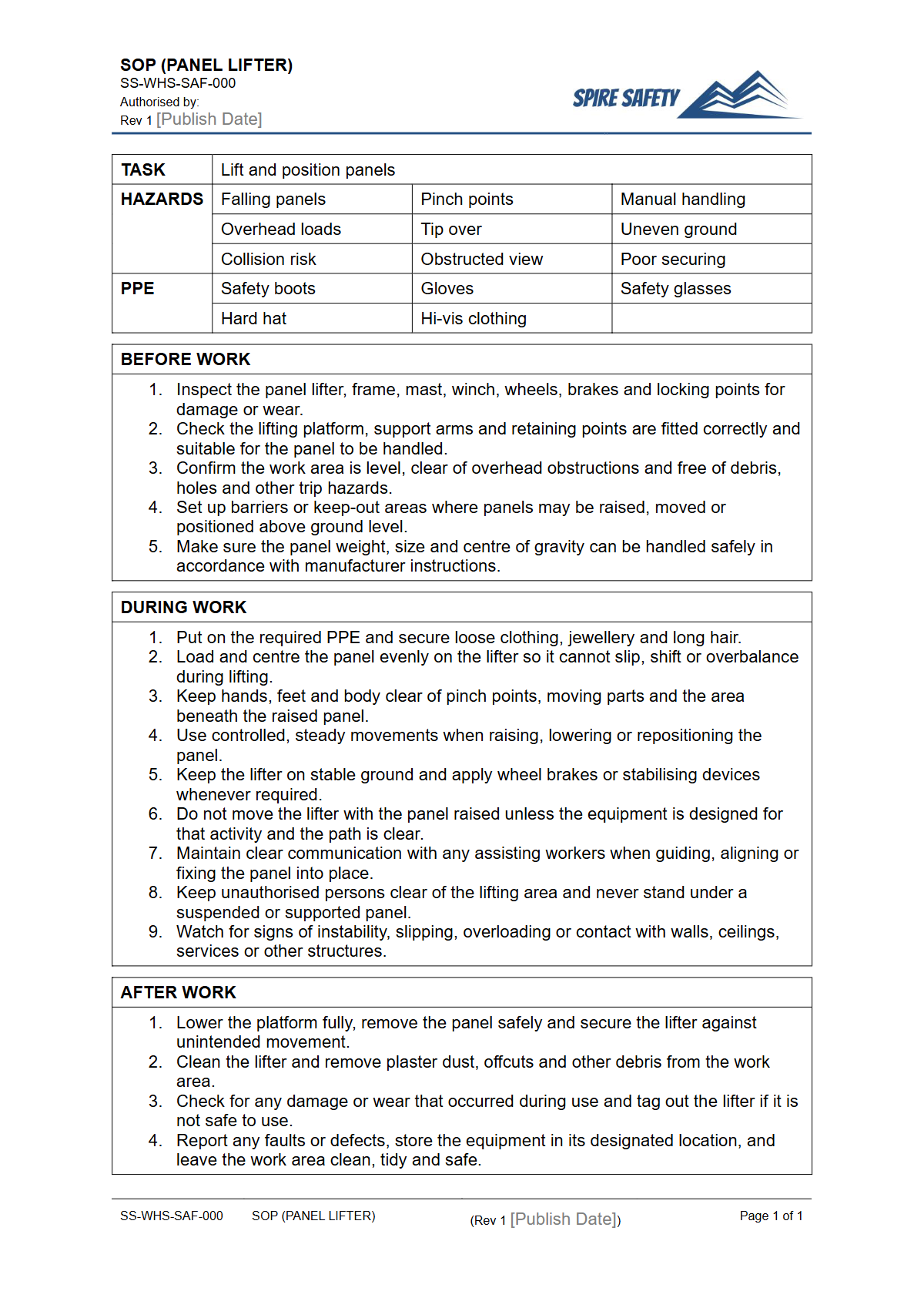
This free Safe Operating Procedure (Panel Lifter) Template provides a structured framework for documenting the required steps to safely operate a panel lifter. Using this template helps organisations systematically identify hazards, assess risks, and implement effective control measures.
A panel lifter, while simple, presents risks such as musculoskeletal injuries from awkward postures, crush injuries, and hazards associated with falling loads. Formalising the procedure ensures all operators follow a consistent, safe method of work, minimising the risk of incidents and injuries on site.
Developing clear and accessible SOPs is a fundamental component of effective WHS management systems. This document serves as a practical tool to meet your legal obligations to provide and maintain a safe system of work. It guides users through pre-operational checks, step-by-step operating instructions, and post-operational tasks, forming a critical part of your risk management documentation.
Video walkthrough
How to use the Free Safe Operating Procedure (Panel Lifter) Template
To effectively implement this procedure, begin by downloading the template in your preferred format (DOCX for easy editing or PDF). The next step is customisation, which is crucial for the document's relevance and effectiveness.
This template is a starting point, not a finished document. You must adapt its contents to reflect the specific make and model of the panel lifter used in your workplace, the types of panels being lifted (e.g., plasterboard, glass, wood), and the unique environmental conditions of your work areas.
Consultation with the workers who will be using the equipment is a mandatory part of this process. They have direct experience with the task and can provide valuable insight into the practical hazards and workable controls.
Once customised, the SOP should be used as a basis for training and competency assessment. We also offer a range of other equipment-specific templates, such as our FREE Telehandler SOP Template, that follow a similar customisation process.
When to use it
A Safe Operating Procedure for a panel lifter should be developed and implemented before any worker is permitted to operate the equipment. It forms an essential part of the induction and training process for new employees or for existing workers assigned to tasks involving panel lifters for the first time.
The SOP should be a living document, reviewed and updated regularly, especially when a new model of lifter is introduced, the task changes, or following an incident or near miss.
The SOP should also be used as a reference for regular refresher training and toolbox talks to reinforce safe work practices. Keeping the document readily accessible in the work area, either in hard copy or digitally, ensures workers can refer to it whenever they are unsure about a step.
Its use is also a key piece of evidence during any formal WHS compliance auditing activities.
Who should use it
The primary users of this SOP are the operators themselves. The document is designed to be a clear, practical guide that any trained individual can follow to perform the task safely.
It empowers workers by providing them with clear instructions on the approved method for operating the machinery, including critical safety checks and emergency responses.
Supervisors and managers also have a key role in using the SOP. They are responsible for ensuring that workers are trained in the procedure and follow it consistently.
They use the SOP as a tool for monitoring work, conducting safety observations, and investigating any deviations from the prescribed method. WHS advisors and personnel will use the document to ensure it is integrated into the broader safety framework, alongside other essential procedures like our Free Air Compressor SOP.
By establishing a clear, documented procedure, you create a consistent standard of safety across your organisation. This template is one of many resources available in our free WHS resources library, designed to support Australian businesses in building safer workplaces.
Common mistakes
Common mistakes to avoid
- Using the panel lifter on unstable or uneven ground, increasing the risk of it tipping over.
- Exceeding the manufacturer's specified load capacity, which can lead to equipment failure.
- Failing to conduct thorough pre-start visual inspections to check for damage or faults.
- Not properly securing the panel onto the lifter before moving or raising it.
Legal references
Legal considerations
The following legal requirements may be relevant to this type of work.
- Work Health and Safety Act (Harmonised) — Provides the primary duties for protecting workers and other people from work health and safety risks.
- Work Health and Safety Regulations (Harmonised) — Sets out requirements supporting the management of workplace hazards and risks.
The following codes may be relevant to this type of work.
- Managing WHS Risks Code of Practice — Provides practical guidance on identifying hazards, assessing risks and applying effective controls.
- Work Health and Safety Consultation, Cooperation and Coordination Code of Practice — Provides practical guidance on consulting workers and coordinating with other duty holders.
- Managing the Work Environment and Facilities Code of Practice — Provides practical guidance on safe work environments, workplace facilities and related controls.
Did you know
Manual Handling Risk
Musculoskeletal disorders resulting from hazardous manual tasks are a leading cause of serious workers' compensation claims in Australia. Using mechanical aids like panel lifters correctly is a key control measure to reduce this risk.
FAQ
Frequently asked questions
01What is a Safe Operating Procedure for a panel lifter?
02Who is responsible for creating a panel lifter SOP?
03Does a panel lifter require a license to operate in Australia?
04How often should a panel lifter SOP be reviewed?
Share this resource
Free Safe Operating Procedure (Panel Lifter) Template
Browse Categories
How To Use It
- 1Download and open in Word or PDF.
- 2Replace the placeholders with your business details.
- 3Get it reviewed by a WHS specialist before rollout.
Need it customised?
Our WHS consultants can adapt this template to your site, run a gap analysis, or audit what you already have in place.
Book a Free Consultation WHS consulting servicesor call 1300 156 382
Related templates
- Free Safe Operating Procedure (Panel Saw) Template
- Free Safe Operating Procedure (Panini Press) Template
- Free Safe Operating Procedure (Pantry Shelf Cleaning) Template
- Free Safe Operating Procedure (Parcel Cage Handling) Template
- Free Safe Operating Procedure (Parcel Handover) Template
- Free Safe Operating Procedure (Parcel Staging) Template