
Free Safe Operating Procedure (Paint Stripping) Template
Need a starting point for managing paint stripping hazards? Our free Safe Operating Procedure (Paint Stripping) template provides a structured format.
Free Safe Operating Procedure (Paint Stripping) Template
DOCX • 126 KB + PDF
Updated Oct 2026
No signup required
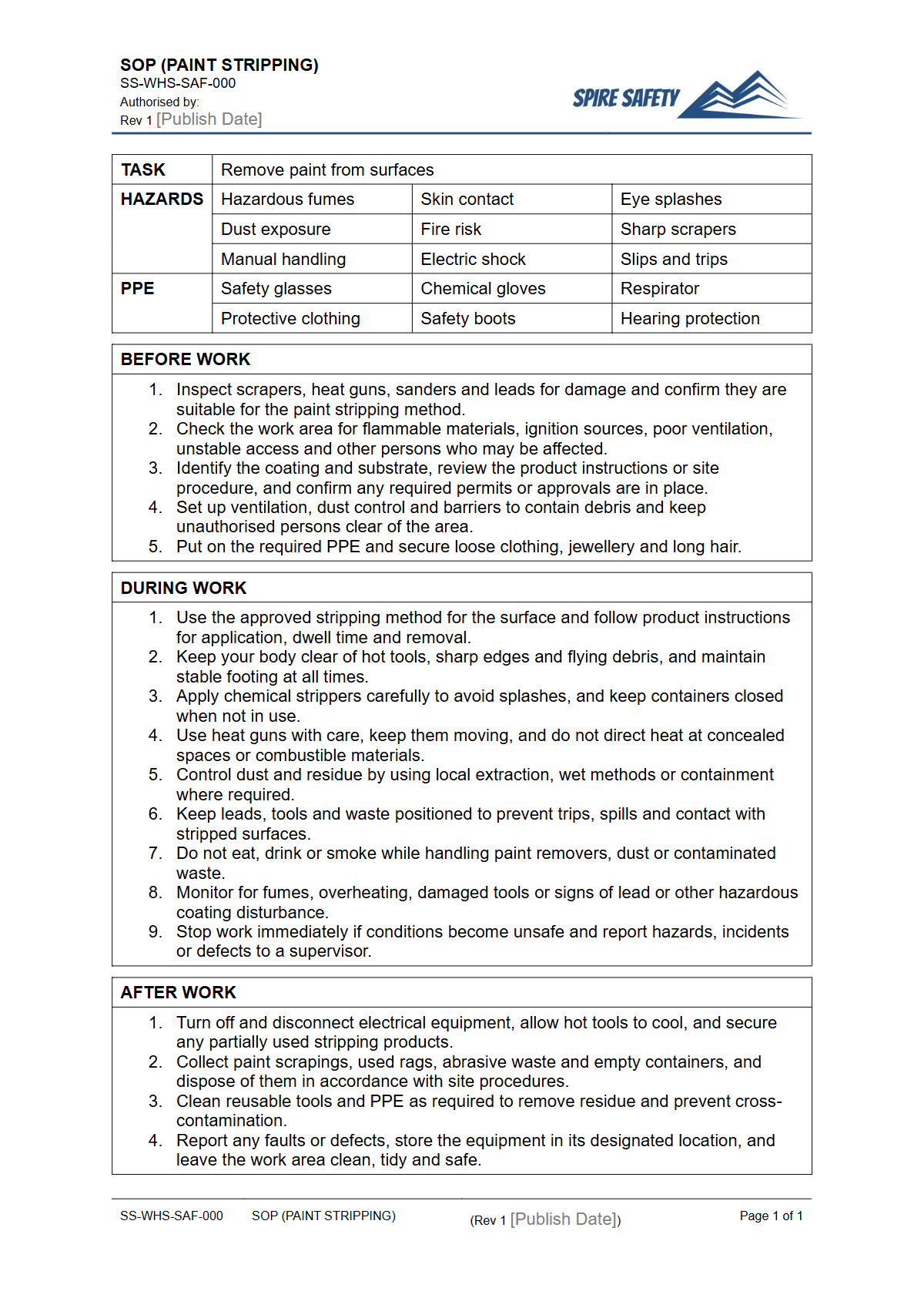
Purpose of the Free Safe Operating Procedure (Paint Stripping) Template
Paint stripping introduces significant workplace hazards, including exposure to hazardous chemicals, flammable materials, and airborne dust. This Free Safe Operating Procedure (Paint Stripping) Template provides a structured starting point for documenting the required safety controls for this high-risk task.
Using a standardised SOP helps ensure that all workers follow a consistent, safe process, assists in worker training, and demonstrates a key step in fulfilling your WHS duties.
A well-developed SOP is a critical document within your overall safety framework. It formalises the risk assessment process into a practical, step-by-step guide that minimises the chance of injury or illness.
Integrating task-specific procedures like this one is a fundamental part of building robust WHS management systems that protect your team and your business.
Video walkthrough
How to use the Free Safe Operating Procedure (Paint Stripping) Template
This template is available for immediate download in DOCX format for easy editing, as well as a reference PDF. It is designed as a foundational document that you must adapt to your specific operational context.
Important: This is a template, not a finished document. You must customise this Safe Operating Procedure to reflect the specific chemicals, tools, equipment, and environment at your workplace.
We cannot guarantee its suitability for your specific circumstances; its effectiveness depends on a thorough, site-specific risk assessment. If you require assistance, consider engaging our WHS consulting services.
To implement this SOP effectively:
- Download the DOCX file.
- Conduct a thorough risk assessment for the paint stripping tasks performed in your workplace, considering the specific surfaces, coatings, and stripping agents (chemical, thermal, or mechanical).
- Complete all sections of the template, detailing the required Personal Protective Equipment (PPE), pre-start checks, step-by-step instructions, and emergency responses.
- Consult with your workers who perform the task. Their direct experience is invaluable for creating a practical and effective procedure.
- Finalise and approve the document according to your organisation's internal processes.
- Induct and train all relevant workers on the contents of the finalised SOP before they undertake the task.
Key Elements of a Paint Stripping SOP
A comprehensive Safe Operating Procedure for paint stripping should be clear, concise, and cover all stages of the task. Our template prompts you to define:
- Required PPE: Specify the exact type of respiratory protection (e.g., P2 respirator, air-fed hood), chemical-resistant gloves, eye protection, and coveralls required for the specific stripping agent being used.
- Hazards & Risks: List all identified hazards, such as chemical burns, inhalation of volatile organic compounds (VOCs), fire and explosion risks from flammable solvents or heat guns, lead dust from old paint, and manual handling injuries.
- Pre-Operational Checks: Detail the steps to take before starting, such as ensuring ventilation systems are active and effective, checking fire extinguishers are accessible, and inspecting power tools or heat guns for damage. For other related equipment, specific SOPs are also necessary, like our Free Air Compressor SOP Template for tasks involving pneumatic tools.
- Step-by-Step Procedure: Outline the sequence of work from start to finish. This includes preparing the area, applying the stripping agent, the removal process (scraping, sanding), and cleaning the work area.
- Waste Disposal: Provide clear instructions for safely containing and disposing of chemical residues, stripped paint flakes (which may be hazardous waste), and contaminated rags.
- Emergency Procedures: Detail immediate actions in case of a chemical spill, fire, or medical emergency.
When to Use a Paint Stripping SOP
A specific, documented SOP for paint stripping should be used whenever the task is performed by workers. It is not just for complex industrial jobs; it is equally important for smaller, routine maintenance tasks.
The procedure is a vital tool for new worker inductions, refresher training, and for supervisors to monitor work practices.
Periodic reviews of the SOP are also critical. The procedure should be revisited and potentially updated whenever a new chemical or piece of equipment is introduced, or after any incident or near-miss. Regular reviews are also a core activity during formal safety evaluations, such as those conducted as part of WHS compliance auditing.
Who Should Use This Safe Operating Procedure
This SOP template is designed for use by multiple roles within an organisation:
- PCBUs (Persons Conducting a Business or Undertaking) use it to help meet their primary duty of care to ensure a safe work environment.
- Managers and Supervisors use it to direct work, train staff, and ensure safety protocols are consistently followed.
- Workers use it as a clear guide to perform their tasks safely and correctly, understanding the risks and the controls in place to protect them.
Documenting procedures for all high-risk tasks creates a library of resources that forms the backbone of your safety system. You can find more templates for other common tasks in our free WHS resources library.
Common mistakes
Common mistakes to avoid
- Using inadequate or poorly maintained ventilation, leading to high concentrations of airborne contaminants.
- Selecting the wrong type of PPE, especially gloves and respirators that are not rated for the specific chemicals being used.
- Failing to properly manage ignition sources like sparks or static electricity when using flammable solvents.
- Incorrectly disposing of hazardous waste, such as lead paint chips or chemical-soaked rags, posing an environmental risk.
Legal references
Legal considerations
The following legal requirements may be relevant to this type of work.
- Work Health and Safety Act (Harmonised) — Provides the primary duties for protecting workers and other people from work health and safety risks.
- Work Health and Safety Regulations (Harmonised) — Sets out requirements supporting the management of workplace hazards and risks.
The following codes may be relevant to this type of work.
- Managing WHS Risks Code of Practice — Provides practical guidance on identifying hazards, assessing risks and applying effective controls.
- Work Health and Safety Consultation, Cooperation and Coordination Code of Practice — Provides practical guidance on consulting workers and coordinating with other duty holders.
- Managing the Work Environment and Facilities Code of Practice — Provides practical guidance on safe work environments, workplace facilities and related controls.
Did you know
A Phased-Out Chemical
Methylene chloride, once a common and highly effective paint stripper, has been largely phased out or heavily restricted in many regions due to its significant health risks, including being a potential carcinogen.
FAQ
Frequently asked questions
01What are the main hazards of paint stripping?
02Is a Safe Operating Procedure legally required for paint stripping in Australia?
03What PPE is typically needed for paint stripping?
04What's the difference between chemical and mechanical paint stripping?
Share this resource
Free Safe Operating Procedure (Paint Stripping) Template
Browse Categories
How To Use It
- 1Download and open in Word or PDF.
- 2Replace the placeholders with your business details.
- 3Get it reviewed by a WHS specialist before rollout.
Need it customised?
Our WHS consultants can adapt this template to your site, run a gap analysis, or audit what you already have in place.
Book a Free Consultation WHS consulting servicesor call 1300 156 382
Related templates
- Free Safe Operating Procedure (Paintless Dent Repair) Template
- Free Safe Operating Procedure (Pallet Cage) Template
- Free Safe Operating Procedure (Pallet Exchange) Template
- Free Safe Operating Procedure (Pallet Racking Access) Template
- Free Safe Operating Procedure (Palletiser) Template
- Free Safe Operating Procedure (Panel Beating) Template