
Free Safe Operating Procedure (Pallet Cage) Template
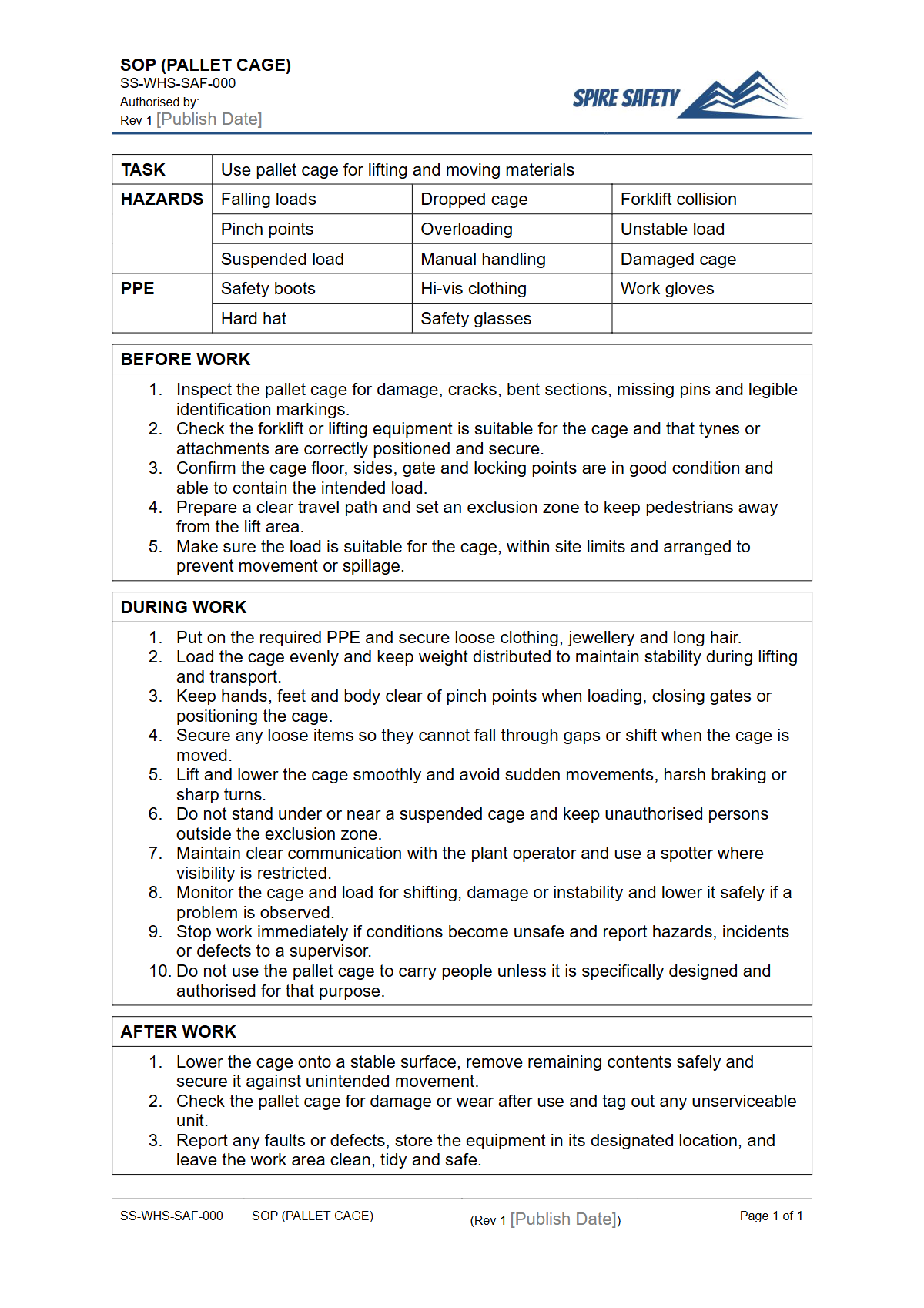
Download our free Safe Operating Procedure (Pallet Cage) Template. This customisable DOCX and PDF helps you document safe work methods for your team.
Free Safe Operating Procedure (Pallet Cage) Template
DOCX • 126 KB + PDF
Updated Oct 2026
No signup required
Purpose of the Free Safe Operating Procedure (Pallet Cage) Template
Streamline your safety protocols for material handling with our Free Safe Operating Procedure (Pallet Cage) Template. This resource provides a structured framework for documenting the step-by-step process of using pallet cages safely, helping to mitigate risks like falling objects, equipment instability, and manual handling injuries. Using a standardised SOP ensures that all workers follow a consistent, pre-approved method, reducing guesswork and the likelihood of incidents.
The primary purpose of this Safe Operating Procedure is to help your organisation control risks associated with lifting and moving goods in a cage. Pallet cages, when used incorrectly, can introduce serious hazards.
This template guides you in outlining critical safety controls, from pre-operational checks to correct loading and attachment techniques. Formalising these processes is a key part of developing robust WHS management systems that protect your workers and support your compliance obligations.
Video walkthrough
How to use the Free Safe Operating Procedure (Pallet Cage) Template
This Safe Operating Procedure template is provided in both DOCX and PDF formats. Download the DOCX file to edit and tailor the content directly to your workplace needs, or use the PDF for easy printing and distribution.
It is structured to align with Australian WHS best practices and provides a solid foundation for your site-specific safety documentation.
Important: This document is a template and must be customised for your business. We have created it as a starting point.
You must consult with your workers and other relevant parties to ensure the final SOP reflects the specific pallet cages in use, the lifting equipment (e.g., forklifts, telehandlers), the tasks performed, and the unique environmental conditions of your workplace. An SOP for a small warehouse will differ from one used on a large construction site.
Key Sections to Customise
- Pre-Operational Checks: Detail the specific inspection points for your pallet cages, such as checking for cracks in welds, damaged mesh, bent frames, and ensuring gate latches function correctly.
- Attachment Procedure: Outline the precise steps for safely securing the cage to the tines of a forklift or the attachment point of another lifting machine. Using a pallet cage is often combined with other equipment, so procedures must be integrated, much like the steps outlined in our FREE Telehandler SOP Template.
- Loading and Unloading: Specify rules for packing the cage, including distributing weight evenly, not exceeding the Safe Working Load (SWL), and ensuring no items protrude through the mesh. The flow of goods from a loading area often involves other equipment, and a FREE Conveyer System SOP Template can help standardise that part of the process.
- Emergency Procedures: Clearly state the actions to take in case of an emergency, such as a shifted load, equipment malfunction, or damage to the pallet cage during operation.
When to use a Pallet Cage Safe Operating Procedure
A Safe Operating Procedure for pallet cages should be used as a primary training document for new and existing workers. It should be readily available at the point of work for easy reference.
The SOP is a critical tool during worker inductions, pre-start meetings, and whenever a risk assessment identifies the use of pallet cages as a hazardous task. It serves as the benchmark for correct performance, ensuring every operator understands the established safe method before they begin work.
This is similar to how operators should be familiar with a FREE Pallet Jack SOP (Safe Operating Procedure) Template before using that equipment.
Who should use it
This Safe Operating Procedure should be used by several key roles within an organisation:
- Operators: Workers who physically attach, load, and move pallet cages must be trained on the SOP and follow it precisely.
- Supervisors: Line managers and supervisors are responsible for ensuring operators are trained and that the procedures outlined in the SOP are being followed consistently. They use it as a tool for monitoring and correcting work practices.
- WHS Managers and Personnel: Safety professionals use the SOP as a formal part of the overall safety management system. They are typically responsible for drafting, reviewing, and updating the document in consultation with workers. The effectiveness of these procedures can be verified through a systematic WHS compliance audit.
By implementing a clear, well-defined SOP, your organisation can significantly improve safety outcomes when handling materials with pallet cages. For more downloadable safety documents, you can browse our complete free WHS resources library.
Common mistakes
Common mistakes to avoid
- Overloading the cage beyond its stated Safe Working Load (SWL).
- Using a damaged cage with bent frames, broken welds, or faulty latches.
- Failing to properly secure the cage to the forklift tines.
- Stacking goods unstably or allowing them to protrude from the sides.
Legal references
Legal considerations
The following legal requirements may be relevant to this type of work.
- Work Health and Safety Act (Harmonised) — Provides the primary duties for protecting workers and other people from work health and safety risks.
- Work Health and Safety Regulations (Harmonised) — Sets out requirements supporting the management of workplace hazards and risks.
The following codes may be relevant to this type of work.
- Managing WHS Risks Code of Practice — Provides practical guidance on identifying hazards, assessing risks and applying effective controls.
- Work Health and Safety Consultation, Cooperation and Coordination Code of Practice — Provides practical guidance on consulting workers and coordinating with other duty holders.
- Managing the Work Environment and Facilities Code of Practice — Provides practical guidance on safe work environments, workplace facilities and related controls.
Did you know
Attachment Matters
Most pallet cage incidents occur not from cage failure, but from improper attachment to the forklift. If the cage is not securely fitted with the correct retaining pins or locking mechanism, it can easily slide off the tines during movement or tilting.
FAQ
Frequently asked questions
01Can a pallet cage be used to lift people?
02What is the Safe Working Load (SWL) of a pallet cage?
03Do I need a specific licence to use a pallet cage with a forklift?
04How often should pallet cages be inspected?
Share this resource
Free Safe Operating Procedure (Pallet Cage) Template
Browse Categories
How To Use It
- 1Download and open in Word or PDF.
- 2Replace the placeholders with your business details.
- 3Get it reviewed by a WHS specialist before rollout.
Need it customised?
Our WHS consultants can adapt this template to your site, run a gap analysis, or audit what you already have in place.
Book a Free Consultation WHS consulting servicesor call 1300 156 382
Related templates
- Free Safe Operating Procedure (Pallet Exchange) Template
- Free Safe Operating Procedure (Pallet Racking Access) Template
- Free Safe Operating Procedure (Palletiser) Template
- Free Safe Operating Procedure (Panel Beating) Template
- Free Safe Operating Procedure (Panel Lifter) Template
- Free Safe Operating Procedure (Panel Saw) Template