
Free Safe Operating Procedure (Paintless Dent Repair) Template
Streamline your workshop safety with our free Safe Operating Procedure (Paintless Dent Repair) template. Download the customisable DOCX to get started.
Free Safe Operating Procedure (Paintless Dent Repair) Template
DOCX • 126 KB + PDF
Updated Oct 2026
No signup required
Purpose of the Free Safe Operating Procedure (Paintless Dent Repair) Template
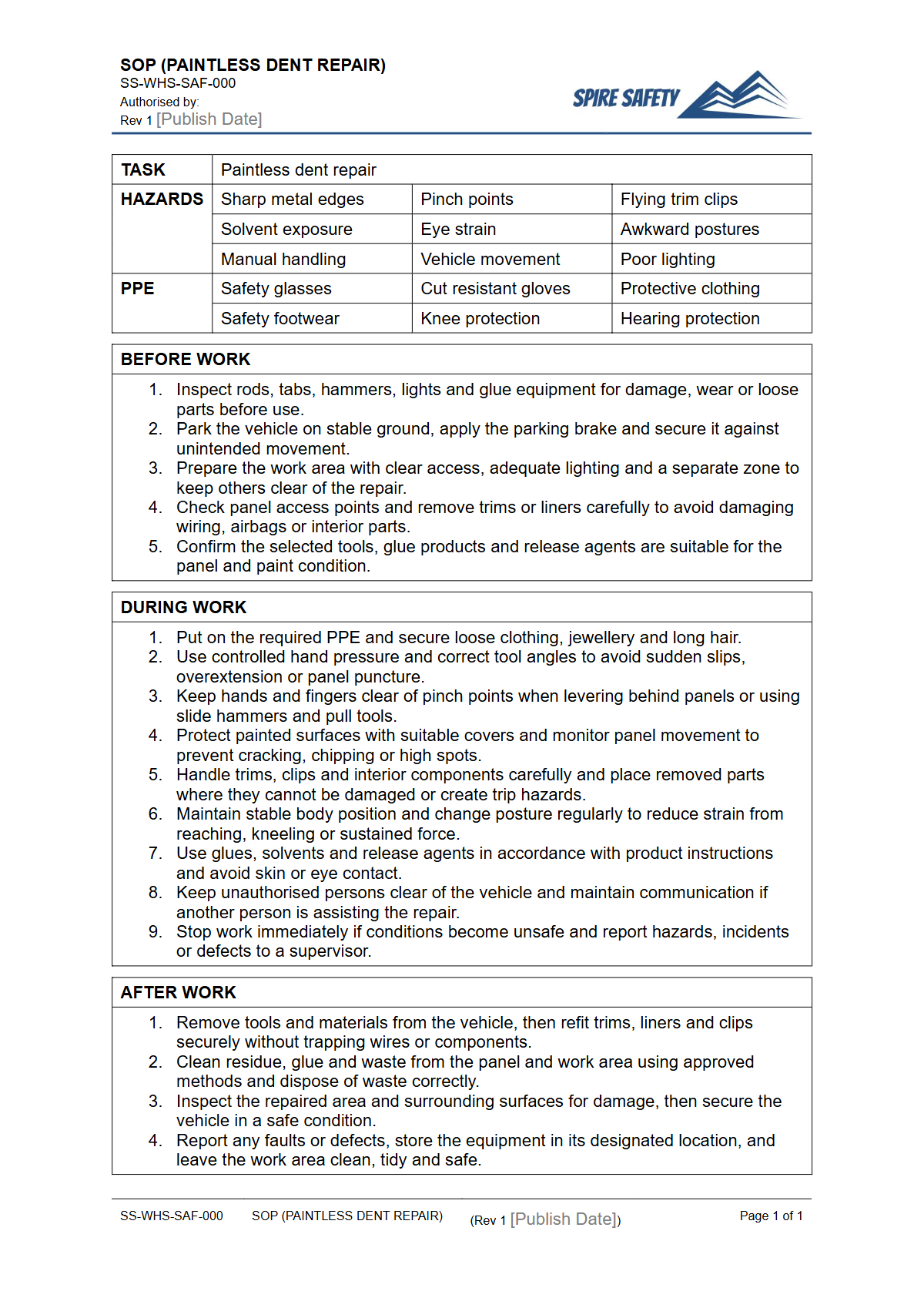
Paintless Dent Repair (PDR) is a skilled trade that, like any workshop task, carries inherent risks. This free Safe Operating Procedure (Paintless Dent Repair) template provides a structured framework for documenting the safest way to perform PDR tasks in your workplace.
A well-developed SOP is a critical tool for standardising procedures, training staff, and demonstrating a commitment to health and safety. It helps control hazards associated with PDR, such as ergonomic strain from awkward postures, eye strain from focused lighting, and manual handling risks.
By clearly outlining the steps, required personal protective equipment (PPE), and safety checks, an SOP helps minimise the chance of injury and ensures work is performed consistently and safely. Integrating task-specific SOPs like this one is a fundamental part of building a comprehensive WHS management system that protects both your workers and your business.
Video walkthrough
How to use the Free Safe Operating Procedure (Paintless Dent Repair) Template
This document is provided in both DOCX and PDF formats. Download the DOCX file to edit and adapt it to your specific operational needs.
Your finished SOP should accurately reflect the unique tools, equipment, environment, and processes used in your workshop. A generic procedure is not effective; customisation is essential for it to be a meaningful safety tool.
Important: It's crucial to remember that this is a template, not a finished document. We have designed it as a starting point, and you must adapt its contents to reflect the specific equipment, chemicals, processes, and environment of your workplace.
Involve the technicians who actually perform the work in the customisation process to ensure the SOP is practical and accurate. Your workshop might have other documented procedures for different equipment, such as our free Air Compressor SOP template, and this PDR guide should complement them.
What's Included in Your PDR SOP Template?
Our template is structured to guide you through documenting all critical safety aspects of the PDR process. It includes sections for:
- Required Personal Protective Equipment (PPE): Specify items like safety glasses and appropriate gloves.
- Pre-Operational Checks: Detail inspections for tools, lighting, and the work area before a job begins.
- Step-by-Step Procedure: Outline the core tasks from assessing the dent and selecting tools to performing the repair and final checks.
- Post-Operational Tasks: Cover procedures for tool cleaning, storage, and worksite cleanup.
- Potential Hazards and Control Measures: A dedicated section to list risks and how you manage them.
Documenting a manual, tool-based task requires attention to detail. Just as you would for a high-risk power tool using a circular saw SOP, a specific procedure for PDR is essential for managing more subtle ergonomic and process-related risks.
Key Hazards in Paintless Dent Repair
While PDR avoids paints and solvents, it introduces other risks that must be managed. Your SOP should address:
- Ergonomic Hazards: Technicians often work in sustained, awkward postures (bending, kneeling, reaching) which can lead to musculoskeletal disorders (MSDs). The SOP should encourage posture variation, stretching, and use of ergonomic aids where possible.
- Lighting and Vision: The specialised, high-intensity lights used to read dents can cause eye strain or fatigue. The procedure should include guidance on light positioning and taking regular breaks.
- Tool-Related Injuries: PDR tools are often sharp or pointed. Slips can lead to puncture wounds or impact injuries. Proper tool handling and maintenance are key controls.
- Slips, Trips, and Falls: General workshop hazards like cables, tools left on the floor, and uneven surfaces are always a concern. Good housekeeping practices should be a core part of the procedure.
If you are unsure how to adequately assess or control these risks, seeking expert WHS consulting can provide clarity and ensure your control measures are effective and proportionate to the risk.
When to Use This Safe Operating Procedure
An SOP is not a 'set and forget' document. It should be used as a primary reference document during several key activities:
- Training and Induction: For new technicians learning the PDR process or for experienced workers new to your workshop.
- Refresher Training: As part of regular toolbox talks or scheduled safety training to reinforce correct procedures.
- Pre-Work Reference: A quick review before undertaking a non-routine or complex repair.
- Incident Investigation: To determine if a deviation from the established safe procedure contributed to a near-miss or injury.
- Audits and Reviews: The SOP should be reviewed periodically (e.g., annually) or whenever a process changes. This review is a key part of regular WHS compliance auditing.
Who Should Use This SOP?
Responsibility for the SOP is shared. Workshop Managers or Supervisors are responsible for ensuring the SOP is developed, customised, and implemented.
They must ensure workers are trained on its contents and that the prescribed controls are available and used. PDR Technicians and other workers are responsible for following the procedure, using the provided PPE and controls, and reporting any hazards or issues they encounter.
This collaborative approach ensures the SOP remains a living, effective document. For more guidance and templates, explore our complete library of free WHS resources.
Common mistakes
Common mistakes to avoid
- Using the downloaded template without customising it for your specific tools and workshop environment.
- Failing to involve the technicians who perform the work in the drafting and review process.
- Not providing adequate training to ensure all workers understand and follow the documented procedure.
- Forgetting to review and update the SOP after an incident, or when new tools or techniques are introduced.
Legal references
Legal considerations
The following legal requirements may be relevant to this type of work.
- Work Health and Safety Act (Harmonised) — Provides the primary duties for protecting workers and other people from work health and safety risks.
- Work Health and Safety Regulations (Harmonised) — Sets out requirements supporting the management of workplace hazards and risks.
The following codes may be relevant to this type of work.
- Managing WHS Risks Code of Practice — Provides practical guidance on identifying hazards, assessing risks and applying effective controls.
- Work Health and Safety Consultation, Cooperation and Coordination Code of Practice — Provides practical guidance on consulting workers and coordinating with other duty holders.
- Managing the Work Environment and Facilities Code of Practice — Provides practical guidance on safe work environments, workplace facilities and related controls.
Did you know
A Precise Origin
Paintless Dent Repair was invented by Oskar Flaig, a Mercedes-Benz employee, in 1960. He used a hammer handle to push out a small dent from a show car, developing the technique to avoid costly repainting for minor cosmetic damage.
Ergonomic Risk
Musculoskeletal disorders (MSDs), often caused by poor ergonomics, are one of the most common types of work-related injuries in the vehicle repair and maintenance industry in Australia.
FAQ
Frequently asked questions
01What is a Safe Operating Procedure for Paintless Dent Repair?
02Why is an SOP important for paintless dent repair?
03Do I need to train my staff on this PDR SOP?
04Can I use this template for other auto body repairs?
Share this resource
Free Safe Operating Procedure (Paintless Dent Repair) Template
Browse Categories
How To Use It
- 1Download and open in Word or PDF.
- 2Replace the placeholders with your business details.
- 3Get it reviewed by a WHS specialist before rollout.
Need it customised?
Our WHS consultants can adapt this template to your site, run a gap analysis, or audit what you already have in place.
Book a Free Consultation WHS consulting servicesor call 1300 156 382
Related templates
- Free Safe Operating Procedure (Pallet Cage) Template
- Free Safe Operating Procedure (Pallet Exchange) Template
- Free Safe Operating Procedure (Pallet Racking Access) Template
- Free Safe Operating Procedure (Palletiser) Template
- Free Safe Operating Procedure (Panel Beating) Template
- Free Safe Operating Procedure (Panel Lifter) Template