
Free Safe Operating Procedure (Paddock Weed Removal) Template
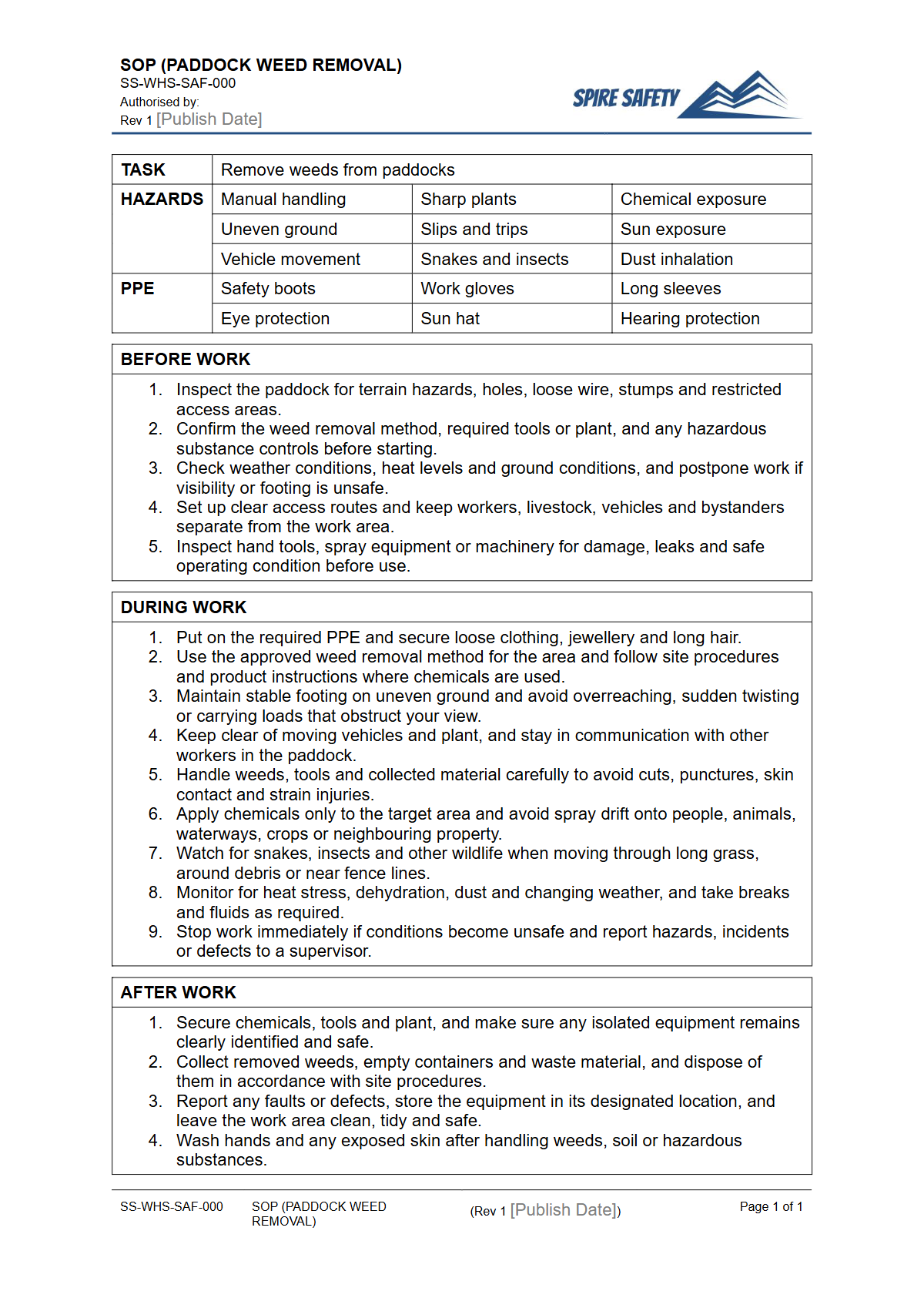
Effectively manage the risks associated with paddock weed removal using our customisable template. Download your free Safe Operating Procedure to start today.
Free Safe Operating Procedure (Paddock Weed Removal) Template
DOCX • 126 KB + PDF
Updated Oct 2026
No signup required
Purpose of the Free Safe Operating Procedure (Paddock Weed Removal) Template
Paddock weed removal is a common but hazardous task in Australian agriculture. This Free Safe Operating Procedure (Paddock Weed Removal) Template provides a structured framework to help persons conducting a business or undertaking (PCBUs) document a safe system of work.
It guides you in identifying hazards and implementing control measures for activities ranging from manual pulling and chipping to the application of herbicides. A documented SOP is a critical tool for ensuring tasks are performed consistently and safely, helping to meet your duty of care obligations.
The procedure helps address common risks such as musculoskeletal injuries from manual tasks, exposure to hazardous chemicals, and incidents involving machinery. It also prompts consideration of environmental hazards like sun exposure, heat stress, and encounters with venomous snakes or insects.
By standardising your approach, you create a safer working environment for all personnel involved in ground maintenance and agricultural operations. A well-developed SOP forms a vital component of your overall WHS management system.
Video walkthrough
How to use the Free Safe Operating Procedure (Paddock Weed Removal) Template
This document is a starting point, not a finished product. It must be adapted to suit the specific context of your workplace, including the types of weeds, the terrain, the equipment used, and the chemicals applied.
Effective customisation is essential for managing your unique risks.
Follow these steps to implement the Safe Operating Procedure effectively:
- Download the DOCX file and open it on your computer.
- Consult with the workers who will be performing the weed removal tasks. Their practical experience is invaluable for identifying all relevant hazards.
- Carefully review each section and fill in the details specific to your site. This includes listing the exact Personal Protective Equipment (PPE), tools, equipment (like quad bikes or spray units), and emergency procedures.
- If your operations involve other heavy equipment, you might also require our free Spreader SOP template for herbicide application.
- Ensure the procedure is reviewed and approved by a competent person, such as a farm manager or WHS officer.
- Use the finalised SOP as a basis for training and inducting workers before they undertake the task.
Please note: We've created this template as a starting point. You must customise it to reflect the specific equipment, chemicals, environment, and processes used in your workplace.
This process of consultation and customisation is a key part of your legal safety obligations.
When to use a Safe Operating Procedure
A Safe Operating Procedure for paddock weed removal should be used as a primary reference document for the task. It should be readily accessible to all workers involved.
Use it during worker training, inductions for new staff or contractors, and as a checklist before work begins. This SOP should also be referenced during regular safety talks or toolbox meetings to reinforce safe work practices.
For similar agricultural tasks, you may find our free Planter SOP template useful.
Furthermore, the SOP serves as a critical document following a near miss or incident. It should be reviewed as part of the investigation process to determine if the documented procedure was followed and whether it needs to be updated to prevent a recurrence.
Regular reviews, ideally annually, ensure the procedure remains current with any changes in equipment, chemicals, or work methods. If you require expert assistance in reviewing your safety documentation, consider our WHS consulting services.
Who should use this template
This template is designed for anyone responsible for health and safety in an agricultural or rural setting. This includes:
- Farm Owners and Managers
- Property Managers and Landholders
- Team Leaders and Supervisors
- Work Health and Safety (WHS) Officers and Advisors
- Workers and contractors who perform weed removal tasks
It provides a clear and organised format that helps supervisors ensure workers are properly instructed, while empowering workers to understand the risks and safety controls associated with their job. For other common farm machinery, you can explore resources like our free Grain Drill SOP template to build a comprehensive safety library.
If you're looking to build a more extensive collection of safety documents, you can browse our entire free WHS resources library for a wide range of templates and guides.
Common mistakes
Common mistakes to avoid
- Forgetting to check the Safety Data Sheet (SDS) for any chemicals used.
- Failing to wear the correct Personal Protective Equipment (PPE) for the task.
- Not considering environmental factors like heat stress, UV exposure, or wildlife (snakes, insects).
- Using a generic SOP without customising it for site-specific hazards and equipment.
Legal references
Legal considerations
The following legal requirements may be relevant to this type of work.
- Work Health and Safety Act (Harmonised) — Provides the primary duties for protecting workers and other people from work health and safety risks.
- Work Health and Safety Regulations (Harmonised) — Sets out requirements supporting the management of workplace hazards and risks.
The following codes may be relevant to this type of work.
- Managing WHS Risks Code of Practice — Provides practical guidance on identifying hazards, assessing risks and applying effective controls.
- Work Health and Safety Consultation, Cooperation and Coordination Code of Practice — Provides practical guidance on consulting workers and coordinating with other duty holders.
- Managing the Work Environment and Facilities Code of Practice — Provides practical guidance on safe work environments, workplace facilities and related controls.
Did you know
Herbicide Resistance
Over-reliance on a single herbicide type can lead to herbicide-resistant weeds, a major challenge in Australian agriculture that requires integrated weed management strategies.
Manual Task Injuries
Musculoskeletal injuries from manual tasks like pulling weeds or carrying equipment are among the most common injuries in agriculture. Proper technique and task rotation are key preventative measures.
FAQ
Frequently asked questions
01What is a Safe Operating Procedure (SOP) for?
02Do I need a separate SOP for manual vs. chemical weed removal?
03How often should we review this Paddock Weed Removal SOP?
04Is this template enough for WHS compliance?
Share this resource
Free Safe Operating Procedure (Paddock Weed Removal) Template
Browse Categories
How To Use It
- 1Download and open in Word or PDF.
- 2Replace the placeholders with your business details.
- 3Get it reviewed by a WHS specialist before rollout.
Need it customised?
Our WHS consultants can adapt this template to your site, run a gap analysis, or audit what you already have in place.
Book a Free Consultation WHS consulting servicesor call 1300 156 382
Related templates
- Free Safe Operating Procedure (Paint Booth Operation) Template
- Free Safe Operating Procedure (Paint Mixing) Template
- Free Safe Operating Procedure (Paint Stripping) Template
- Free Safe Operating Procedure (Paintless Dent Repair) Template
- Free Safe Operating Procedure (Pallet Cage) Template
- Free Safe Operating Procedure (Pallet Exchange) Template