
Free Safe Operating Procedure (Paint Booth Operation) Template
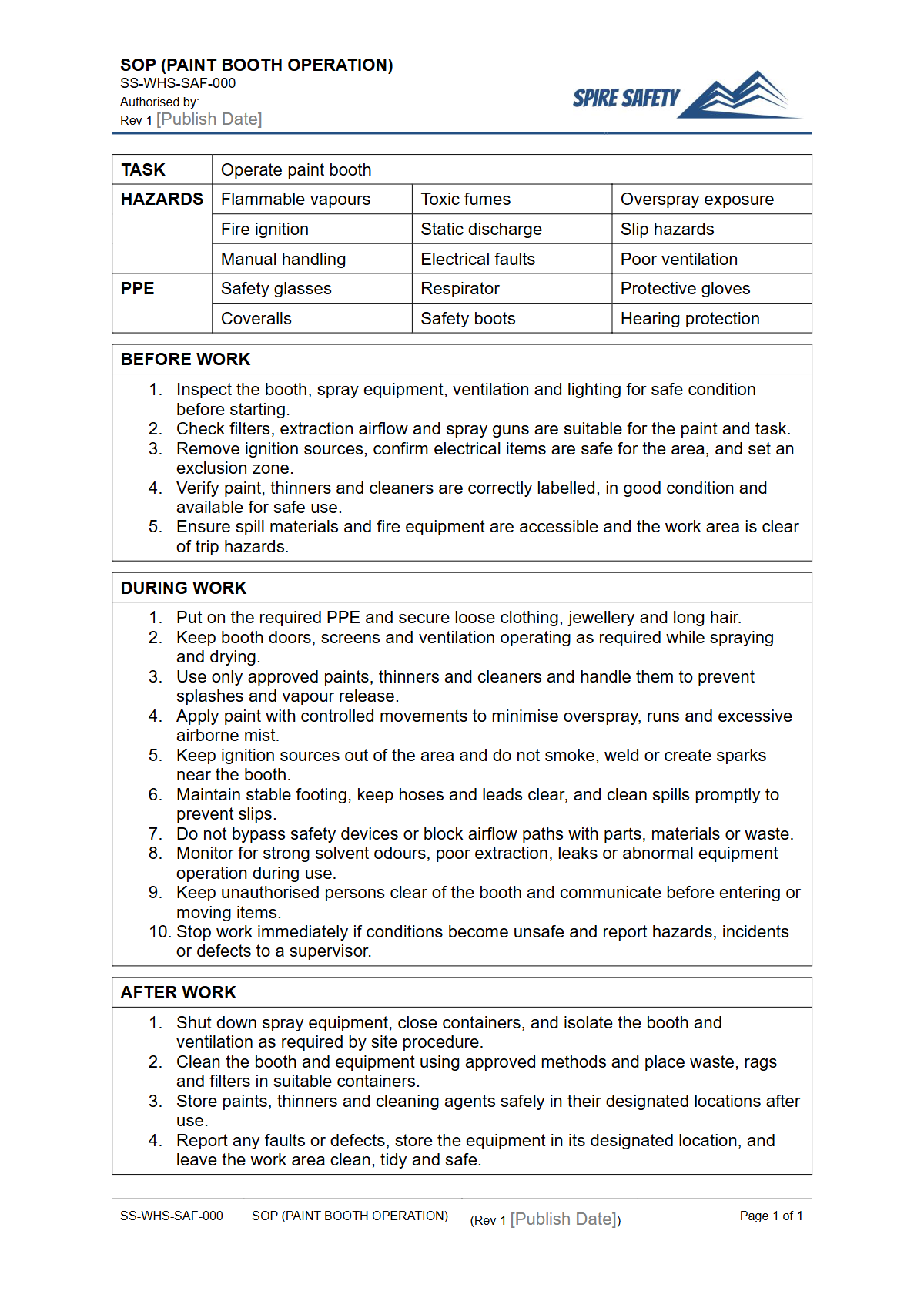
Clearly define the steps for safely operating a paint booth with our customisable template. Download your free Safe Operating Procedure to get started.
Free Safe Operating Procedure (Paint Booth Operation) Template
DOCX • 126 KB + PDF
Updated Oct 2026
No signup required
Purpose of the Free Safe Operating Procedure (Paint Booth Operation) Template
Operating a paint spray booth involves significant risks, including exposure to hazardous chemicals, fire, and explosion. This Free Safe Operating Procedure (Paint Booth Operation) Template provides a structured framework for documenting the essential steps to control these hazards and ensure worker safety.
A documented SOP is a critical tool for standardising work practices, preventing incidents, and demonstrating due diligence. It helps formalise procedures for everything from pre-start checks and correct PPE selection to shutdown and emergency response, forming a key part of your safety management system.
This Safe Operating Procedure (SOP) helps your organisation define and communicate the expected safe behaviour for all personnel involved in spray painting tasks. By implementing a clear procedure, you reduce the likelihood of errors that could lead to serious injury or ill health.
It also provides a consistent basis for training new operators and conducting refresher courses for experienced staff. The process often involves other equipment, so it's wise to ensure you also have an effective Air Compressor SOP in place.
Video walkthrough
How to use the Free Safe Operating Procedure (Paint Booth Operation) Template
This document is a downloadable template in both DOCX and PDF formats, designed as a solid starting point. It is not a complete, ready-to-use document.
You must systematically work through each section and adapt it to the specific context of your workplace. This involves identifying the make and model of your paint booth, the specific paints and chemicals used (including reviewing their Safety Data Sheets), and the unique environmental factors of your site.
Customisation is Essential
Please note: this is a template that we have developed as a starting point. It must be customised to the specific paint booth models, chemicals, and processes used in your workplace. We strongly recommend a consultation process involving the workers who operate the equipment and their supervisors to ensure the final SOP is practical, accurate, and effective. The goal is to create a document that becomes a reliable reference for daily operations, not just a file on a server. Integrating this process is a key function of building robust WHS management systems.
Key Hazards in Paint Booth Operation
A thorough risk assessment should inform the contents of your final SOP. Key hazards to consider and control include:
- Chemical Exposure: Inhalation and skin contact with isocyanates, solvents, and other volatile organic compounds (VOCs) can cause serious health effects, including occupational asthma, dermatitis, and long-term organ damage.
- Fire and Explosion: The atomised mist of flammable paints and the build-up of solvent vapours create a highly combustible atmosphere. Ignition sources like static electricity, non-compliant electrical fittings, or smoking must be strictly controlled.
- Air Quality and Ventilation: Inadequate ventilation can lead to a hazardous build-up of toxic and flammable vapours. The extraction system is a critical control that must be tested and maintained regularly.
- Confined Space Risks: Depending on their design and accessibility, some paint booths may be classified as confined spaces, requiring specific entry permits and rescue plans.
When to use this Safe Operating Procedure
An SOP for paint booth operation is not a one-time document. It should be actively used in day-to-day operations to reinforce safe work habits.
Key times to use the SOP include during worker inductions and job-specific training, as a pre-start checklist before commencing any spray painting task, and for periodic safety observations or refresher training. It also serves as a critical piece of evidence during internal or external WHS compliance audits to demonstrate that risks are being managed systematically.
Who should use it
This SOP should be readily accessible and understood by everyone involved with the paint booth. This includes:
- Operators: The primary users, including painters, panel beaters, and apprentices who perform the spray painting.
- Supervisors and Managers: To oversee work, enforce safety standards, and conduct safety checks.
- WHS/HSE Personnel: For developing training materials, conducting risk assessments, and auditing compliance.
- Maintenance Staff: To understand the safety requirements before undertaking maintenance or cleaning of the booth and its components.
A comprehensive safety program ensures that documented procedures exist for all key tasks. Just as you would require a specific procedure for high-risk plant like a circular saw, the paint booth demands its own detailed SOP. For more templates and safety guides, you can explore our complete free WHS resources library.
Common mistakes
Common mistakes to avoid
- Using incorrect or poorly fitted respiratory protection for the specific chemicals being sprayed.
- Failing to properly ground the workpiece and spray equipment, creating a static electricity ignition risk.
- Spraying with extraction fans turned off, malfunctioning, or clogged with overspray.
- Storing excessive quantities of flammable paints and thinners inside the booth during operation.
Legal references
Legal considerations
The following legal requirements may be relevant to this type of work.
- Work Health and Safety Act (Harmonised) — Provides the primary duties for protecting workers and other people from work health and safety risks.
- Work Health and Safety Regulations (Harmonised) — Sets out requirements supporting the management of workplace hazards and risks.
The following codes may be relevant to this type of work.
- Managing WHS Risks Code of Practice — Provides practical guidance on identifying hazards, assessing risks and applying effective controls.
- Work Health and Safety Consultation, Cooperation and Coordination Code of Practice — Provides practical guidance on consulting workers and coordinating with other duty holders.
- Managing the Work Environment and Facilities Code of Practice — Provides practical guidance on safe work environments, workplace facilities and related controls.
Did you know
Isocyanate Hazard
Isocyanates, commonly found in two-pack polyurethane paints, are a leading cause of occupational asthma in Australia. Correct use of air-fed respiratory protection is a critical control.
Ventilation's Dual Role
Paint booth ventilation systems are engineered not only to provide breathable air but also to keep the concentration of flammable vapours below their Lower Explosive Limit (LEL), preventing explosions.
FAQ
Frequently asked questions
01What PPE is required for operating a paint booth?
02How often should a paint booth Safe Operating Procedure be reviewed?
03Are paint booths in Australia considered confined spaces?
04What are the main fire risks in a spray booth?
Share this resource
Free Safe Operating Procedure (Paint Booth Operation) Template
Browse Categories
How To Use It
- 1Download and open in Word or PDF.
- 2Replace the placeholders with your business details.
- 3Get it reviewed by a WHS specialist before rollout.
Need it customised?
Our WHS consultants can adapt this template to your site, run a gap analysis, or audit what you already have in place.
Book a Free Consultation WHS consulting servicesor call 1300 156 382
Related templates
- Free Safe Operating Procedure (Paint Mixing) Template
- Free Safe Operating Procedure (Paint Stripping) Template
- Free Safe Operating Procedure (Paintless Dent Repair) Template
- Free Safe Operating Procedure (Pallet Cage) Template
- Free Safe Operating Procedure (Pallet Exchange) Template
- Free Safe Operating Procedure (Pallet Racking Access) Template