
Free Safe Operating Procedure (Package Label Check) Template
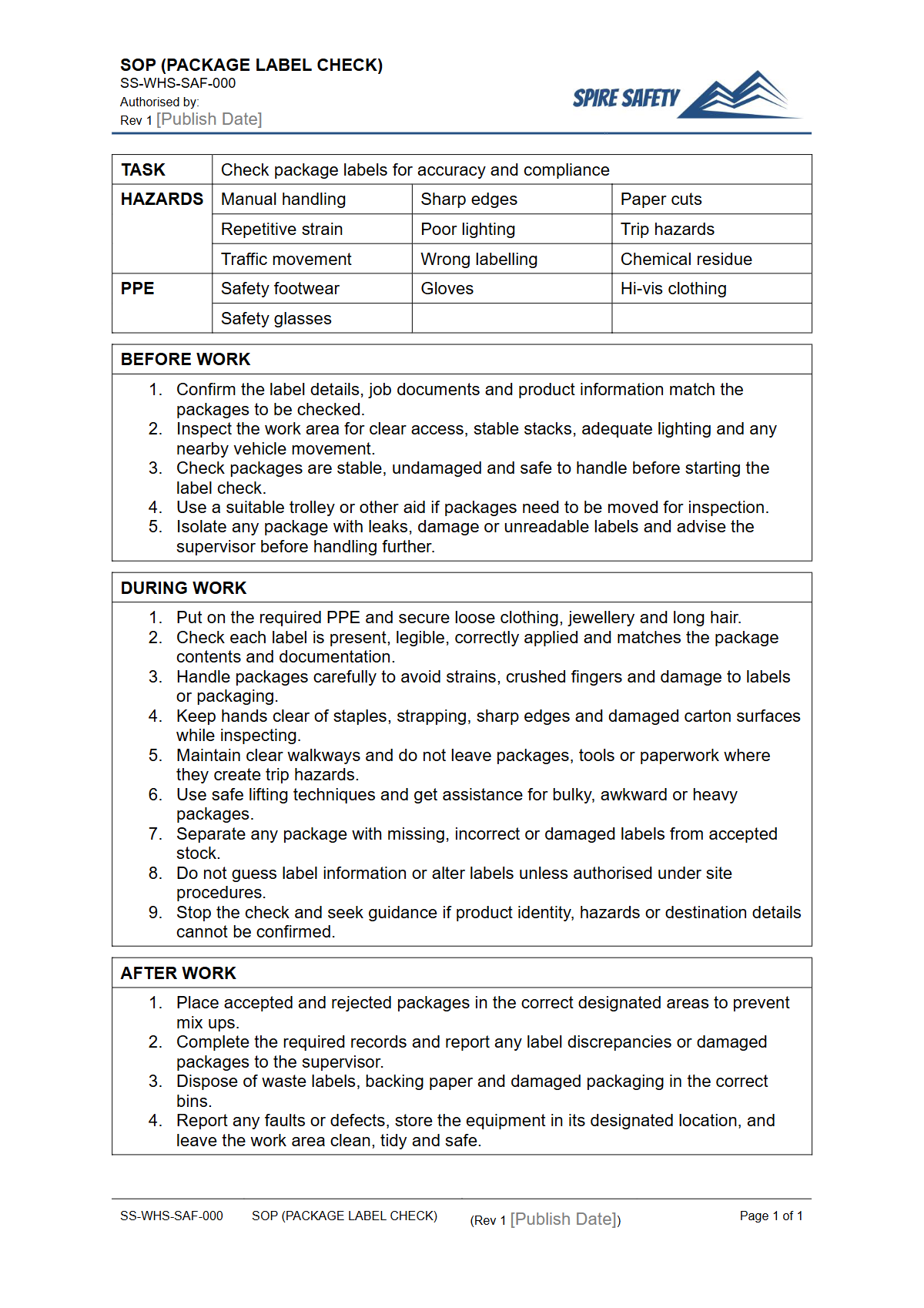
Download our free Safe Operating Procedure (Package Label Check) template. This customisable DOCX and PDF helps formalise your package labelling protocols.
Free Safe Operating Procedure (Package Label Check) Template
DOCX • 126 KB + PDF
Updated Oct 2026
No signup required
Purpose of the Free Safe Operating Procedure (Package Label Check) Template
Incorrectly labelled packages can cause significant disruptions in any logistics, warehousing, or manufacturing environment. This can lead to lost stock, delayed shipments, customer dissatisfaction, and serious safety incidents, especially when hazardous materials are involved.
Our Free Safe Operating Procedure (Package Label Check) Template provides a structured starting point for creating a formalised process to verify package labels are accurate, legible, and correctly applied. Implementing a clear SOP ensures every team member performs this critical task consistently, reducing the risk of human error.
A documented procedure is a key component of robust WHS management systems. It serves as an essential training tool for new employees and a clear reference for existing staff, promoting a proactive safety culture. By standardising the label checking process, your organisation can improve inventory accuracy, streamline dispatch, and demonstrate due diligence in managing workplace risks associated with incorrect package identification.
Video walkthrough
How to use the Free Safe Operating Procedure (Package Label Check) Template
This Safe Operating Procedure template is provided in both DOCX and PDF formats for your convenience. The DOCX file is fully editable, allowing you to tailor it to the specific demands of your worksite.
To effectively implement this SOP, you should add site-specific details, including the types of labels used, the scanning equipment involved, specific software interfaces, and the personnel responsible for each step.
Important: This is a template, not a finished document. To be effective, you must customise it to reflect your workplace's unique processes, equipment, and risks.
We strongly recommend consulting with your team, including warehouse operators and supervisors, to ensure the final procedure is practical and comprehensive. If you require assistance, our WHS consulting team can help you develop and integrate site-specific safety documentation.
When to use this Safe Operating Procedure
A package label check SOP should be applied at every key handover point within your supply chain to maintain the integrity of your inventory and dispatch processes. Key moments to perform the procedure include:
- Goods Receiving: When stock arrives, verifying labels against the manifest or purchase order prevents incorrect goods from entering your inventory. This is particularly important when receiving pallets that need to be moved with equipment covered by a specific FREE Telehandler SOP Template.
- Put-Away and Storage: Checking labels before placing items into their designated storage locations ensures they can be easily found later.
- Picking and Packing: Operators should verify labels as they pick items for an order to prevent incorrect products from being sent to the packing station.
- Dispatch: A final check before a package leaves the facility is the last line of defence against shipping errors. This is crucial where packages are moving quickly, such as on automated lines managed by a FREE Conveyer System SOP.
- Stocktakes and Cycle Counts: Regular label checks during inventory counts help identify and correct labelling discrepancies before they become larger problems.
Who should use this document
This Safe Operating Procedure is intended for all personnel involved in the handling and movement of goods. The specific roles may vary between organisations but typically include:
- Warehouse and Store Persons
- Inwards and Outwards Goods Officers
- Forklift and Plant Operators
- Dispatch Coordinators
- Pickers and Packers
- Team Leaders and Supervisors
Supervisors and managers have a critical role in ensuring the procedure is followed, providing adequate training, and reviewing the SOP's effectiveness. Regular reviews are essential for continuous improvement and may be informed by formal WHS compliance auditing to identify any gaps in the process. This ensures the procedure remains relevant and effective as your operations evolve. Find more templates like this one in our complete free WHS resources library.
Common mistakes
Common mistakes to avoid
- Failing to update the SOP when new label types or scanning equipment are introduced.
- Staff scanning a single 'master' label for a whole pallet instead of individual package labels.
- Ignoring or failing to verify special handling instructions like 'Keep Refrigerated' or 'This Way Up'.
- Providing inadequate training for new, temporary, or casual staff on the correct labelling procedure.
Legal references
Legal considerations
The following legal requirements may be relevant to this type of work.
- Work Health and Safety Act (Harmonised) — Provides the primary duties for protecting workers and other people from work health and safety risks.
- Work Health and Safety Regulations (Harmonised) — Sets out requirements supporting the management of workplace hazards and risks.
The following codes may be relevant to this type of work.
- Managing WHS Risks Code of Practice — Provides practical guidance on identifying hazards, assessing risks and applying effective controls.
- Work Health and Safety Consultation, Cooperation and Coordination Code of Practice — Provides practical guidance on consulting workers and coordinating with other duty holders.
- Managing the Work Environment and Facilities Code of Practice — Provides practical guidance on safe work environments, workplace facilities and related controls.
Did you know
Cost of Errors
Barcode scanning and labelling errors in the retail and logistics industries can cost businesses millions of dollars each year through lost inventory, misdirected shipments, and corrective actions.
Emergency Information
The Australian Dangerous Goods (ADG) Code mandates specific labelling for transporting dangerous goods, ensuring emergency services can quickly identify hazards and respond appropriately in an incident.
FAQ
Frequently asked questions
01Why is a formal SOP needed for something as simple as checking a label?
02What key details should be included in a package label check SOP?
03How often should a Safe Operating Procedure for package labelling be reviewed?
04Can this template be used for checking GHS and dangerous goods labels?
Share this resource
Free Safe Operating Procedure (Package Label Check) Template
Browse Categories
How To Use It
- 1Download and open in Word or PDF.
- 2Replace the placeholders with your business details.
- 3Get it reviewed by a WHS specialist before rollout.
Need it customised?
Our WHS consultants can adapt this template to your site, run a gap analysis, or audit what you already have in place.
Book a Free Consultation WHS consulting servicesor call 1300 156 382
Related templates
- Free Safe Operating Procedure (Pad Printing) Template
- Free Safe Operating Procedure (Paddock Gate Handling) Template
- Free Safe Operating Procedure (Paddock Weed Removal) Template
- Free Safe Operating Procedure (Paint Booth Operation) Template
- Free Safe Operating Procedure (Paint Mixing) Template
- Free Safe Operating Procedure (Paint Stripping) Template