
Free Safe Operating Procedure (Pad Printing) Template
Effectively manage pad printing hazards with our free Safe Operating Procedure template. Download this customisable document to detail your workplace-specific controls.
Free Safe Operating Procedure (Pad Printing) Template
DOCX • 126 KB + PDF
Updated Oct 2026
No signup required
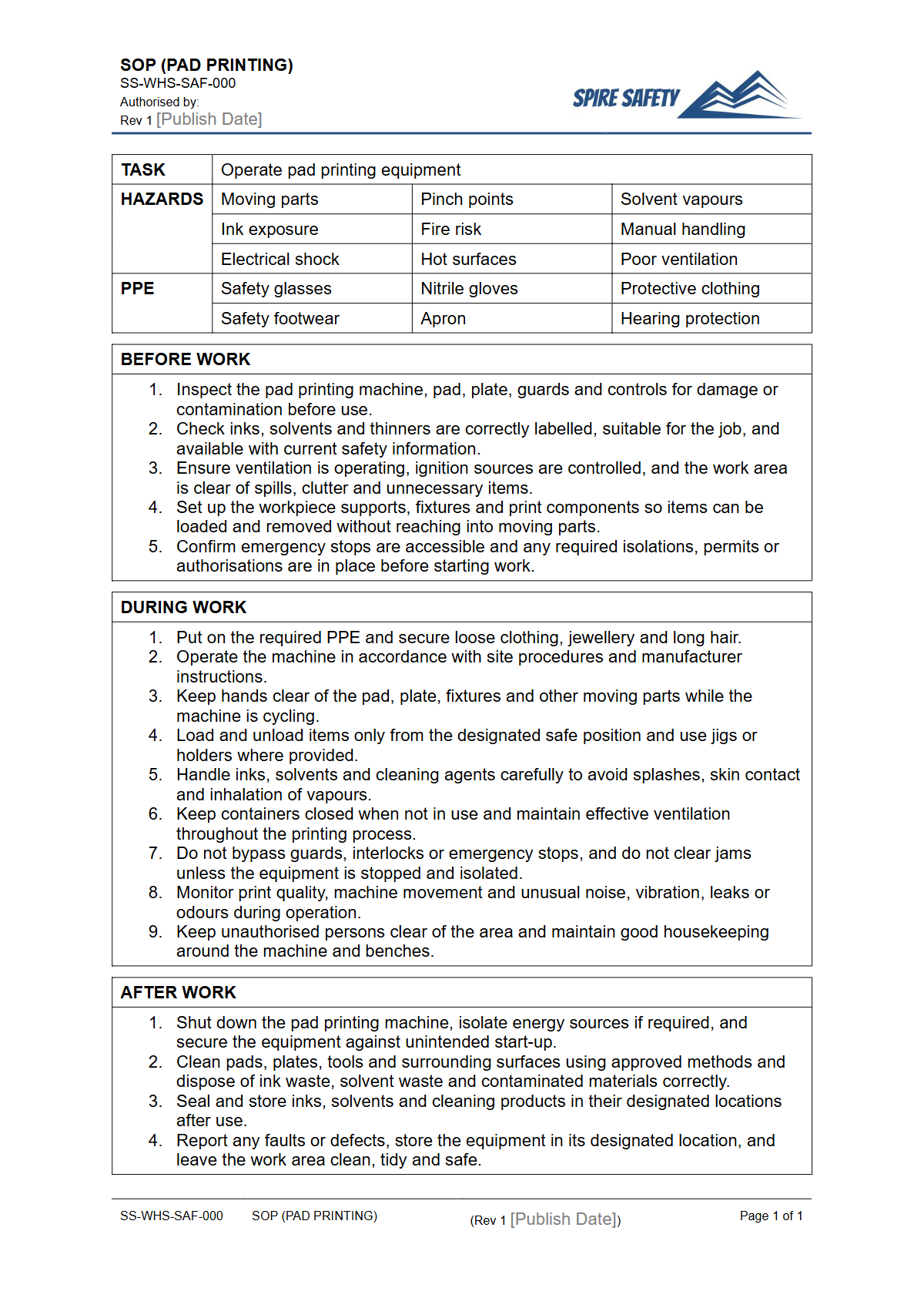
Purpose of the Free Safe Operating Procedure (Pad Printing) Template
A Safe Operating Procedure (SOP) is a fundamental administrative control used to standardise a task and manage associated risks. The purpose of this template is to help your organisation establish clear, consistent instructions for operating pad printing equipment.
It serves as a practical guide for workers, outlining pre-operational checks, safe operation steps, cleaning procedures, and emergency responses. By formally documenting these processes, you create a valuable resource for worker induction, ongoing training, and reinforcing safe work behaviours.
A well-developed SOP is a cornerstone of effective WHS management systems, demonstrating a commitment to proactive risk management.
Video walkthrough
How to use the Free Safe Operating Procedure (Pad Printing) Template
This resource is available as a fully editable DOCX file, allowing you to tailor it to your specific operational needs. A non-editable PDF version is also provided for easy distribution and reference.
To use the template effectively, download the DOCX file and conduct a thorough risk assessment of your pad printing tasks. Populate the document with details about your specific machines, the hazardous chemicals (inks, solvents, cleaners) used, required personal protective equipment (PPE), and emergency procedures.
Important: This document is a template, not a finished SOP. We provide it as a starting point, but it is your responsibility to customise it to reflect the unique equipment, materials, and environment of your workplace.
Failure to adapt the template to your specific circumstances may result in an incomplete or inadequate safety procedure.
Key Hazards in Pad Printing Operations
Pad printing involves a combination of mechanical, chemical, and electrical hazards. A comprehensive SOP must address controls for each.
Before customising your SOP, it's vital to conduct a thorough risk assessment to identify all potential hazards specific to your setup.
Chemical Hazards
The inks, solvents, and cleaning agents used in pad printing are often hazardous chemicals. Key risks include inhalation of volatile organic compounds (VOCs), skin contact leading to dermatitis or absorption, and eye splashes.
Your SOP should specify ventilation requirements (e.g., local exhaust ventilation), mandatory PPE (e.g., chemical-resistant gloves, safety glasses), and safe chemical handling and storage procedures.
Mechanical Hazards
Pad printers contain moving parts, creating risks of entanglement, crushing, and pinch points. The SOP must detail the location and function of all machine guards, ensuring they are never removed or bypassed during operation.
It should also include instructions for lockout/tagout procedures to be performed before any maintenance, cleaning, or jam-clearing activities. Many workshops use compressed air to power or clean equipment; if your system uses one, ensure you also have a corresponding Free Air Compressor SOP.
Electrical Hazards
Like any powered equipment, pad printers pose a risk of electric shock or fire, particularly if they are poorly maintained or used in environments with flammable solvents. The procedure should include pre-use inspection of cords and connections, and specify that only qualified personnel can perform electrical repairs. If the printing process is part of a larger production line, you may need to integrate this SOP with others, such as a FREE Conveyer System SOP.
When to Reference a Pad Printing SOP
The completed SOP should be a readily accessible document that is referenced frequently. It must be used during the induction and training of all new operators.
Existing staff should use it for refresher training to ensure standards are maintained. Supervisors can also use the SOP as a checklist during routine workplace inspections or behavioural observations.
Furthermore, the document is essential for periodic reviews and safety audits, providing a baseline against which actual practice can be measured. A formal WHS compliance auditing process can verify that the procedures outlined are being followed correctly.
Who Should Use This Safe Operating Procedure
This SOP template is designed for a range of personnel within an organisation. WHS managers and supervisors will use it to develop and implement the procedure as part of their risk management responsibilities.
Operators are the primary end-users who must follow the procedure every time they use the equipment. Maintenance staff should also be familiar with the SOP, particularly the sections on isolation and de-energising the machine before undertaking work.
If you need expert guidance on integrating SOPs into your broader safety framework, our WHS consulting services can provide tailored support.
By implementing a robust Safe Operating Procedure for pad printing, you take a significant step towards protecting your workers and fulfilling your WHS duties. Explore our complete free WHS resources library for more templates and guides to support your safety initiatives.
Common mistakes
Common mistakes to avoid
- Using incorrect or expired Safety Data Sheets (SDS) for inks and solvents.
- Failing to use or maintain local exhaust ventilation systems, leading to hazardous fume build-up.
- Wearing the wrong type of gloves, which may degrade or offer no protection against specific chemicals.
- Bypassing or disabling machine guards to clear jams or speed up production, creating severe entanglement risks.
Legal references
Legal considerations
The following legal requirements may be relevant to this type of work.
- Work Health and Safety Act (Harmonised) — Provides the primary duties for protecting workers and other people from work health and safety risks.
- Work Health and Safety Regulations (Harmonised) — Sets out requirements supporting the management of workplace hazards and risks.
The following codes may be relevant to this type of work.
- Managing WHS Risks Code of Practice — Provides practical guidance on identifying hazards, assessing risks and applying effective controls.
- Work Health and Safety Consultation, Cooperation and Coordination Code of Practice — Provides practical guidance on consulting workers and coordinating with other duty holders.
- Managing the Work Environment and Facilities Code of Practice — Provides practical guidance on safe work environments, workplace facilities and related controls.
Did you know
Printing Origins
Pad printing technology was developed in Switzerland for the watchmaking industry to print detailed images onto the curved faces of watch dials.
Invisible Hazard
Many solvents used in pad printing inks release Volatile Organic Compounds (VOCs), which can be an invisible but significant respiratory hazard if not managed with proper ventilation.
FAQ
Frequently asked questions
01What are the main hazards of pad printing?
02Is training required to operate a pad printing machine?
03How often should a pad printing SOP be reviewed?
04What PPE is needed for pad printing?
Share this resource
Free Safe Operating Procedure (Pad Printing) Template
Browse Categories
How To Use It
- 1Download and open in Word or PDF.
- 2Replace the placeholders with your business details.
- 3Get it reviewed by a WHS specialist before rollout.
Need it customised?
Our WHS consultants can adapt this template to your site, run a gap analysis, or audit what you already have in place.
Book a Free Consultation WHS consulting servicesor call 1300 156 382
Related templates
- Free Safe Operating Procedure (Paddock Gate Handling) Template
- Free Safe Operating Procedure (Paddock Weed Removal) Template
- Free Safe Operating Procedure (Paint Booth Operation) Template
- Free Safe Operating Procedure (Paint Mixing) Template
- Free Safe Operating Procedure (Paint Stripping) Template
- Free Safe Operating Procedure (Paintless Dent Repair) Template