
Free Safe Operating Procedure (Paddock Gate Handling) Template
Effectively manage risks associated with opening and closing paddock gates with our structured template. Download your free Paddock Gate Handling SOP today.
Free Safe Operating Procedure (Paddock Gate Handling) Template
DOCX • 126 KB + PDF
Updated Oct 2026
No signup required
Purpose of the Free Safe Operating Procedure (Paddock Gate Handling) Template
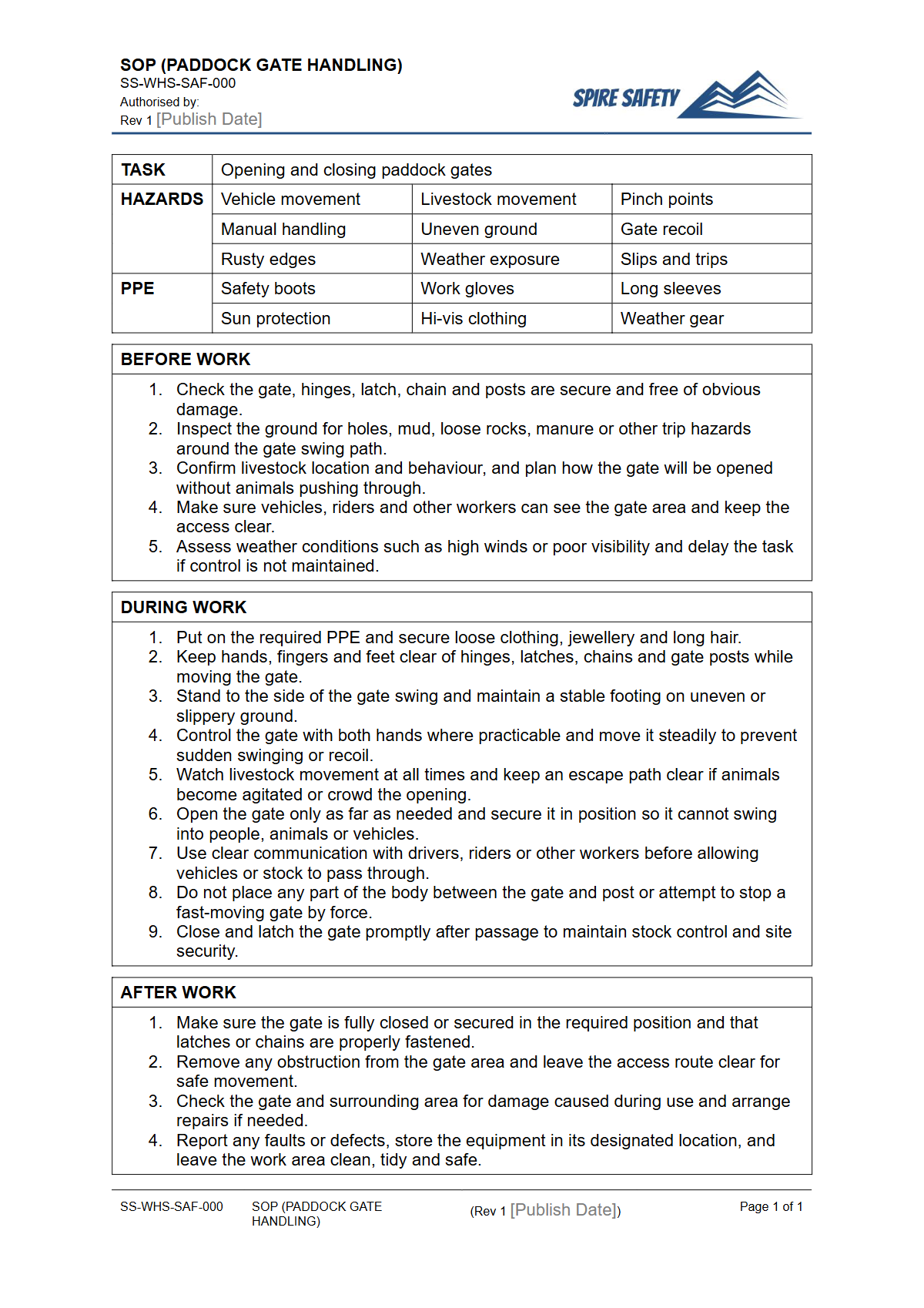
This Free Safe Operating Procedure (Paddock Gate Handling) Template provides a comprehensive framework for documenting the safe and correct method for handling gates on rural and agricultural properties. While opening a gate may seem like a simple task, it carries significant risks, including manual handling injuries, crush points, and unexpected interaction with vehicles or livestock.
Using this Safe Operating Procedure helps your organisation systematically identify these hazards and implement robust control measures, forming a key part of your safety management system. It formalises expectations for workers, ensures consistency in training, and demonstrates a proactive approach to workplace health and safety.
A documented procedure is essential for managing foreseeable risks. This is particularly true for tasks that are repetitive or appear low-risk but can lead to serious injury over time or through a single lapse in concentration.
Implementing a formal SOP helps in fulfilling the primary duty of care required of a Person Conducting a Business or Undertaking (PCBU) under Australian WHS legislation. It is a practical tool that supports the creation of a safer work environment for everyone on site.
The procedure also forms a critical part of your broader WHS management systems, ensuring that operational tasks are integrated with safety protocols.
Key Hazards Addressed
This SOP template guides you to consider and control several key hazards, including:
- Musculoskeletal Injuries: Risks from pushing, pulling, or lifting heavy, poorly maintained, or awkward gates. This includes strains and sprains to the back, shoulders, and arms.
- Crush and Pinch Points: Injuries caused by hands or limbs being caught between the gate and the gatepost, or by a gate falling unexpectedly.
- Vehicle Interaction: The risk of being struck by a vehicle while opening, closing, or holding a gate, particularly in areas with poor visibility.
- Livestock Movement: Dangers associated with unpredictable animal behaviour, such as being pushed against a gate or trampled during stock movements.
- Slips, Trips, and Falls: Hazards from uneven ground, mud, or obstacles near the gateway.
Video walkthrough
How to use the Free Safe Operating Procedure (Paddock Gate Handling) Template
This template is provided in both DOCX and PDF formats for your convenience. The DOCX version is fully editable, allowing you to tailor the content directly to the specific gates, equipment, and environmental conditions at your workplace.
To use it effectively, download the document and methodically work through each section, adding, removing, and modifying content to reflect your site-specific risk assessment findings. For tasks involving specialised agricultural machinery, you might also require procedures like our FREE Grain Drill SOP Template to ensure comprehensive coverage of farm activities.
Customisation is Essential
Important: This document is a template only. We have provided a structured starting point, but you must customise it to align with the unique hazards and operational context of your workplace.
Consultation is a mandatory part of this process. You must discuss the procedure with your workers and any health and safety representatives to ensure it is practical, relevant, and understood by everyone who will use it.
Final responsibility for the accuracy and adequacy of the finished Safe Operating Procedure rests with the PCBU.
When to use a Safe Operating Procedure
A Safe Operating Procedure for paddock gate handling should be used as a primary training document for new employees, contractors, and visitors who will be required to perform the task. It should be readily accessible at the worksite for easy reference.
Furthermore, the SOP is a critical tool for conducting refresher training, especially if procedures change or after a long period of absence. It should also be reviewed as part of any incident investigation or near-miss involving a gate, helping to identify and correct any gaps in the existing safety process.
Reviewing operational documents in parallel, such as our FREE Spreader SOP Template, ensures consistency across all farm tasks.
Who should use it
This Safe Operating Procedure template is designed for use by anyone responsible for safety and operations in an agricultural or rural setting. This includes:
- Farm Managers and Owners (PCBUs): To meet their WHS obligations by implementing a formal, documented process for managing risks.
- Supervisors and Team Leaders: As a tool for instructing workers, verifying competency, and monitoring adherence to safe work practices.
- WHS Officers and Consultants: As a foundational document to be customised and integrated into a broader safety framework. Performing regular checks against these documents can be part of a formal WHS compliance auditing program.
- Workers: As a clear and concise guide to performing the task safely, helping them understand the risks and the required control measures.
By standardising the procedure for this common task, your organisation can reduce variability in behaviour and significantly lower the likelihood of incidents. For other common farm machinery, consider implementing additional specific procedures, such as our FREE Planter SOP Template.
If this document isn't exactly what you need, feel free to browse our complete free WHS resources library for other templates, checklists, and guides.
Common mistakes
Common mistakes to avoid
- Failing to inspect the gate's condition (hinges, latches, stability) before use.
- Using poor manual handling techniques, such as twisting the back while pulling or pushing.
- Leaving gates unsecured, creating a risk of them swinging unexpectedly in the wind or on a slope.
- Not accounting for vehicle traffic or livestock movement when opening or closing gates.
Legal references
Legal considerations
The following legal requirements may be relevant to this type of work.
- Work Health and Safety Act (Harmonised) — Provides the primary duties for protecting workers and other people from work health and safety risks.
- Work Health and Safety Regulations (Harmonised) — Sets out requirements supporting the management of workplace hazards and risks.
The following codes may be relevant to this type of work.
- Managing WHS Risks Code of Practice — Provides practical guidance on identifying hazards, assessing risks and applying effective controls.
- Work Health and Safety Consultation, Cooperation and Coordination Code of Practice — Provides practical guidance on consulting workers and coordinating with other duty holders.
- Managing the Work Environment and Facilities Code of Practice — Provides practical guidance on safe work environments, workplace facilities and related controls.
Did you know
Manual Handling Risk
Musculoskeletal disorders from hazardous manual tasks are a leading cause of serious workers' compensation claims in Australian agriculture. Even "simple" tasks like handling a heavy gate contribute to this risk.
FAQ
Frequently asked questions
01Is a Safe Operating Procedure legally required for paddock gates?
02How often should this Paddock Gate Handling SOP be reviewed?
03Can this template be used for other types of gates?
04What training is needed alongside this Safe Operating Procedure?
Share this resource
Free Safe Operating Procedure (Paddock Gate Handling) Template
Browse Categories
How To Use It
- 1Download and open in Word or PDF.
- 2Replace the placeholders with your business details.
- 3Get it reviewed by a WHS specialist before rollout.
Need it customised?
Our WHS consultants can adapt this template to your site, run a gap analysis, or audit what you already have in place.
Book a Free Consultation WHS consulting servicesor call 1300 156 382
Related templates
- Free Safe Operating Procedure (Paddock Weed Removal) Template
- Free Safe Operating Procedure (Paint Booth Operation) Template
- Free Safe Operating Procedure (Paint Mixing) Template
- Free Safe Operating Procedure (Paint Stripping) Template
- Free Safe Operating Procedure (Paintless Dent Repair) Template
- Free Safe Operating Procedure (Pallet Cage) Template