
Free Safe Operating Procedure (Overflow Bin Response) Template
Effectively manage the risks associated with overflow bins with our structured procedure template. Download your free Overflow Bin Response SOP to get started.
Free Safe Operating Procedure (Overflow Bin Response) Template
DOCX • 126 KB + PDF
Updated Oct 2026
No signup required
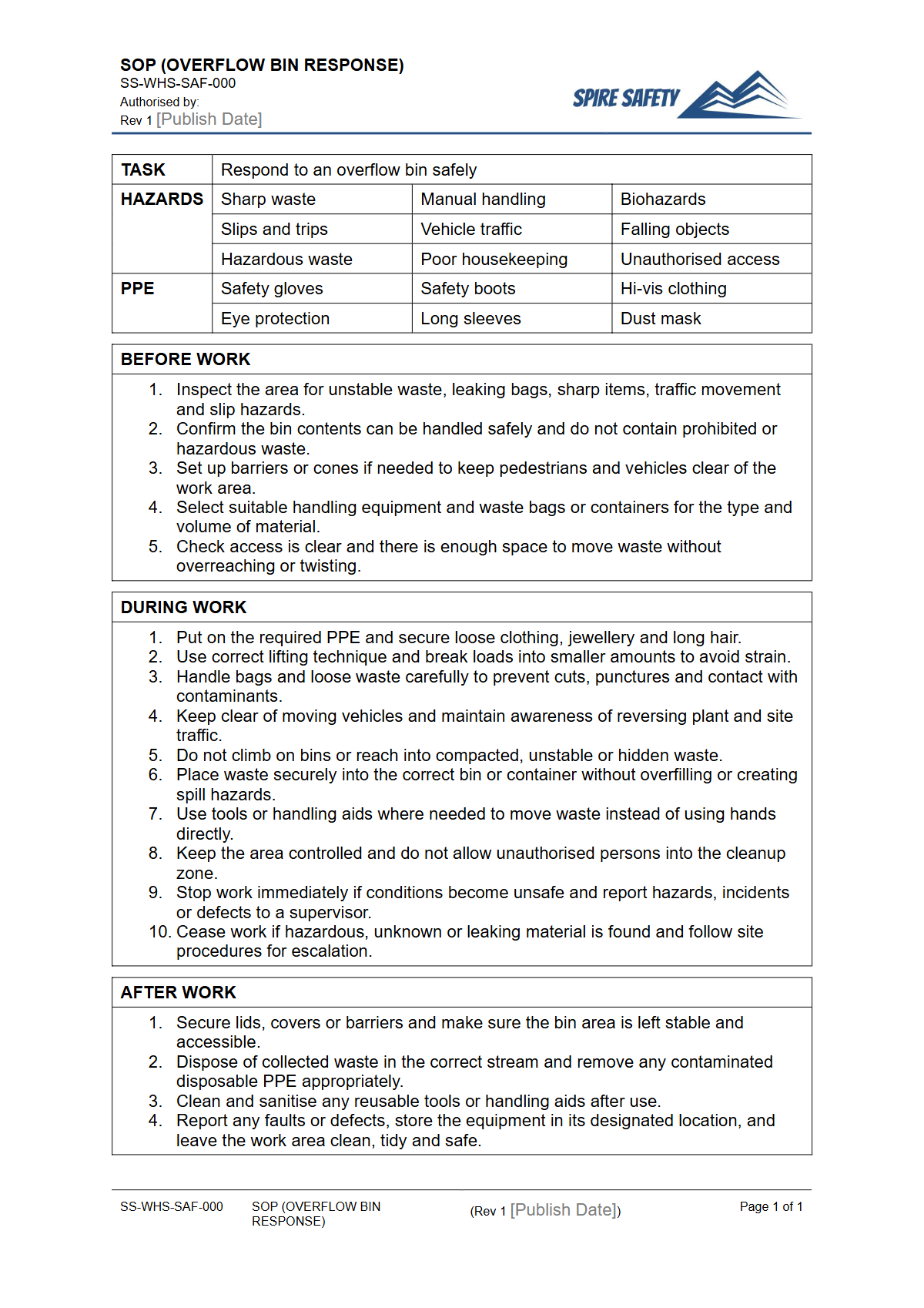
Purpose of the Free Safe Operating Procedure (Overflow Bin Response) Template
Managing overflow bins in industrial, agricultural, or manufacturing settings presents a unique set of risks. This Free Safe Operating Procedure (Overflow Bin Response) Template provides a structured starting point for documenting the approved, step-by-step process for your workplace.
It helps you control hazards such as manual handling injuries, slips and trips from spilt materials, falls from height, and potential entanglement with associated machinery. By clearly defining the required sequence of actions, PPE, and safety checks, this SOP promotes a consistent and safe approach to a common but potentially hazardous task.
An overflow bin is often integrated into a larger process, such as a production line or materials handling system. For related machinery, you might also need our FREE Conveyer System SOP (Safe Operating Procedure) Template to ensure all interconnected parts of the task are covered.
This document is designed to help your Person Conducting a Business or Undertaking (PCBU) meet its primary duty of care to ensure worker safety.
Video walkthrough
How to use the Free Safe Operating Procedure (Overflow Bin Response) Template
This resource is available as both a DOCX file for easy editing and a PDF for quick reference. The key to its effectiveness is customisation.
Please note: This is a template only. We have not assessed the specific hazards and risks present in your workplace. You must conduct a thorough risk assessment in consultation with your workers and adapt this document to reflect your specific equipment, materials, environment, and organisational procedures. Remove any steps that are not relevant and add any that are unique to your site.
Key Elements to Customise
- Plant and Equipment: Detail the specific make and model of any machinery associated with the bin, including isolation and de-energisation points.
- Personal Protective Equipment (PPE): List the mandatory PPE required for the task, such as steel-capped boots, high-visibility clothing, safety glasses, respiratory protection suitable for the dust type, and industrial-grade gloves.
- Step-by-Step Procedure: Outline the exact sequence of actions, from pre-task checks and securing the area to the method of clearing the bin (e.g., using specific tools, manual handling techniques) and post-task clean-up.
- Emergency Procedures: Specify the response for foreseeable emergencies, such as injury, spills, or equipment malfunction.
Integrating individual SOPs into a cohesive safety framework is a critical step for comprehensive risk management. A well-structured system ensures that procedures like this one are consistently implemented, reviewed, and improved. For guidance on creating a holistic safety framework, consider learning more about WHS management systems.
When to use it
A Safe Operating Procedure for overflow bin response is a proactive tool that should be used consistently, not just after an incident. It is a critical document for training new and transferred employees, ensuring they understand the approved, safe method from their first day on the task.
It also serves as a valuable resource for refresher training for experienced workers, reinforcing safe habits and communicating any updates to the procedure. Supervisors should use the SOP as a benchmark for observing work practices and providing feedback, while workers should reference it before starting the task to refresh their memory on the correct, safe sequence of actions.
Regular reviews of your safety documentation are essential to maintain relevance and effectiveness. Procedures should be re-evaluated whenever there is a change to equipment or process, after an incident or near-miss occurs, and as a result of findings from WHS compliance auditing.
Who should use it
This Safe Operating Procedure is intended for use by all personnel involved in the task of managing overflow bins. This includes:
- Operators and Workers: The primary users who must follow the procedure step-by-step to perform the task safely. Their direct input during the customisation phase is invaluable, as they have firsthand experience with the practical challenges and risks.
- Supervisors and Team Leaders: Responsible for ensuring workers are trained on the SOP and follow it correctly. They use it as a tool for instruction, monitoring, and enforcement of safety standards.
- WHS Managers and Personnel: Responsible for developing, reviewing, and updating the SOP as part of the broader workplace health and safety system. They ensure it aligns with relevant legislation, Codes of Practice, and internal standards.
In workplaces with diverse machinery, it is good practice to maintain a library of task-specific procedures. For instance, an agricultural business might use this SOP alongside a FREE Spreader SOP (Safe Operating Procedure) Template to cover different aspects of their operations.
This ensures that clear, documented guidance is available for all high-risk tasks. When complex operational risks are present, engaging external expertise through WHS consulting can provide valuable insights and help ensure your safety systems are robust and effective.
Explore our complete free WHS resources library for more templates to support your safety management system.
Common mistakes
Common mistakes to avoid
- Failing to isolate and de-energise associated machinery (e.g., conveyors) before attempting to clear a bin.
- Using incorrect manual handling techniques or over-exertion, leading to sprains and strains.
- Neglecting to specify and enforce the use of correct PPE, particularly respiratory protection for dusts.
- Not providing practical training on the SOP and verifying worker competency before they perform the task.
Legal references
Legal considerations
The following legal requirements may be relevant to this type of work.
- Work Health and Safety Act (Harmonised) — Provides the primary duties for protecting workers and other people from work health and safety risks.
- Work Health and Safety Regulations (Harmonised) — Sets out requirements supporting the management of workplace hazards and risks.
The following codes may be relevant to this type of work.
- Managing WHS Risks Code of Practice — Provides practical guidance on identifying hazards, assessing risks and applying effective controls.
- Work Health and Safety Consultation, Cooperation and Coordination Code of Practice — Provides practical guidance on consulting workers and coordinating with other duty holders.
- Managing the Work Environment and Facilities Code of Practice — Provides practical guidance on safe work environments, workplace facilities and related controls.
Did you know
Manual Handling Risks
According to Safe Work Australia, injuries resulting from hazardous manual tasks are the most common type of work-related injury in the country, highlighting the need for robust procedures and controls.
FAQ
Frequently asked questions
01What hazards are typically involved in clearing an overflow bin?
02Does this SOP template cover lockout/tagout (LOTO) procedures?
03How often should we review our Overflow Bin Response SOP?
04Can I use this template for any type of overflow bin?
Share this resource
Free Safe Operating Procedure (Overflow Bin Response) Template
Browse Categories
How To Use It
- 1Download and open in Word or PDF.
- 2Replace the placeholders with your business details.
- 3Get it reviewed by a WHS specialist before rollout.
Need it customised?
Our WHS consultants can adapt this template to your site, run a gap analysis, or audit what you already have in place.
Book a Free Consultation WHS consulting servicesor call 1300 156 382
Related templates
- Free Safe Operating Procedure (Overhead Crane) Template
- Free Safe Operating Procedure (Oxygen Cylinder Change) Template
- Free Safe Operating Procedure (Oyster Shucking) Template
- Free Safe Operating Procedure (Package Damage Check) Template
- Free Safe Operating Procedure (Package Label Check) Template
- Free Safe Operating Procedure (Pad Printing) Template