
Free Safe Operating Procedure (Overhead Crane) Template
Download our free Safe Operating Procedure (Overhead Crane) Template to manage high-risk lifting. This customisable guide helps formalise your WHS processes.
Free Safe Operating Procedure (Overhead Crane) Template
DOCX • 126 KB + PDF
Updated Oct 2026
No signup required
Purpose of the Free Safe Operating Procedure (Overhead Crane) Template
Operating an overhead crane introduces significant risks, including dropped loads, collisions, and equipment failure. This free Safe Operating Procedure (Overhead Crane) Template provides a structured framework for documenting the required steps to perform lifting operations safely.
Formalising your process is a critical control measure that helps your organisation meet its duty of care under Australian WHS laws. An SOP ensures that every operator, from new trainees to experienced personnel, follows a consistent, pre-approved method for every task, minimising guesswork and human error.
Using a standardised SOP helps integrate safe work practices directly into your daily operations. It serves as a practical tool for risk management, forming a crucial part of your overall safety framework.
For a business to demonstrate due diligence, having documented procedures for high-risk plant is essential. These documents are a cornerstone of effective WHS management systems, providing clear evidence of proactive safety management.
Video walkthrough
How to use the Free Safe Operating Procedure (Overhead Crane) Template
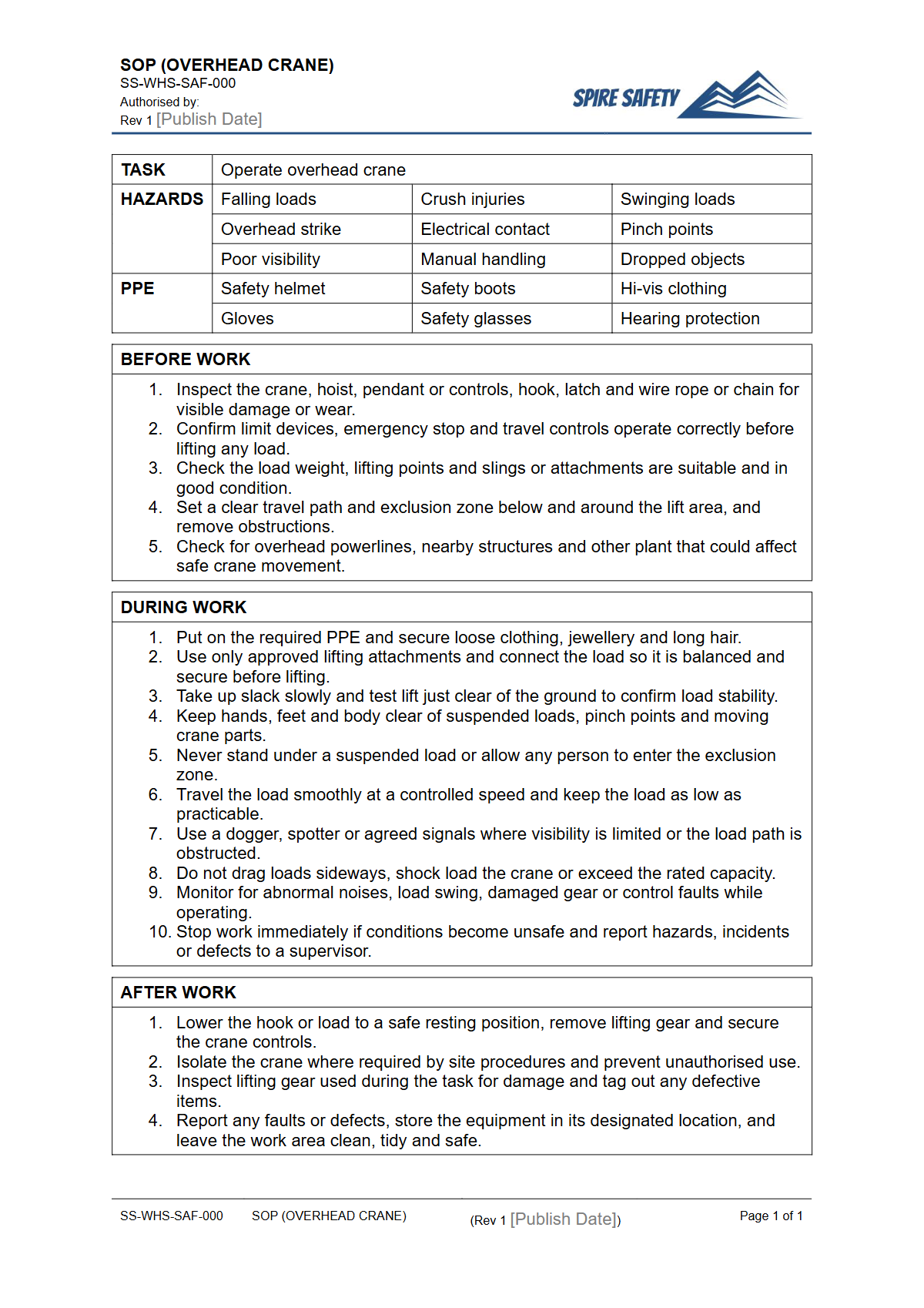
This resource is available for immediate download in both DOCX and PDF formats. The DOCX version is fully editable, allowing you to tailor the content to your specific operational needs.
The template includes sections for pre-operational checks, step-by-step operating instructions, shutdown procedures, and emergency protocols. Your goal is to transform this template into a practical, site-specific document.
Important: This template provides a foundation aligned with Australian WHS practice, but it is not a complete solution. We stress that you must customise this document to reflect the specific models of overhead cranes, lifting attachments, loads, and environmental conditions at your workplace.
We recommend consulting with crane operators, supervisors, and health and safety representatives during the customisation process to ensure the final SOP is accurate and effective.
The process of customising this document is similar for other types of high-risk equipment. For example, our FREE Telehandler SOP Template follows a comparable structure, requiring specific details about the plant and its intended tasks to be effective.
The principles of hazard identification, risk assessment, and control measures are universal.
When to use an Overhead Crane Safe Operating Procedure
A Safe Operating Procedure for an overhead crane should be used before and during every lifting operation. It is not a document to be filed away and forgotten.
It should be readily accessible to operators at or near the crane's operating controls. The SOP is a primary reference for training new employees, conducting refresher training for existing staff, and performing competency assessments.
It establishes a clear benchmark for expected safe behaviour.
The SOP also plays a vital role in safety oversight. Supervisors use it to monitor work practices and conduct workplace inspections.
Furthermore, should an incident or near-miss occur, the SOP serves as a critical reference during the investigation to determine if procedures were followed. Regular reviews of the SOP are also essential, particularly after an incident, when a new crane is introduced, or when lifting processes change.
This continuous improvement cycle is often checked during a formal WHS compliance auditing process.
Who should use this Safe Operating Procedure
This SOP is intended for several key groups within a workplace. The primary users are the crane operators themselves, who must follow the documented steps to ensure their safety and the safety of those around them.
Doggers and riggers who prepare and sling loads must also be familiar with the relevant sections of the procedure to ensure loads are secure and balanced correctly. These roles require specific high-risk work licences and a clear understanding of the entire lifting process.
Supervisors and managers are responsible for implementing the SOP, ensuring operators are trained, and enforcing its use on the floor. They use the document as a tool for safety conversations and performance management.
For Safety Managers and Persons Conducting a Business or Undertaking (PCBUs), the SOP is a key piece of evidence demonstrating that the organisation has a formal system in place to manage the risks associated with overhead cranes. Much like our FREE Conveyer System SOP, this document helps formalise safe practices for critical plant.
Maintenance personnel should also refer to the SOP, especially for sections on isolation, lockout/tagout, and pre-start checks, to ensure the crane is safe to return to service after repairs. Having clear procedures for all fixed plant is a sign of a mature safety system, whether it's a crane or an industrial Free Air Compressor SOP. You can explore more procedural documents in our free WHS resources library to build out your safety management system.
Common mistakes
Common mistakes to avoid
- Failing to properly customise the template to the specific crane and workplace.
- Not training all operators, doggers, and supervisors on the finalised SOP.
- Skipping pre-operational safety checks to save time.
- Incorrectly estimating load weight, leading to overloading the crane's Safe Working Load (SWL).
Legal references
Legal considerations
The following legal requirements may be relevant to this type of work.
- Work Health and Safety Act (Harmonised) — Provides the primary duties for protecting workers and other people from work health and safety risks.
- Work Health and Safety Regulations (Harmonised) — Sets out requirements supporting the management of workplace hazards and risks.
The following codes may be relevant to this type of work.
- Managing WHS Risks Code of Practice — Provides practical guidance on identifying hazards, assessing risks and applying effective controls.
- Work Health and Safety Consultation, Cooperation and Coordination Code of Practice — Provides practical guidance on consulting workers and coordinating with other duty holders.
- Managing the Work Environment and Facilities Code of Practice — Provides practical guidance on safe work environments, workplace facilities and related controls.
Did you know
The Danger of Side Pulling
Using an overhead crane to pull a load sideways (side pulling) is one of the most dangerous misuses. It places extreme stress on the hoist rope and drum components, potentially leading to catastrophic failure, and can cause the load to swing uncontrollably once lifted.
FAQ
Frequently asked questions
01What is an SOP for an overhead crane?
02Who is responsible for writing a Safe Operating Procedure?
03How often should an overhead crane SOP be reviewed?
04Is a high-risk work licence required to operate an overhead crane?
Share this resource
Free Safe Operating Procedure (Overhead Crane) Template
Browse Categories
How To Use It
- 1Download and open in Word or PDF.
- 2Replace the placeholders with your business details.
- 3Get it reviewed by a WHS specialist before rollout.
Need it customised?
Our WHS consultants can adapt this template to your site, run a gap analysis, or audit what you already have in place.
Book a Free Consultation WHS consulting servicesor call 1300 156 382
Related templates
- Free Safe Operating Procedure (Oxygen Cylinder Change) Template
- Free Safe Operating Procedure (Oyster Shucking) Template
- Free Safe Operating Procedure (Package Damage Check) Template
- Free Safe Operating Procedure (Package Label Check) Template
- Free Safe Operating Procedure (Pad Printing) Template
- Free Safe Operating Procedure (Paddock Gate Handling) Template