
Free Safe Operating Procedure (Oxygen Cylinder Change) Template
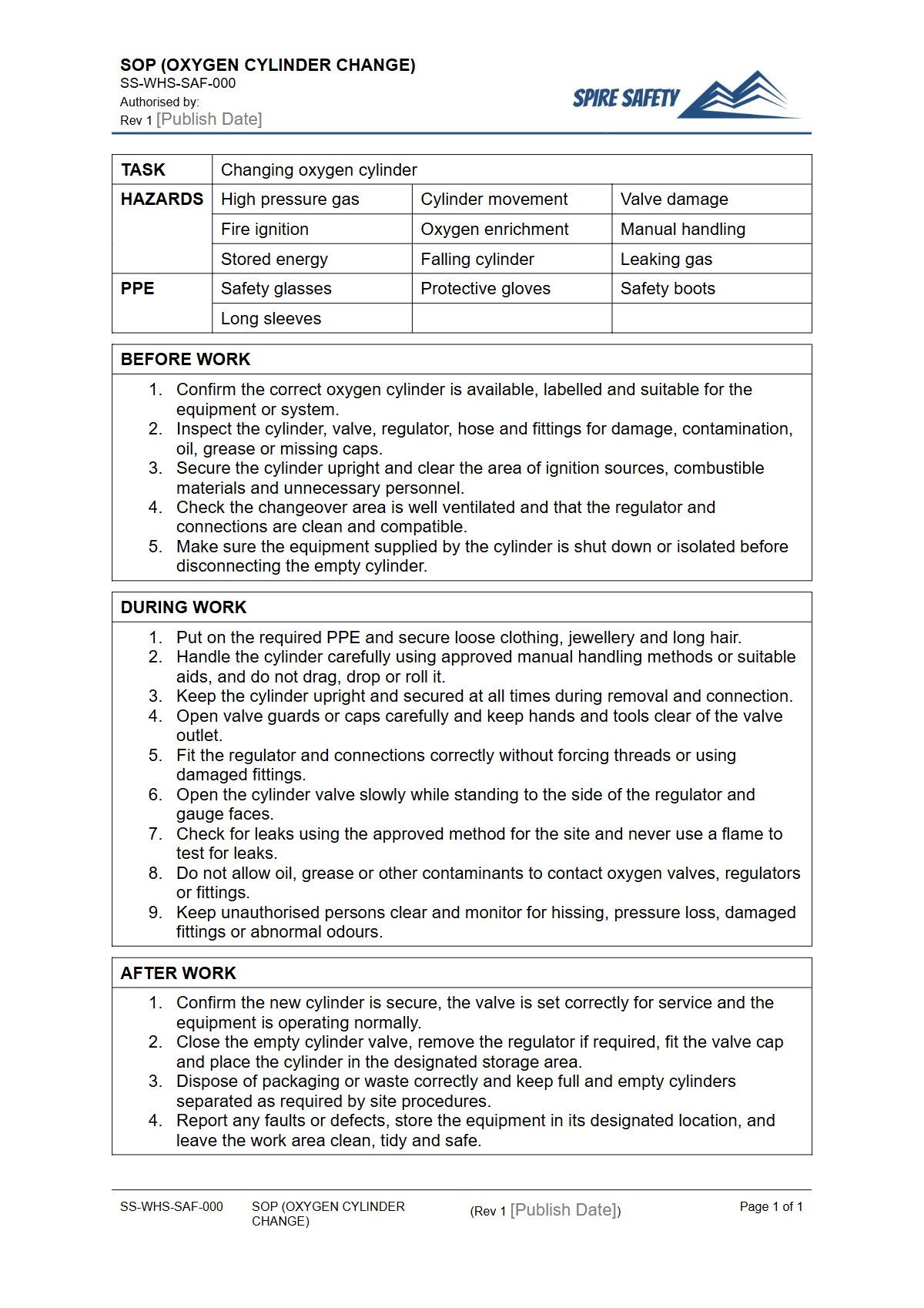
Clearly outline the steps for safely changing oxygen cylinders in your workplace. Download our customisable Safe Operating Procedure template to get started.
Free Safe Operating Procedure (Oxygen Cylinder Change) Template
DOCX • 126 KB + PDF
Updated Oct 2026
No signup required
Purpose of the Free Safe Operating Procedure (Oxygen Cylinder Change) Template
Handling and changing oxygen cylinders presents significant risks if not managed correctly. This Free Safe Operating Procedure (Oxygen Cylinder Change) Template provides a structured framework for documenting a safe, repeatable process for your workers.
It helps you address key hazards such as high-pressure gas release, fire and explosion risks from oxygen enrichment, and musculoskeletal injuries from manual handling. By formalising the procedure, you establish a clear standard of work, which is fundamental to meeting your WHS obligations and protecting your team.
A documented Safe Operating Procedure (SOP) is an essential tool for training, competency assessment, and operational consistency. It ensures every worker follows the same safety-critical steps, minimising the chance of error or incident.
This is particularly important for high-risk tasks involving hazardous chemicals and pressurised systems. Establishing robust procedures is a cornerstone of effective WHS management systems, demonstrating a proactive approach to safety.
Video walkthrough
How to use the Free Safe Operating Procedure (Oxygen Cylinder Change) Template
This document is a template, not a finished product. To make it effective, you must customise it to reflect the specific equipment, environment, and organisational rules of your workplace.
Download the DOCX file and adapt it by incorporating details about your cylinder types, storage areas, trolley systems, and specific regulator models. It is crucial to conduct a risk assessment for the task at your site and ensure the controls listed in the SOP are relevant and adequate.
Important: We have provided a comprehensive starting point based on Australian WHS principles, but we cannot know the specific hazards of your workplace. You must consult with your workers and other relevant stakeholders to tailor this document.
Be sure to add details such as the exact Personal Protective Equipment (PPE) required, emergency contact numbers, and the names or positions of responsible persons. This collaborative customisation ensures the final SOP is a practical and effective tool for your business.
When to use a Safe Operating Procedure
A Safe Operating Procedure for changing oxygen cylinders should be used in several key situations. It forms the basis of all practical training and competency assessments for any worker assigned the task.
It should be readily available in the work area as a clear reference guide for operators to consult before or during the process. Furthermore, the SOP is a critical document to review during safety inspections, incident investigations, and procedural reviews to ensure it remains current and effective.
Just as you would have a defined process for pressurised equipment outlined in an Free Air Compressor SOP, the same level of procedural discipline is required for gas cylinders.
Who should use it
This Safe Operating Procedure should be used by personnel who are directly involved in the task, as well as those who supervise them. This includes workshop staff, maintenance teams, laboratory technicians, healthcare workers, and any other operator authorised to change oxygen cylinders.
Supervisors and WHS managers should use the SOP to guide their training programs, conduct observations, and verify compliance. The document serves as an official record of the 'one safe way' your organisation has approved for performing this task.
Evidence of such documented procedures and related training records is often a key focus during a formal WHS compliance auditing process.
In addition to operators performing the changeover, personnel responsible for transporting cylinders may also need to be aware of certain aspects of the procedure, especially regarding safe movement and securing of cylinders. In environments where mechanised lifting is required to move pallets of cylinders, operators of relevant machinery would need their own procedures, such as those detailed in a FREE Telehandler SOP Template, to ensure safe interaction between tasks.
Using a structured template helps formalise your processes, creating a safer work environment for everyone. Explore our complete free WHS resources library for more templates and guides to support your safety management system.
Common mistakes
Common mistakes to avoid
- Using oily or greasy hands, gloves, or tools on the cylinder valve or regulator.
- Failing to secure the cylinder upright with a chain or strap before, during, and after the changeover.
- Opening the cylinder valve too quickly, causing a dangerous pressure surge that can damage the regulator.
- Storing full and empty cylinders together without clear separation and status labelling.
Legal references
Legal considerations
The following legal requirements may be relevant to this type of work.
- Work Health and Safety Act (Harmonised) — Provides the primary duties for protecting workers and other people from work health and safety risks.
- Work Health and Safety Regulations (Harmonised) — Sets out requirements supporting the management of workplace hazards and risks.
The following codes may be relevant to this type of work.
- Managing WHS Risks Code of Practice — Provides practical guidance on identifying hazards, assessing risks and applying effective controls.
- Work Health and Safety Consultation, Cooperation and Coordination Code of Practice — Provides practical guidance on consulting workers and coordinating with other duty holders.
- Managing the Work Environment and Facilities Code of Practice — Provides practical guidance on safe work environments, workplace facilities and related controls.
Did you know
Ignition Risk
Oil or grease can spontaneously ignite in the presence of pure, high-pressure oxygen. This is why all components must be kept scrupulously clean and only oxygen-compatible lubricants and sealants should ever be used.
Cylinder Colour Codes
In Australia, industrial oxygen cylinders are typically black, while medical oxygen cylinders have a white body and black shoulder, as specified in Australian Standard AS 4484.
FAQ
Frequently asked questions
01What PPE is required when changing an oxygen cylinder?
02Is an SOP a legal requirement for changing oxygen cylinders in Australia?
03Can I use this template for other types of gas cylinders?
04How often should we review our Oxygen Cylinder Change SOP?
Share this resource
Free Safe Operating Procedure (Oxygen Cylinder Change) Template
Browse Categories
How To Use It
- 1Download and open in Word or PDF.
- 2Replace the placeholders with your business details.
- 3Get it reviewed by a WHS specialist before rollout.
Need it customised?
Our WHS consultants can adapt this template to your site, run a gap analysis, or audit what you already have in place.
Book a Free Consultation WHS consulting servicesor call 1300 156 382
Related templates
- Free Safe Operating Procedure (Oyster Shucking) Template
- Free Safe Operating Procedure (Package Damage Check) Template
- Free Safe Operating Procedure (Package Label Check) Template
- Free Safe Operating Procedure (Pad Printing) Template
- Free Safe Operating Procedure (Paddock Gate Handling) Template
- Free Safe Operating Procedure (Paddock Weed Removal) Template