
Free Safe Operating Procedure (Oyster Shucking) Template
Manage the risks of oyster shucking with our structured Safe Operating Procedure template. Download the customisable DOCX and PDF files to get started.
Free Safe Operating Procedure (Oyster Shucking) Template
DOCX • 126 KB + PDF
Updated Oct 2026
No signup required
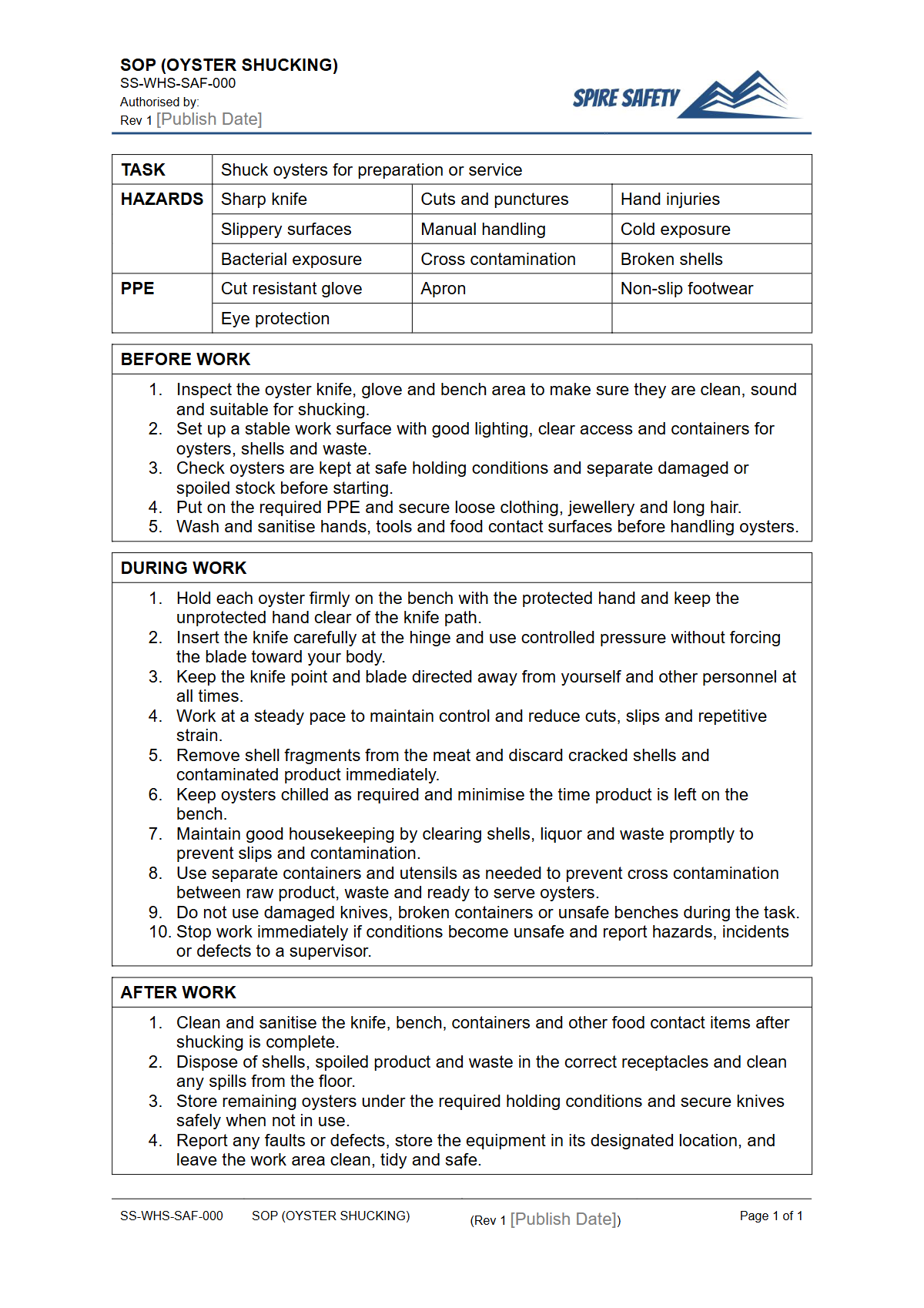
Purpose of the Free Safe Operating Procedure (Oyster Shucking) Template
Oyster shucking is a routine task in many commercial kitchens, seafood retailers, and catering businesses. While it may seem simple, the task carries significant risks, primarily severe cuts and puncture wounds.
This Free Safe Operating Procedure (Oyster Shucking) Template provides a structured framework for documenting the safest way to perform this task, helping you meet your WHS obligations and protect your workers from harm.
A documented SOP standardises the process, ensuring every worker follows the same approved, low-risk method. It serves as a critical tool for training, supervision, and risk management within any food service organisation.
By implementing a clear procedure, you formalise your commitment to a safe work environment and create a reliable reference point for all staff members.
Key Hazards Addressed by this Safe Operating Procedure
This template prompts you to consider controls for the common hazards associated with shucking oysters, including:
- Cuts and puncture wounds from the shucking knife slipping or being used incorrectly.
- Hand and wrist injuries (sprains, strains) from applying excessive force or using poor ergonomic technique.
- Bacterial cross-contamination from inadequate hygiene practices or contact with contaminated surfaces.
- Slips, trips, and falls caused by shell fragments or liquid on the floor.
Video walkthrough
How to use the Free Safe Operating Procedure (Oyster Shucking) Template
This template is designed for ease of use. After downloading the DOCX or PDF file, you must adapt its contents to reflect the unique conditions of your workplace.
It is not a complete, ready-to-use document. Effective safety procedures must be specific to the tools, environment, and people using them.
Important: We provide this template as a structured starting point. You must customise it to reflect the specific equipment, environment, and personnel in your workplace to ensure it is effective. If you are unsure how to conduct the necessary risk assessments or tailor this document, consider engaging professional WHS consulting services.
Customisation Checklist
When adapting the template, ensure you detail the following site-specific information:
- The exact make and model of the oyster knife used.
- The specific type and standard of Personal Protective Equipment (PPE) required (e.g., brand and rating of cut-resistant gloves).
- The location of the designated shucking area and relevant cleaning protocols.
- Emergency procedures, including the location of first aid kits and contact details for first aid officers.
- Procedures for cleaning and sanitising knives and work surfaces to prevent foodborne illness.
Developing SOPs for all high-risk kitchen tasks creates a consistent safety culture. For another common kitchen process, you can download our Safe Operating Procedure for deep fryer operation.
When to use it
A Safe Operating Procedure is a dynamic document that should be used throughout a worker's employment. It is not a 'file and forget' compliance document. Use this SOP when:
- Inducting and training new kitchen hands or chefs.
- Conducting refresher training for experienced staff to prevent complacency.
- Supervising the task to ensure the agreed procedure is being followed correctly.
- Reviewing work practices after an incident, near-miss, or hazard report.
The principles of managing hazards from sharp implements are universal, whether in a kitchen or on a construction site. Our free Circular Saw SOP provides another example of how to document controls for high-risk cutting tasks.
Who should use it
This template is intended for use by anyone with a responsibility for workplace safety in the hospitality, catering, or food retail sectors. This includes:
- Business Owners and Managers (PCBUs): To fulfil their primary duty of care to provide and maintain safe systems of work.
- Head Chefs and Kitchen Supervisors: To train staff, enforce safe practices, and manage day-to-day kitchen risks.
- WHS Managers and Officers: To integrate task-specific procedures into the organisation's overall safety framework.
An SOP is a fundamental building block of effective safety management. These individual procedures should form part of your organisation's broader WHS management systems to ensure a holistic approach to risk reduction. Regular WHS compliance auditing can then verify that these documented procedures are being consistently and effectively implemented in practice. You can explore hundreds of other documents in our free WHS resources library to support your safety goals.
Common mistakes
Common mistakes to avoid
- Using an incorrect knife (e.g., a paring knife) instead of a purpose-built oyster knife.
- Failing to wear a cut-resistant glove on the hand holding the oyster.
- Applying force towards the hand holding the oyster instead of away from the body.
- Not securing the oyster on a stable, non-slip surface, often leading to slips.
Legal references
Legal considerations
The following legal requirements may be relevant to this type of work.
- Work Health and Safety Act (Harmonised) — Provides the primary duties for protecting workers and other people from work health and safety risks.
- Work Health and Safety Regulations (Harmonised) — Sets out requirements supporting the management of workplace hazards and risks.
The following codes may be relevant to this type of work.
- Managing WHS Risks Code of Practice — Provides practical guidance on identifying hazards, assessing risks and applying effective controls.
- Work Health and Safety Consultation, Cooperation and Coordination Code of Practice — Provides practical guidance on consulting workers and coordinating with other duty holders.
- Managing the Work Environment and Facilities Code of Practice — Provides practical guidance on safe work environments, workplace facilities and related controls.
Did you know
The Right Tool for the Job
Oyster knives are specifically designed with a short, thick blade to pry open shells, not to cut. Using a chef's knife or paring knife is a common mistake that significantly increases the risk of the blade snapping or slipping.
A Common Kitchen Injury
Lacerations to the non-dominant hand holding the oyster are one of the most frequent injuries in commercial kitchens. This is why wearing a high-quality, cut-resistant glove is a non-negotiable control measure.
FAQ
Frequently asked questions
01What are the main safety hazards involved in oyster shucking?
02Does this Safe Operating Procedure template cover food safety aspects?
03Who is responsible for training kitchen staff on the oyster shucking SOP?
04How often should we review our oyster shucking procedure?
Share this resource
Free Safe Operating Procedure (Oyster Shucking) Template
Browse Categories
How To Use It
- 1Download and open in Word or PDF.
- 2Replace the placeholders with your business details.
- 3Get it reviewed by a WHS specialist before rollout.
Need it customised?
Our WHS consultants can adapt this template to your site, run a gap analysis, or audit what you already have in place.
Book a Free Consultation WHS consulting servicesor call 1300 156 382
Related templates
- Free Safe Operating Procedure (Package Damage Check) Template
- Free Safe Operating Procedure (Package Label Check) Template
- Free Safe Operating Procedure (Pad Printing) Template
- Free Safe Operating Procedure (Paddock Gate Handling) Template
- Free Safe Operating Procedure (Paddock Weed Removal) Template
- Free Safe Operating Procedure (Paint Booth Operation) Template