
Free Safe Operating Procedure (Outdoor Area Cleaning) Template
Formalise your outdoor cleaning tasks with our comprehensive template. Download this free Safe Operating Procedure to establish clear, safe work instructions.
Free Safe Operating Procedure (Outdoor Area Cleaning) Template
DOCX • 126 KB + PDF
Updated Oct 2026
No signup required
Purpose of the Free Safe Operating Procedure (Outdoor Area Cleaning) Template
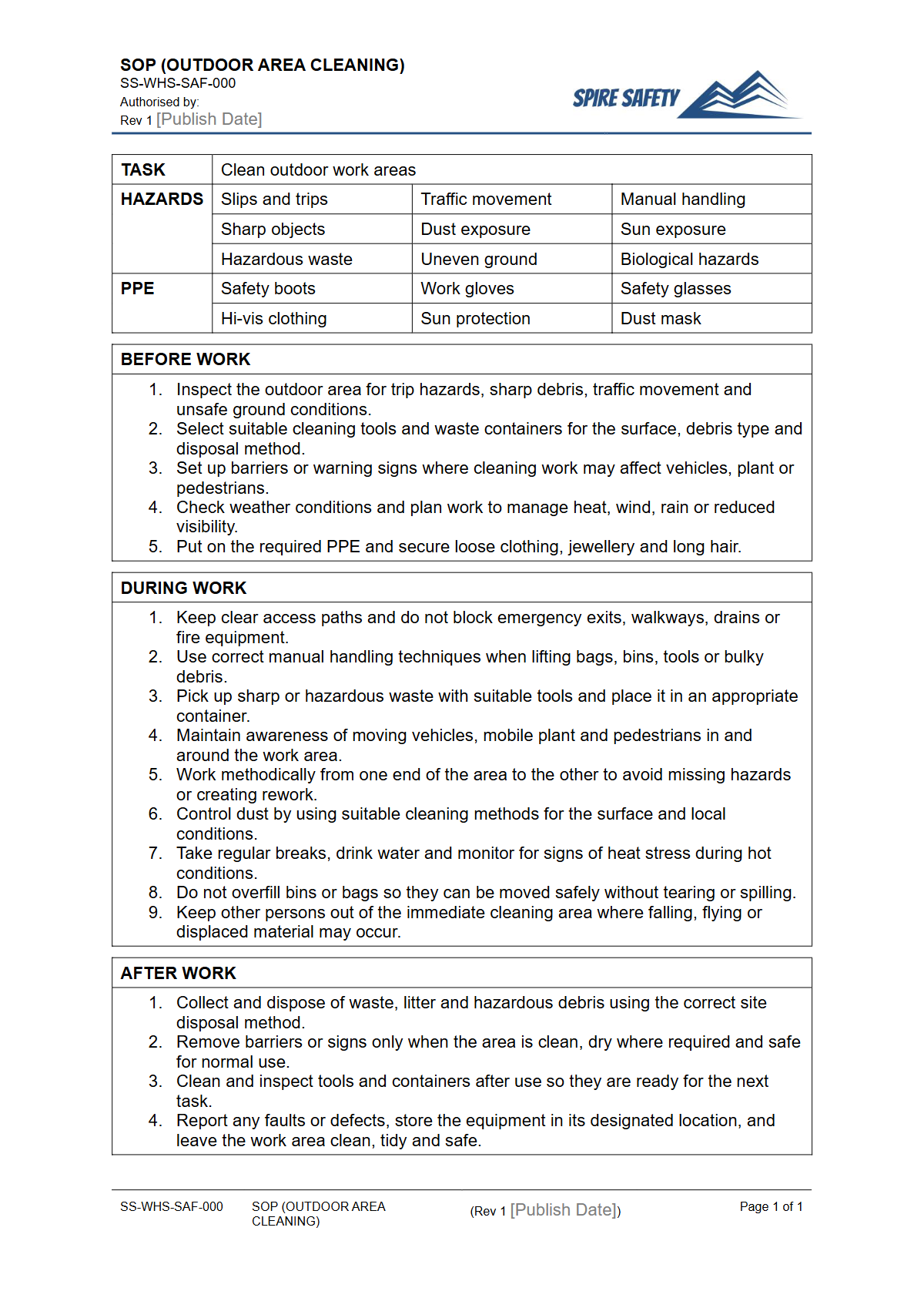
Effectively managing health and safety during routine tasks like cleaning is fundamental to a safe workplace. This Free Safe Operating Procedure (Outdoor Area Cleaning) Template provides a structured framework for documenting the specific steps, hazards, and controls associated with cleaning external areas such as car parks, pathways, courtyards, and building exteriors.
Using a clear SOP helps control common risks like slips from wet surfaces, manual handling injuries from moving equipment, exposure to cleaning chemicals, and hazards from powered equipment like pressure washers or leaf blowers.
A documented procedure ensures that all workers perform the task to the same safe standard, reducing variability and the likelihood of incidents. It serves as a critical training tool for new employees and a reference for experienced staff.
Integrating such procedures is a core component of robust WHS management systems, demonstrating a proactive approach to risk management and organisational commitment to safety.
Video walkthrough
How to use the Free Safe Operating Procedure (Outdoor Area Cleaning) Template
This template is provided in both DOCX and PDF formats for your convenience. The DOCX file is fully editable, allowing you to tailor it precisely to your operational needs.
To use it, simply download the file and open it in a word processor like Microsoft Word or Google Docs.
You must adapt the content to your specific circumstances. This involves:
- Listing the exact personal protective equipment (PPE) required, such as safety glasses, gloves, and non-slip footwear.
- Detailing the specific equipment used at your site, from simple brooms and mops to powered tools.
- Identifying the cleaning agents and chemicals used, referencing their Safety Data Sheets (SDS).
- Mapping out the step-by-step process for your unique environment, including pre-operational checks and post-task cleanup.
Important: This document is a template, not a finished procedure. We have drafted it as a structured starting point, but you must customise it to reflect the unique hazards and controls of your workplace.
We strongly recommend you consult with your workers during this process.
When to use this Safe Operating Procedure
An SOP for outdoor cleaning should be a living document integrated into your daily operations. It is used before any outdoor cleaning task begins, ensuring workers are familiar with the required safe work method.
It forms a key part of worker induction and ongoing training sessions to establish and reinforce safe behaviour.
The SOP should also be a primary reference document when conducting a risk assessment for outdoor cleaning tasks. It should be reviewed and updated regularly, especially after an incident or near-miss, when new equipment or chemicals are introduced, or when the work environment changes.
Regular review is a key activity checked during a WHS compliance auditing process to verify procedural effectiveness.
Who should use this Safe Operating Procedure
This procedure is designed for use by multiple groups within an organisation. Persons Conducting a Business or Undertaking (PCBUs) and managers can use it to fulfil their duty of care by providing a safe system of work.
WHS managers and safety officers will use the template to develop and implement site-specific controls. Supervisors are responsible for ensuring workers are trained on the SOP and follow it correctly during every task.
Ultimately, the end-users are the workers who perform the outdoor cleaning. The SOP provides them with clear, unambiguous instructions to perform their job safely, protecting themselves and others from harm. Procedures for ancillary tasks, such as cleaning up debris after maintenance, should also be formalised; for example, waste from site work may require specific controls similar to those in our FREE Circular Saw SOP (Safe Operating Procedure) Template.
Many outdoor cleaning tasks involve specialised equipment. If your team uses machinery like industrial blowers or pressure washers that run on compressed air, you may also need to develop procedures for the power source.
Our Free Air Compressor SOP (Safe Operating Procedure) Template can provide a useful reference for this.
Formalising procedures for all types of outdoor work helps create a consistent safety culture. Cleaning up after ground-disturbing activities, for instance, has its own set of risks that must be managed. A procedure for cleaning an area after using heavy machinery could be linked to other relevant documents, such as a FREE Trencher SOP (Safe Operating Procedure) Template.
By systematically documenting safe work methods for all operational tasks, you build a safer and more organised workplace. Explore our complete free WHS resources library for more templates to support your safety management system.
Common mistakes
Common mistakes to avoid
- Using a generic template without customising it for the specific site, equipment, and chemicals.
- Failing to adequately train workers on the procedure and confirm their understanding.
- Neglecting to include emergency procedures for chemical spills, injuries, or equipment failure.
- Not involving the workers who actually perform the cleaning task in the development or review of the SOP.
Legal references
Legal considerations
The following legal requirements may be relevant to this type of work.
- Work Health and Safety Act (Harmonised) — Provides the primary duties for protecting workers and other people from work health and safety risks.
- Work Health and Safety Regulations (Harmonised) — Sets out requirements supporting the management of workplace hazards and risks.
The following codes may be relevant to this type of work.
- Managing WHS Risks Code of Practice — Provides practical guidance on identifying hazards, assessing risks and applying effective controls.
- Work Health and Safety Consultation, Cooperation and Coordination Code of Practice — Provides practical guidance on consulting workers and coordinating with other duty holders.
- Managing the Work Environment and Facilities Code of Practice — Provides practical guidance on safe work environments, workplace facilities and related controls.
Did you know
Slips, Trips, and Falls
According to Safe Work Australia, slips, trips, and falls are a leading cause of serious workplace injuries. Effective cleaning procedures and good housekeeping are primary controls for preventing these common incidents.
Chemical Safety
Not all cleaning chemicals are compatible. Mixing certain substances, like bleach and ammonia, can create toxic chlorine gas, posing a severe respiratory hazard to workers and anyone nearby.
FAQ
Frequently asked questions
01What hazards are covered in an SOP for outdoor area cleaning?
02Is a Safe Operating Procedure legally required for outdoor cleaning in Australia?
03How often should an SOP for outdoor cleaning be reviewed?
04Can I use this template for commercial high-pressure water blasting?
Share this resource
Free Safe Operating Procedure (Outdoor Area Cleaning) Template
Browse Categories
How To Use It
- 1Download and open in Word or PDF.
- 2Replace the placeholders with your business details.
- 3Get it reviewed by a WHS specialist before rollout.
Need it customised?
Our WHS consultants can adapt this template to your site, run a gap analysis, or audit what you already have in place.
Book a Free Consultation WHS consulting servicesor call 1300 156 382
Related templates
- Free Safe Operating Procedure (Outdoor Furniture Clean) Template
- Free Safe Operating Procedure (Outdoor Tile Cleaning) Template
- Free Safe Operating Procedure (Oval Boundary Setup) Template
- Free Safe Operating Procedure (Overflow Bin Response) Template
- Free Safe Operating Procedure (Overhead Crane) Template
- Free Safe Operating Procedure (Oxygen Cylinder Change) Template