
Free Safe Operating Procedure (Outboard Motor) Template
Formalise your safety processes for marine operations with our comprehensive template. Download this free Safe Operating Procedure for outboard motors to start today.
Free Safe Operating Procedure (Outboard Motor) Template
DOCX • 126 KB + PDF
Updated Oct 2026
No signup required
Purpose of the Free Safe Operating Procedure (Outboard Motor) Template
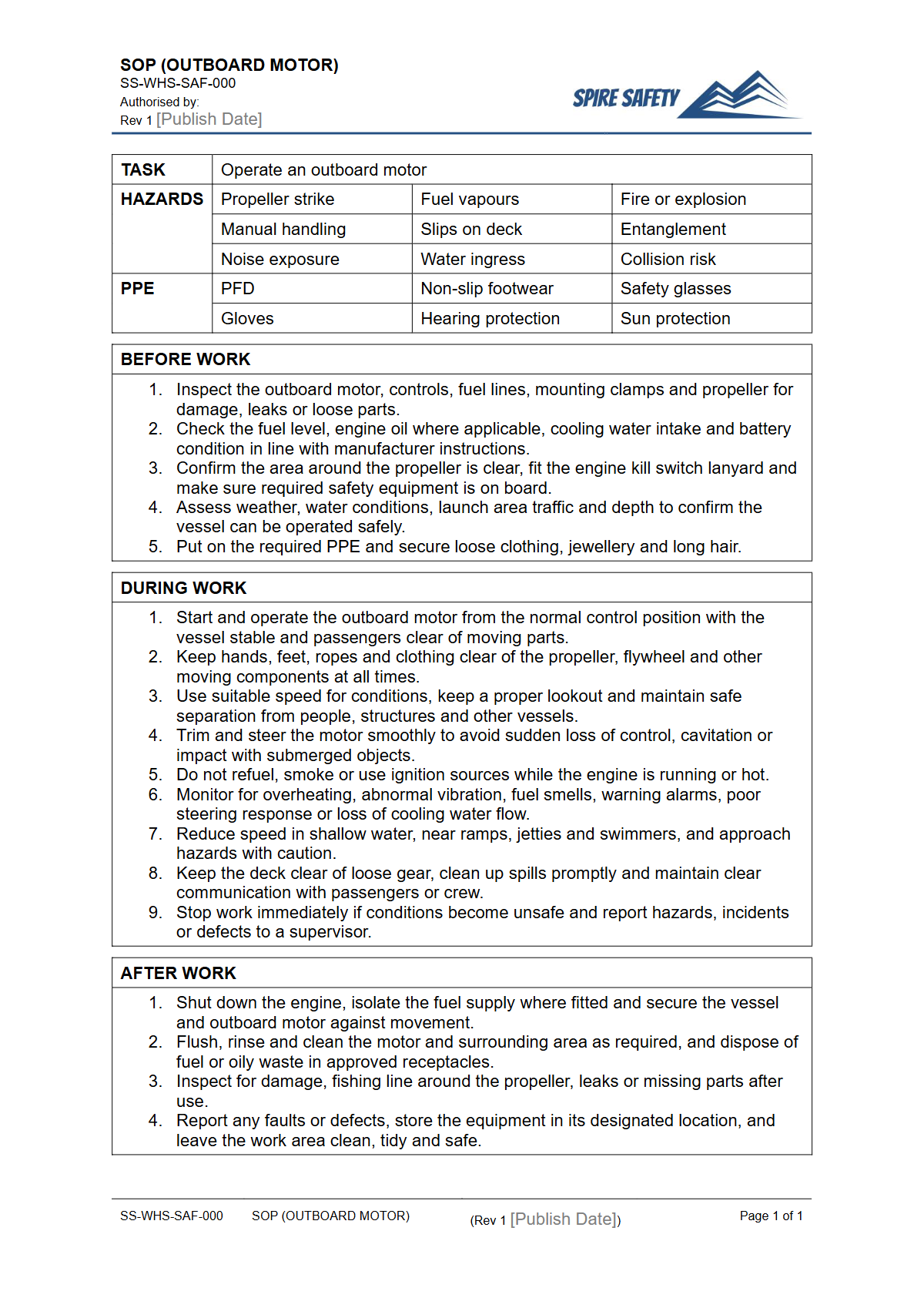
Operating an outboard motor, whether on a small recreational vessel or a commercial workboat, involves significant risks that must be managed. This Free Safe Operating Procedure (Outboard Motor) Template provides a structured framework for documenting the required safety controls and work steps.
Using a standardised procedure helps your organisation meet its duty of care, reduces the likelihood of incidents, and ensures operators are aware of the hazards and the correct methods to mitigate them. It serves as a vital tool for training, inductions, and ongoing risk management.
A comprehensive SOP for outboard motors addresses critical hazards such as propeller entanglement, manual handling injuries when fitting or removing the motor, fire and explosion risks from fuel, and environmental spills. It also covers operational risks like collisions, grounding, noise exposure, and ergonomic strains from vibration and awkward operating postures.
Implementing a clear procedure is a fundamental step in building a positive safety culture around your marine activities.
Key Risk Areas Covered
- Pre-start Checks: Verifying fuel levels, battery charge, steering controls, and propeller condition.
- Refuelling: Steps for safe refuelling to prevent spills and fire, including proper ventilation and avoiding ignition sources.
- Starting and Stopping: Correct sequence for starting the engine, including the mandatory use of a kill switch lanyard.
- On-Water Operation: Guidelines for maintaining a safe speed, lookout procedures, and navigating around hazards.
- Maintenance and Workshop Safety: Procedures for cleaning and basic maintenance tasks. For related workshop activities, our Free Air Compressor SOP can help manage associated risks.
- Emergency Procedures: Actions to take in case of engine failure, fire, or a person-overboard situation.
Video walkthrough
How to use the Free Safe Operating Procedure (Outboard Motor) Template
This template is provided in both DOCX and PDF formats for your convenience. The DOCX file is fully editable, allowing you to tailor the content to the specific types of outboard motors used in your workplace, your unique operational environment, and any state-specific marine regulations.
It is crucial to conduct a site-specific risk assessment and incorporate your findings into the document. Often, boat maintenance may involve other tasks, so integrating procedures like our FREE Circular Saw SOP can create a more holistic safety approach.
Please note: While we have created this template as a robust starting point aligned with Australian WHS principles, you must review and customise it to accurately reflect your own work practices, equipment, and environment. Generic procedures are insufficient; a document becomes effective only when it is specific to the tasks your workers perform.
Integrating this SOP into your broader WHS management systems ensures it is used effectively as part of your overall safety framework.
When to use it
A Safe Operating Procedure for an outboard motor should be a core part of your daily marine operations. It is not a document to be filed away and forgotten. Its primary uses include:
- Worker Training and Inductions: For training new operators and as a refresher for experienced staff.
- Pre-operational Briefings: As a checklist or guide during pre-start or toolbox talks.
- Risk Assessments: To inform the risk assessment process by outlining established controls.
- Incident Investigations: As a benchmark to determine if procedures were followed correctly.
Who should use it
This SOP is designed for use by a range of personnel within an organisation to ensure a consistent and safe approach to operating outboard motors. This includes:
- PCBU/Business Owners: To fulfil their primary duty of care to provide safe systems of work.
- Supervisors and Managers: To train staff, supervise work, and enforce safety standards.
- Workers and Operators: As a clear guide on how to perform their tasks safely.
- WHS Managers and Safety Officers: As a tool for auditing safety compliance and improving workplace procedures. For businesses needing expert guidance on tailoring these documents, engaging with WHS consulting services can provide valuable support.
By making this procedure easily accessible, you empower everyone involved to take responsibility for safety. You can find more templates and checklists like this one in our complete free WHS resources library to build out your safety system.
Common mistakes
Common mistakes to avoid
- Forgetting to attach the kill switch safety lanyard before starting the engine.
- Refuelling while the engine is hot or running, significantly increasing the risk of a fire.
- Neglecting pre-start checks of fuel lines, the propeller, and steering controls.
- Using a generic SOP without customising it for the specific motor, vessel, and operating conditions.
Legal references
Legal considerations
The following legal requirements may be relevant to this type of work.
- Work Health and Safety Act (Harmonised) — Provides the primary duties for protecting workers and other people from work health and safety risks.
- Work Health and Safety Regulations (Harmonised) — Sets out requirements supporting the management of workplace hazards and risks.
The following codes may be relevant to this type of work.
- Managing WHS Risks Code of Practice — Provides practical guidance on identifying hazards, assessing risks and applying effective controls.
- Work Health and Safety Consultation, Cooperation and Coordination Code of Practice — Provides practical guidance on consulting workers and coordinating with other duty holders.
- Managing the Work Environment and Facilities Code of Practice — Provides practical guidance on safe work environments, workplace facilities and related controls.
Did you know
Propeller Strike Danger
The US Coast Guard reports hundreds of propeller strike accidents each year, many of which are fatal or result in severe injuries. Most of these incidents are preventable by using propeller guards and kill switch lanyards.
Fuel Vapour is Heavier than Air
Petrol vapour is three to four times heavier than air, meaning it can accumulate in low spots like the bilge of a boat. This creates a serious explosion risk that requires proper ventilation, especially during and after refuelling.
FAQ
Frequently asked questions
01What are the main hazards of using an outboard motor?
02Is a kill switch lanyard mandatory in Australia?
03How often should a Safe Operating Procedure for an outboard motor be reviewed?
04Do I need a licence to operate a boat with an outboard motor?
Share this resource
Free Safe Operating Procedure (Outboard Motor) Template
Browse Categories
How To Use It
- 1Download and open in Word or PDF.
- 2Replace the placeholders with your business details.
- 3Get it reviewed by a WHS specialist before rollout.
Need it customised?
Our WHS consultants can adapt this template to your site, run a gap analysis, or audit what you already have in place.
Book a Free Consultation WHS consulting servicesor call 1300 156 382
Related templates
- Free Safe Operating Procedure (Outbound Freight Check) Template
- Free Safe Operating Procedure (Outbound Load Staging) Template
- Free Safe Operating Procedure (Outdoor Area Cleaning) Template
- Free Safe Operating Procedure (Outdoor Furniture Clean) Template
- Free Safe Operating Procedure (Outdoor Tile Cleaning) Template
- Free Safe Operating Procedure (Oval Boundary Setup) Template