
Free Safe Operating Procedure (Outbound Freight Check) Template
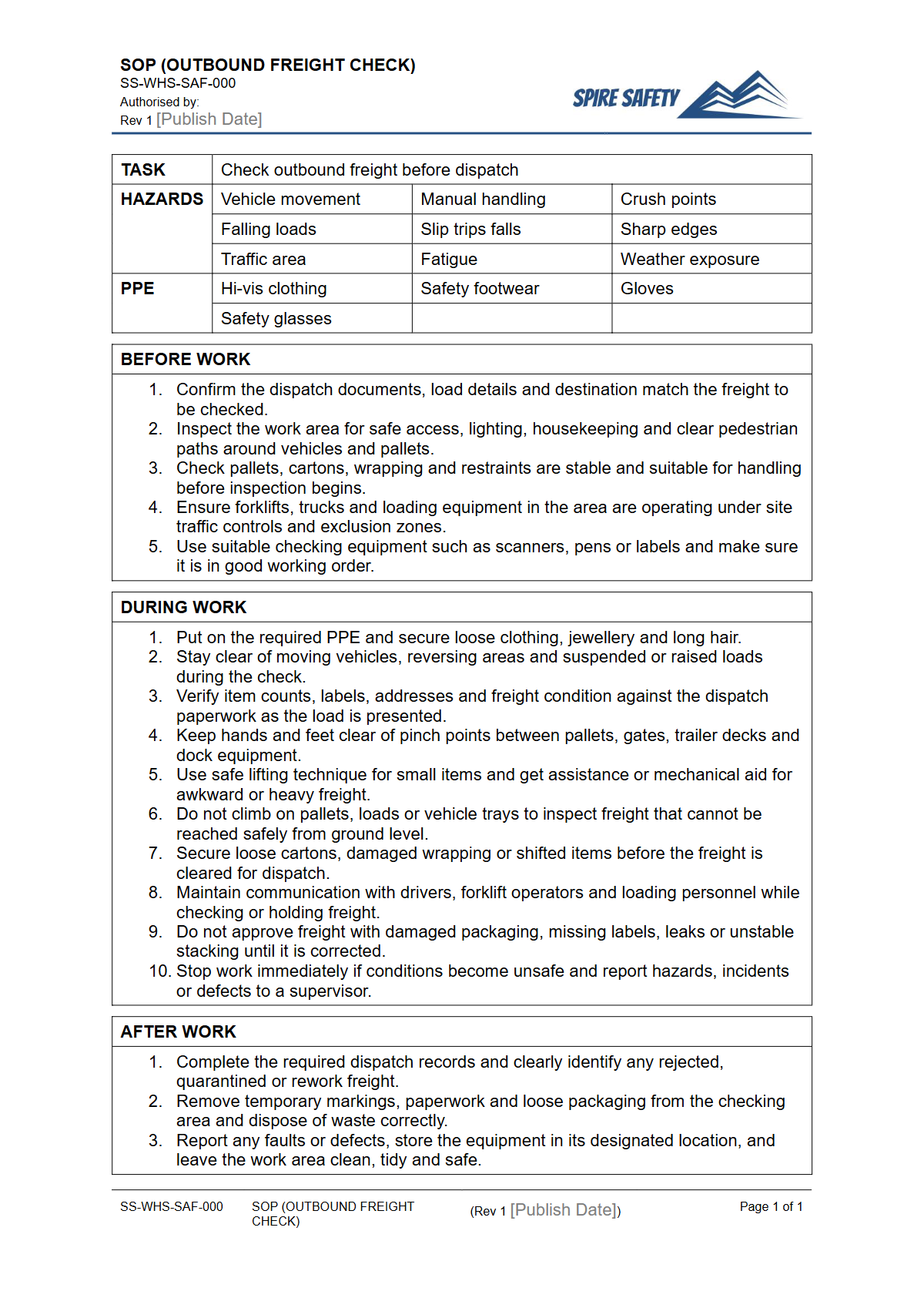
Streamline your dispatch process with our Free Safe Operating Procedure for Outbound Freight Checks.
Free Safe Operating Procedure (Outbound Freight Check) Template
DOCX • 126 KB + PDF
Updated Oct 2026
No signup required
Purpose of the Free Safe Operating Procedure (Outbound Freight Check) Template
Dispatching goods involves significant risks, from manual handling injuries to vehicle interactions and incidents caused by unsecured loads. This Free Safe Operating Procedure (Outbound Freight Check) Template provides a structured framework to help your organisation standardise its final dispatch process.
By implementing a clear SOP, you can minimise hazards, ensure consistency, and create a safer working environment for your team.
A documented procedure helps control risks associated with loading vehicles, securing freight, and managing traffic in the dispatch area. It serves as a vital tool for worker training and provides a clear reference point for correct operational conduct.
Using this template helps formalise your process for checking pallet condition, weight distribution, load restraint, and required documentation, which are all critical steps in preventing incidents both on-site and in transit.
Video walkthrough
How to use the Free Safe Operating Procedure (Outbound Freight Check) Template
This document is a starting point designed to be adapted to your specific operational needs. The downloadable DOCX file is fully editable, allowing you to incorporate details about your site, equipment, and unique processes.
A PDF version is also provided for easy distribution and viewing.
It is essential that you customise this template to reflect the specific machinery, freight types, and risks present in your workplace. We recommend conducting a thorough risk assessment and consulting with your workers to ensure the SOP is practical and effective.
Integrating individual SOPs into cohesive WHS management systems ensures that safety is managed holistically across your organisation rather than in isolation. For complex operations or if you require assistance with the risk assessment process, our WHS consulting services can provide tailored support.
When to use this Safe Operating Procedure
This Safe Operating Procedure should be used every time goods are prepared for dispatch from your facility. It applies to the final stages of the logistics chain before a vehicle departs. Key moments to apply the procedure include:
- Before loading begins, to ensure the vehicle and loading area are safe.
- During the loading process, to verify correct freight placement and weight distribution.
- After loading is complete, as a final verification of load security and documentation.
- During driver handover and pre-departure checks.
Consistency in this process is key, especially in busy environments where machinery like forklifts and conveyors are in constant use. A clear procedure helps manage the flow of work safely, complementing other task-specific documents like a FREE Conveyer System SOP (Safe Operating Procedure) Template.
Who should use it
This SOP is intended for all personnel involved in the outbound freight process. This includes:
- Warehouse and dispatch personnel responsible for picking, packing, and preparing loads.
- Forklift operators and other plant operators who load freight onto vehicles.
- Supervisors and team leaders who oversee dispatch operations.
- Truck drivers, who have a responsibility under Chain of Responsibility (CoR) laws to ensure their vehicle is loaded safely.
All individuals using this SOP must receive training on its contents to ensure they understand their roles and responsibilities. Competency for operating equipment is also critical; for example, a worker using a telehandler must have specific training documented in resources like our FREE Telehandler SOP Template. Regular reviews and refresher training ensure the procedure remains effective.
Formalising this review can be achieved through scheduled WHS compliance auditing to verify that documented procedures are being followed correctly in practice. If your processes involve equipment not listed, you can find more specific templates in our free WHS resources library.
Common mistakes
Common mistakes to avoid
- Using the generic template without customising it for site-specific vehicles, freight types, and hazards.
- Failing to consult with warehouse workers and drivers when developing or updating the procedure.
- Poor record-keeping, leaving no evidence that safety checks were actually completed.
- Treating the SOP as a one-time task instead of a live document that requires regular review and worker training.
Legal references
Legal considerations
The following legal requirements may be relevant to this type of work.
- Work Health and Safety Act (Harmonised) — Provides the primary duties for protecting workers and other people from work health and safety risks.
- Work Health and Safety Regulations (Harmonised) — Sets out requirements supporting the management of workplace hazards and risks.
The following codes may be relevant to this type of work.
- Managing WHS Risks Code of Practice — Provides practical guidance on identifying hazards, assessing risks and applying effective controls.
- Work Health and Safety Consultation, Cooperation and Coordination Code of Practice — Provides practical guidance on consulting workers and coordinating with other duty holders.
- Managing the Work Environment and Facilities Code of Practice — Provides practical guidance on safe work environments, workplace facilities and related controls.
Did you know
Transport Industry Risks
The transport, postal, and warehousing industry has one of the highest rates of serious workers' compensation claims in Australia, with vehicle incidents and muscular stress from manual handling being major causes.
Chain of Responsibility (CoR)
Under Australia's Heavy Vehicle National Law (HVNL), anyone who has influence over the transport chain can be held legally liable for safety breaches. This includes dispatch managers, loaders, and packers—not just the driver.
FAQ
Frequently asked questions
01What should be included in an outbound freight check SOP?
02Is a Safe Operating Procedure for freight checks a legal requirement?
03How can this template help with Chain of Responsibility (CoR) compliance?
04How often should our Outbound Freight Check SOP be reviewed?
Share this resource
Free Safe Operating Procedure (Outbound Freight Check) Template
Browse Categories
How To Use It
- 1Download and open in Word or PDF.
- 2Replace the placeholders with your business details.
- 3Get it reviewed by a WHS specialist before rollout.
Need it customised?
Our WHS consultants can adapt this template to your site, run a gap analysis, or audit what you already have in place.
Book a Free Consultation WHS consulting servicesor call 1300 156 382
Related templates
- Free Safe Operating Procedure (Outbound Load Staging) Template
- Free Safe Operating Procedure (Outdoor Area Cleaning) Template
- Free Safe Operating Procedure (Outdoor Furniture Clean) Template
- Free Safe Operating Procedure (Outdoor Tile Cleaning) Template
- Free Safe Operating Procedure (Oval Boundary Setup) Template
- Free Safe Operating Procedure (Overflow Bin Response) Template