
Free Safe Operating Procedure (Outbound Load Staging) Template
Manage warehouse and logistics risks with our free Safe Operating Procedure for outbound load staging. Download the customisable DOCX and PDF now.
Free Safe Operating Procedure (Outbound Load Staging) Template
DOCX • 126 KB + PDF
Updated Oct 2026
No signup required
Purpose of the Free Safe Operating Procedure (Outbound Load Staging) Template
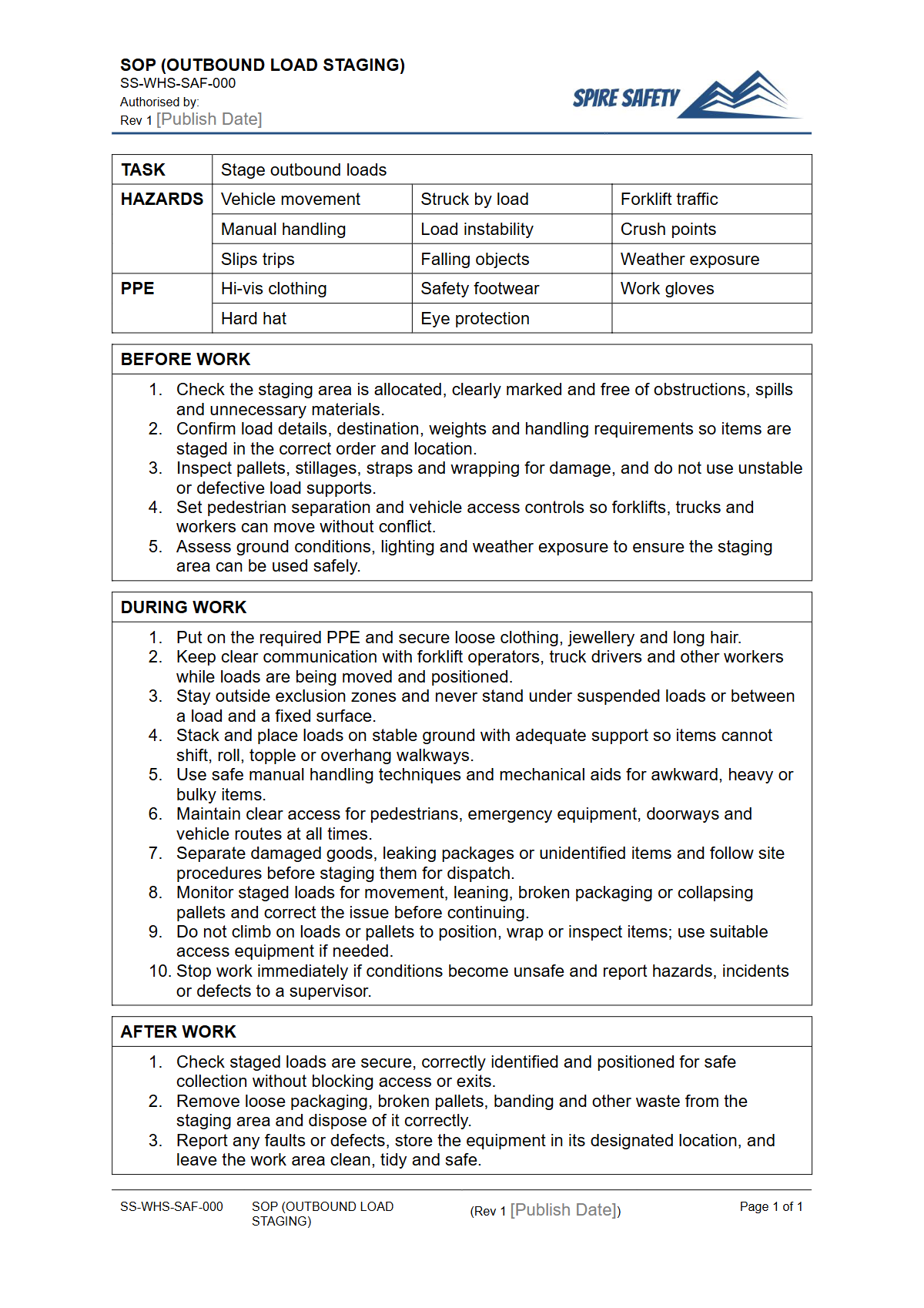
This Free Safe Operating Procedure (Outbound Load Staging) Template provides a structured framework for managing the health and safety risks associated with preparing goods, pallets, and materials for dispatch. Outbound staging areas are busy hubs of activity, presenting hazards such as vehicle and pedestrian interaction, musculoskeletal injuries from manual tasks, and risks from falling objects.
Implementing a detailed SOP helps your organisation to standardise procedures, control identified risks, and provide clear, step-by-step instructions to workers. It forms a critical part of your duty of care by demonstrating a systematic approach to workplace safety in logistics and warehousing environments.
By formally documenting the process, you create a reliable tool for worker training, incident investigation, and continuous improvement. A well-defined procedure ensures that every worker, regardless of experience, follows the same safe steps for palletising, wrapping, labelling, and moving loads to the dispatch bay.
The process often involves machinery, and this document can be used alongside equipment-specific procedures like our free Telehandler SOP template to build a comprehensive safety system.
Video walkthrough
How to use the Free Safe Operating Procedure (Outbound Load Staging) Template
This document is a template designed as a starting point. To make it effective, you must customise it with information specific to your workplace, equipment, and processes.
Download the DOCX file and consult with your team—including warehouse operators, supervisors, and health and safety representatives—to populate the sections with relevant details. Key areas for customisation include specific machinery used, required Personal Protective Equipment (PPE), site layout and traffic flow, emergency contacts, and the step-by-step breakdown of your staging tasks.
Once customised, the SOP should be formally approved and integrated into your overall safety framework. A robust procedure is most effective when it is part of a holistic approach to safety, so consider how it fits within your broader WHS management systems. Remember: we've created this template to save you time on formatting, but the critical safety information must come from your own risk assessment and operational knowledge.
When to use a Safe Operating Procedure
An SOP for outbound load staging should be used as the primary reference document for all workers performing this task. It is a live document that should be applied daily.
It is particularly important during worker induction and training, ensuring new team members learn the correct, safe method from the beginning. The SOP should also be referenced during toolbox talks and pre-start meetings to reinforce key safety messages.
Furthermore, the procedure must be reviewed and updated periodically, after any workplace incident or near-miss, or when a new process, substance, or piece of equipment is introduced to the staging area.
Regular reviews ensure the document remains relevant and effective in controlling risks. These reviews can be scheduled as part of your internal safety calendar or triggered by findings from formal WHS compliance auditing activities, helping you maintain a proactive safety culture.
Who should use this document
This Safe Operating Procedure should be used by several key roles within an organisation. Warehouse Managers and Logistics Coordinators are responsible for implementing and enforcing the procedure.
Supervisors and Team Leaders must use it to train their staff and monitor compliance on the floor. Most importantly, warehouse operators, forklift drivers, and pickers/packers—the individuals physically performing the staging tasks—must understand and follow the procedure every time.
Health and Safety Representatives (HSRs) and WHS Advisors will also use the document as a tool for risk assessment, training development, and incident investigation. Using clear, specific SOPs for distinct processes, such as our Conveyer System SOP, helps ensure every worker understands their role-specific safety obligations.
For organisations managing complex logistics or seeking to establish best-practice safety frameworks, expert guidance can be invaluable. Engaging professional WHS consulting services can help you tailor and implement procedures that are perfectly aligned with your operational needs and regulatory obligations.
Our template is just one of many professional documents designed to support Australian businesses. You can explore our complete free WHS resources library for more templates, checklists, and guides to enhance your safety management system.
Common mistakes
Common mistakes to avoid
- Using the template 'as-is' without customising it for site-specific hazards and equipment.
- Failing to adequately manage the interaction between pedestrians and forklifts or other vehicles in the staging area.
- Improperly stacking or securing palletised goods, leading to instability and risk of collapse.
- Neglecting to train workers on the finalised SOP or failing to enforce its use on the floor.
Legal references
Legal considerations
The following legal requirements may be relevant to this type of work.
- Work Health and Safety Act (Harmonised) — Provides the primary duties for protecting workers and other people from work health and safety risks.
- Work Health and Safety Regulations (Harmonised) — Sets out requirements supporting the management of workplace hazards and risks.
The following codes may be relevant to this type of work.
- Managing WHS Risks Code of Practice — Provides practical guidance on identifying hazards, assessing risks and applying effective controls.
- Work Health and Safety Consultation, Cooperation and Coordination Code of Practice — Provides practical guidance on consulting workers and coordinating with other duty holders.
- Managing the Work Environment and Facilities Code of Practice — Provides practical guidance on safe work environments, workplace facilities and related controls.
Did you know
Staging and Loading Risks
According to Safe Work Australia, the Transport, Postal & Warehousing industry has one of the highest rates of serious workers' compensation claims, with body stressing and being hit by moving objects being major causes of injury.
FAQ
Frequently asked questions
01What is outbound load staging?
02Why is a Safe Operating Procedure important for load staging?
03Is this template suitable for staging all types of goods?
04Who is responsible for ensuring workers follow the SOP?
Share this resource
Free Safe Operating Procedure (Outbound Load Staging) Template
Browse Categories
How To Use It
- 1Download and open in Word or PDF.
- 2Replace the placeholders with your business details.
- 3Get it reviewed by a WHS specialist before rollout.
Need it customised?
Our WHS consultants can adapt this template to your site, run a gap analysis, or audit what you already have in place.
Book a Free Consultation WHS consulting servicesor call 1300 156 382
Related templates
- Free Safe Operating Procedure (Outdoor Area Cleaning) Template
- Free Safe Operating Procedure (Outdoor Furniture Clean) Template
- Free Safe Operating Procedure (Outdoor Tile Cleaning) Template
- Free Safe Operating Procedure (Oval Boundary Setup) Template
- Free Safe Operating Procedure (Overflow Bin Response) Template
- Free Safe Operating Procedure (Overhead Crane) Template