
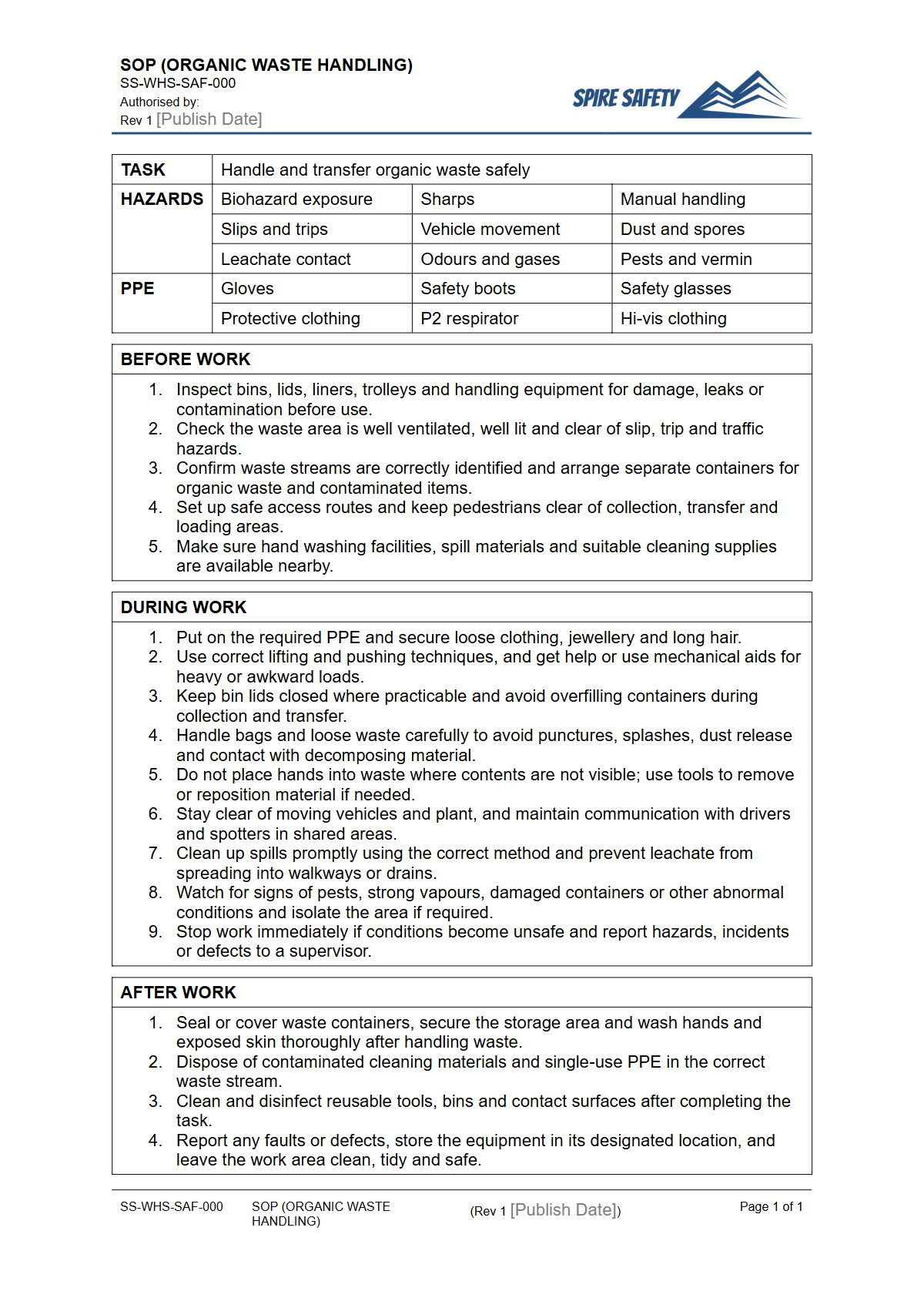
Free Safe Operating Procedure (Organic Waste Handling) Template
Download our free Safe Operating Procedure for organic waste handling to standardise your processes.
Free Safe Operating Procedure (Organic Waste Handling) Template
DOCX • 126 KB + PDF
Updated Oct 2026
No signup required
Purpose of the Free Safe Operating Procedure (Organic Waste Handling) Template
Effectively managing organic waste is crucial for hygiene, safety, and environmental responsibility. Our Free Safe Operating Procedure (Organic Waste Handling) Template provides a structured framework for documenting the specific steps required to handle materials like food scraps, garden waste, and other biodegradable matter safely.
This document helps businesses formalise their processes, control associated hazards such as biological exposure, manual handling injuries, and pest infestations, and ensure all workers follow a consistent, safe method.
Using a standardised Safe Operating Procedure (SOP) is a fundamental component of a robust safety system. It serves as a key training tool for new employees and a reference for experienced staff, ensuring everyone understands their responsibilities.
Integrating this SOP into your broader WHS management systems helps demonstrate a systematic approach to risk management and promotes a proactive safety culture within your organisation.
Video walkthrough
How to use the Free Safe Operating Procedure (Organic Waste Handling) Template
This template is provided in both DOCX and PDF formats for your convenience. The DOCX file is fully editable, allowing you to tailor the content to the unique requirements of your workplace.
To use the template effectively, you should conduct a risk assessment of your specific organic waste handling tasks and incorporate the findings into the document. This includes detailing the types of waste, the equipment used, required Personal Protective Equipment (PPE), and emergency response procedures.
IMPORTANT: This document is a template, not a completed procedure. We have designed it as a starting point, and you must customise it to reflect the specific hazards, equipment (such as compactors or balers), and control measures relevant to your operations.
Failure to do so may result in a procedure that is not fit for purpose. For processes involving automated machinery, you may also need a specific conveyer system SOP to cover equipment-related risks.
When to use this Safe Operating Procedure
This Safe Operating Procedure should be developed and implemented before any workers are assigned to tasks involving organic waste. It forms a critical part of the induction and training process.
The SOP should be readily accessible in the work area for easy reference during day-to-day operations. It is also a vital document for conducting refresher training, especially if procedures change or new equipment is introduced.
For example, in a commercial kitchen setting, this procedure would be used alongside others like a Safe Operating Procedure for a deep fryer to create a comprehensive safety framework.
Who should use it
This SOP is intended for use by all personnel involved in the collection, storage, transport, and disposal of organic waste. This includes kitchen hands, cleaners, groundskeepers, agricultural workers, and waste management operators.
Supervisors and managers are responsible for ensuring the SOP is implemented, understood, and followed by all relevant staff. They must also schedule regular reviews and updates to the document. The finalised SOP serves as an evidence document during safety inspections and can be a key reference during a WHS compliance audit.
In agricultural settings, the handling and application of organic matter like compost or manure require specific procedures to prevent contamination and musculoskeletal injuries. This SOP can be adapted for such environments, often in conjunction with equipment-specific documents like a spreader SOP to ensure both material and machinery are handled safely.
If your workplace deals with particularly hazardous or complex organic waste streams, such as biosolids or abattoir by-products, seeking specialist advice is recommended. An expert can help ensure your risk controls are adequate and your procedures are robust.
Our WHS consulting services can provide tailored support for developing complex safety documentation.
This document is one of many available to help you build a safer workplace. Feel free to explore our complete free WHS resources library for more templates, checklists, and guides to support your safety management system.
Common mistakes
Common mistakes to avoid
- Using the template without performing a site-specific risk assessment and customisation.
- Failing to provide or enforce the use of appropriate Personal Protective Equipment (PPE).
- Neglecting to train workers on the finalised SOP and its specific requirements.
- Poor housekeeping practices that lead to spills, odours, and pest problems.
Legal references
Legal considerations
The following legal requirements may be relevant to this type of work.
- Work Health and Safety Act (Harmonised) — Provides the primary duties for protecting workers and other people from work health and safety risks.
- Work Health and Safety Regulations (Harmonised) — Sets out requirements supporting the management of workplace hazards and risks.
The following codes may be relevant to this type of work.
- Managing WHS Risks Code of Practice — Provides practical guidance on identifying hazards, assessing risks and applying effective controls.
- Work Health and Safety Consultation, Cooperation and Coordination Code of Practice — Provides practical guidance on consulting workers and coordinating with other duty holders.
- Managing the Work Environment and Facilities Code of Practice — Provides practical guidance on safe work environments, workplace facilities and related controls.
Did you know
Waste Generation
Australia generates over 14 million tonnes of organic waste annually, with a significant portion originating from households and commercial businesses like supermarkets and restaurants.
Biogas Potential
When organic waste decomposes in an anaerobic environment (without oxygen), it produces biogas. This can be captured and used as a renewable energy source for generating electricity and heat.
FAQ
Frequently asked questions
01What are the main hazards of handling organic waste?
02Is this SOP template suitable for all types of organic waste?
03How often should we review our Organic Waste Handling SOP?
04What PPE is generally required for handling organic waste?
Share this resource
Free Safe Operating Procedure (Organic Waste Handling) Template
Browse Categories
How To Use It
- 1Download and open in Word or PDF.
- 2Replace the placeholders with your business details.
- 3Get it reviewed by a WHS specialist before rollout.
Need it customised?
Our WHS consultants can adapt this template to your site, run a gap analysis, or audit what you already have in place.
Book a Free Consultation WHS consulting servicesor call 1300 156 382
Related templates
- Free Safe Operating Procedure (Oscillating Tool) Template
- Free Safe Operating Procedure (Outboard Motor) Template
- Free Safe Operating Procedure (Outbound Freight Check) Template
- Free Safe Operating Procedure (Outbound Load Staging) Template
- Free Safe Operating Procedure (Outdoor Area Cleaning) Template
- Free Safe Operating Procedure (Outdoor Furniture Clean) Template