
Free Safe Operating Procedure (Orchard Pruning) Template
Download our free Safe Operating Procedure (Orchard Pruning) Template to document safe work practices. This customisable guide helps you manage risks.
Free Safe Operating Procedure (Orchard Pruning) Template
DOCX • 126 KB + PDF
Updated Oct 2026
No signup required
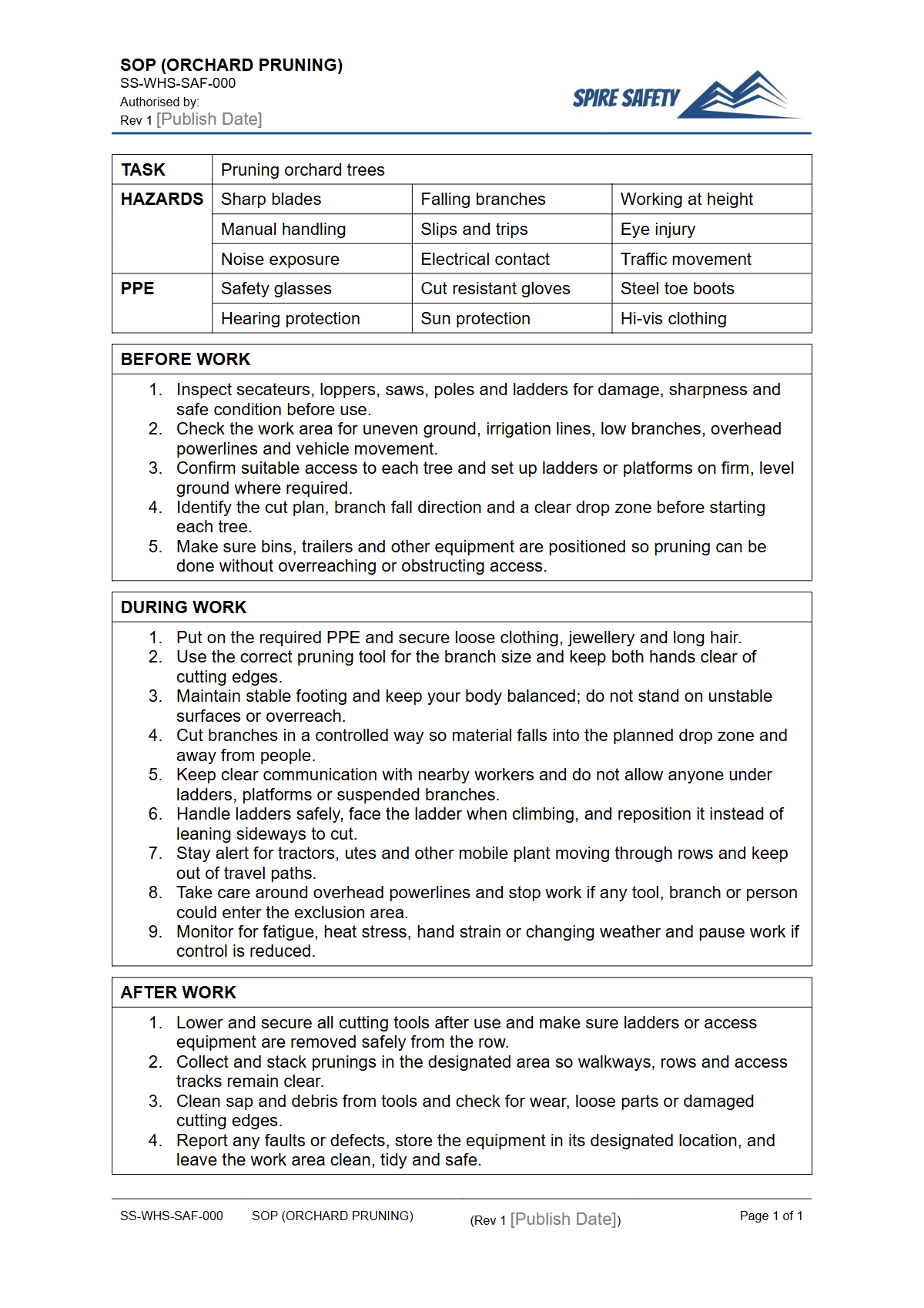
Purpose of the Free Safe Operating Procedure (Orchard Pruning) Template
This Safe Operating Procedure (SOP) for orchard pruning provides a structured starting point for businesses in the agricultural sector to formally document the safest way to perform pruning tasks. Orchard pruning involves significant risks, including falls from height, cuts from saws or shears, ergonomic injuries from repetitive motions, and hazards related to machinery.
Using a formal procedure helps to systematically identify these hazards, outline control measures, and ensure all workers follow a consistent, safe method of work. This approach is fundamental to meeting your Work Health and Safety (WHS) obligations and creating a safer working environment for everyone on site.
A well-defined SOP is a key component of effective WHS management systems, serving as both a training tool for new workers and a reference for experienced staff. It standardises expectations around pre-start checks, personal protective equipment (PPE), and emergency procedures, reducing the likelihood of incidents and injuries.
By implementing this procedure, you demonstrate a commitment to proactive safety management.
Video walkthrough
How to use the Free Safe Operating Procedure (Orchard Pruning) Template
This template is designed to be a comprehensive foundation, but it must be adapted to your specific operational context. Download the DOCX file and customise it with details relevant to your orchard, equipment, and workforce.
Your process should involve consulting with the workers who actually perform the pruning tasks, as their practical experience is invaluable for identifying real-world risks and effective controls.
Key steps for customisation include:
- Identifying the specific types of powered and manual tools used (e.g., chainsaws, pole saws, pneumatic loppers, secateurs).
- Detailing the access equipment used, such as ladders, elevating work platforms (EWPs), or mobile platforms.
- Listing the required PPE, which might include safety glasses, gloves, steel-capped boots, and hearing protection for powered tools.
- Documenting site-specific emergency procedures, including first aid contacts and assembly points.
- Specifying the training and competency requirements for workers performing the task.
Remember, this document is a starting point. We have developed it to align with Australian WHS principles, but it is your responsibility to ensure the final SOP is tailored to the unique conditions and hazards of your workplace.
When to use it
An SOP for orchard pruning should be used whenever pruning tasks are undertaken, whether daily during peak season or for periodic maintenance. It is most effective when integrated into your daily operations.
It should be referenced during pre-start meetings or toolbox talks to reinforce safe work practices before work begins. It is also a critical document to have available during worker training and induction.
If conditions change, such as the introduction of new equipment or after a near miss, the SOP must be reviewed and updated immediately to reflect the new circumstances.
For complex operations involving heavy machinery for access or clearing, you may need to supplement this procedure with others, such as our FREE Telehandler SOP Template, to cover all associated tasks.
Who should use it
This SOP should be used by anyone involved in the orchard pruning process. This includes:
- Persons Conducting a Business or Undertaking (PCBUs): Farm owners and managers must ensure the SOP is developed, implemented, and maintained as part of their duty of care.
- Supervisors and Team Leaders: They are responsible for ensuring workers understand and follow the procedure, providing adequate supervision, and conducting relevant training.
- Workers: The individuals performing the pruning must be trained on the SOP and are required to follow its instructions to ensure their own safety and the safety of others.
- WHS Professionals and Consultants: Safety advisors can use this template as a tool when developing site-specific documentation for clients in the agricultural industry.
Regular safety checks and reviews are essential to maintain the effectiveness of your SOPs. A formal WHS compliance auditing process can help verify that procedures are being followed correctly in the field and identify any gaps in your safety system. If your operation uses pneumatic pruners, you should also document the procedures for the equipment powering them, using a resource like our Free Air Compressor SOP (Safe Operating Procedure) Template.
For a consistent approach to power tool safety across your business, you might also find value in our FREE Circular Saw SOP (Safe Operating Procedure) Template, which shares similar principles for pre-start checks and hazard control. You can explore our full range of customisable documents in our free WHS resources library to build out your safety management system.
Common mistakes
Common mistakes to avoid
- Using a generic template without customising it for specific tools, equipment, and site conditions.
- Failing to consult with workers who perform the pruning when drafting or reviewing the procedure.
- Neglecting to provide and document formal training on the finalised SOP for all relevant staff.
- Not reviewing and updating the SOP after an incident, a near miss, or the introduction of new equipment.
Legal references
Legal considerations
The following legal requirements may be relevant to this type of work.
- Work Health and Safety Act (Harmonised) — Provides the primary duties for protecting workers and other people from work health and safety risks.
- Work Health and Safety Regulations (Harmonised) — Sets out requirements supporting the management of workplace hazards and risks.
The following codes may be relevant to this type of work.
- Managing WHS Risks Code of Practice — Provides practical guidance on identifying hazards, assessing risks and applying effective controls.
- Work Health and Safety Consultation, Cooperation and Coordination Code of Practice — Provides practical guidance on consulting workers and coordinating with other duty holders.
- Managing the Work Environment and Facilities Code of Practice — Provides practical guidance on safe work environments, workplace facilities and related controls.
Did you know
Agricultural Injury Rates
The agriculture, forestry, and fishing industry consistently has one of Australia's highest rates of serious workplace injury claims. Body stressing (manual handling) and falls from height are two of the most common causes of injury in this sector.
FAQ
Frequently asked questions
01What are the main hazards involved in orchard pruning?
02Does this SOP template replace a risk assessment for pruning?
03How often should an SOP for orchard pruning be reviewed?
04Is training required after creating the Safe Operating Procedure?
Share this resource
Free Safe Operating Procedure (Orchard Pruning) Template
Browse Categories
How To Use It
- 1Download and open in Word or PDF.
- 2Replace the placeholders with your business details.
- 3Get it reviewed by a WHS specialist before rollout.
Need it customised?
Our WHS consultants can adapt this template to your site, run a gap analysis, or audit what you already have in place.
Book a Free Consultation WHS consulting servicesor call 1300 156 382
Related templates
- Free Safe Operating Procedure (Orchard Weed Control) Template
- Free Safe Operating Procedure (Order Picker) Template
- Free Safe Operating Procedure (Order Pickup Handling) Template
- Free Safe Operating Procedure (Ore Sorter) Template
- Free Safe Operating Procedure (Organic Waste Handling) Template
- Free Safe Operating Procedure (Oscillating Tool) Template