
Free Safe Operating Procedure (Order Picker) Template
Formalise your warehouse safety with our Free Safe Operating Procedure (Order Picker) Template. Download this user-friendly document to standardise use.
Free Safe Operating Procedure (Order Picker) Template
DOCX • 126 KB + PDF
Updated Oct 2026
No signup required
Purpose of the Free Safe Operating Procedure (Order Picker) Template
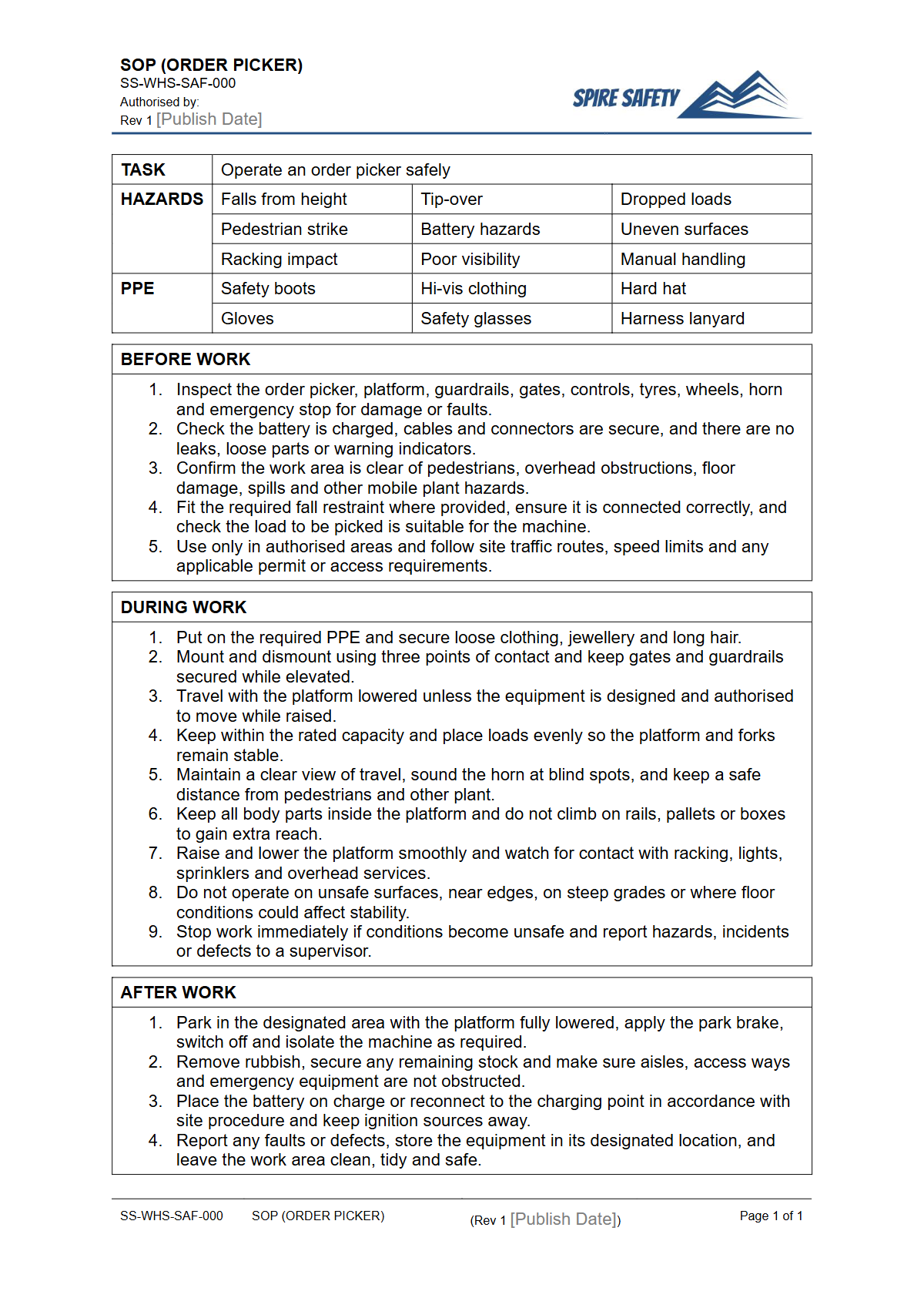
Operating an order picker, a type of specialised forklift, presents significant safety risks, including falls from height, collisions, and manual handling injuries. This Free Safe Operating Procedure (Order Picker) Template provides a structured framework for documenting the safest way to perform this task.
Using a standardised SOP helps your organisation meet its duty of care by providing clear instructions to workers, reducing the likelihood of incidents, and ensuring consistent training standards. It serves as a critical component of your workplace's broader safety framework, demonstrating a commitment to proactive risk management and forming a key part of effective WHS management systems.
Video walkthrough
How to use the Free Safe Operating Procedure (Order Picker) Template
This downloadable document provides a comprehensive starting point, not a final, compliant solution. It is crucial to adapt the content to the specific order picker models used at your site, the layout of your warehouse, and the unique environmental factors of your workplace.
Consult with your operators, supervisors, and health and safety representatives during customisation. Review the manufacturer’s operating manual and incorporate your site-specific risk assessment findings. A well-developed SOP for one piece of plant, like an order picker, should be consistent with procedures for related equipment, such as those detailed in our Conveyer System SOP.
Important: We have created this template as a guide. You must customise this document to reflect the specific hazards, risks, and control measures relevant to your workplace and operations.
Spire Safety accepts no liability for the use of this template.
What’s Included in the Template?
Our Order Picker SOP template is logically structured to guide operators through the task safely from start to finish. It includes dedicated sections for:
- Required Personal Protective Equipment (PPE)
- Pre-operational safety checks and equipment inspection
- Step-by-step instructions for safe operation, including travelling, raising/lowering the platform, and picking stock
- Procedures for parking, shutting down, and securing the machine
- Emergency procedures and contact information
This format is designed for clarity and ease of use during training and on-the-job reference. You can explore similar structured documents in our extensive free WHS resources library.
When to Use This Safe Operating Procedure
A Safe Operating Procedure for an order picker should be a central part of your daily operations and safety management. It should be used during the induction and training of new operators to establish a baseline of safe behaviour.
The SOP also serves as an essential tool for refresher training and for verifying competency over time. Furthermore, it should be reviewed and referenced immediately following any incident, near miss, or hazard report involving an order picker.
Regular WHS compliance audits may also identify the need to create, update, or improve your SOPs to address identified gaps in your safety processes.
Who Should Use This SOP
This procedure is intended for several key roles within an organisation. Primarily, all authorised and licenced order picker operators must be trained on and follow the SOP.
Supervisors and managers are responsible for enforcing its use, providing training, and ensuring operators remain competent. WHS personnel and trainers will use the document to develop training programs and conduct risk assessments. The principles of safe operation are transferable across various types of high-risk plant, and you may find it useful to standardise your approach by using similar templates, such as our telehandler SOP.
Integrating the SOP Into Your Safety System
A standalone document offers limited value; its effectiveness comes from its integration into your overall WHS system. The SOP should be referenced in your training records, linked within your risk register, and made easily accessible to workers in their operational areas, whether in digital or physical format.
Regular reviews, scheduled at least annually or as conditions change, ensure it remains relevant and effective. If you need assistance embedding SOPs and other safety documents into a cohesive and practical system, consider seeking professional WHS consulting to ensure your framework is robust and aligned with best practice.
Common mistakes
Common mistakes to avoid
- Using the generic template without customising it for the specific workplace and equipment.
- Failing to train all operators on the finalised SOP and document the training.
- Operators becoming complacent and skipping mandatory pre-operational checks.
- Neglecting to review and update the SOP after a near miss, incident, or process change.
Legal references
Legal considerations
The following legal requirements may be relevant to this type of work.
- Work Health and Safety Act (Harmonised) — Provides the primary duties for protecting workers and other people from work health and safety risks.
- Work Health and Safety Regulations (Harmonised) — Sets out requirements supporting the management of workplace hazards and risks.
The following codes may be relevant to this type of work.
- Managing WHS Risks Code of Practice — Provides practical guidance on identifying hazards, assessing risks and applying effective controls.
- Work Health and Safety Consultation, Cooperation and Coordination Code of Practice — Provides practical guidance on consulting workers and coordinating with other duty holders.
- Managing the Work Environment and Facilities Code of Practice — Provides practical guidance on safe work environments, workplace facilities and related controls.
Did you know
Licence Specificity
The LO (order picker) licence is distinct from the LF (forklift) licence because it involves specific training on working at height, as the operator travels up with the load.
Warehouse Risks
According to Safe Work Australia, the transport, postal, and warehousing industry has one of the highest rates of serious workers' compensation claims, with vehicle incidents and falls being major causes.
FAQ
Frequently asked questions
01Is a Safe Operating Procedure a legal requirement for order pickers in Australia?
02What is the difference between a SWMS and an SOP for an order picker?
03How often should we review our order picker SOP?
04Do operators need a specific licence for an order picker?
Share this resource
Free Safe Operating Procedure (Order Picker) Template
Browse Categories
How To Use It
- 1Download and open in Word or PDF.
- 2Replace the placeholders with your business details.
- 3Get it reviewed by a WHS specialist before rollout.
Need it customised?
Our WHS consultants can adapt this template to your site, run a gap analysis, or audit what you already have in place.
Book a Free Consultation WHS consulting servicesor call 1300 156 382
Related templates
- Free Safe Operating Procedure (Order Pickup Handling) Template
- Free Safe Operating Procedure (Ore Sorter) Template
- Free Safe Operating Procedure (Organic Waste Handling) Template
- Free Safe Operating Procedure (Oscillating Tool) Template
- Free Safe Operating Procedure (Outboard Motor) Template
- Free Safe Operating Procedure (Outbound Freight Check) Template