
Free Safe Operating Procedure (Order Pickup Handling) Template
Streamline your order collection process with our comprehensive Safe Operating Procedure for order pickup handling.
Free Safe Operating Procedure (Order Pickup Handling) Template
DOCX • 126 KB + PDF
Updated Oct 2026
No signup required
Purpose of the Free Safe Operating Procedure (Order Pickup Handling) Template
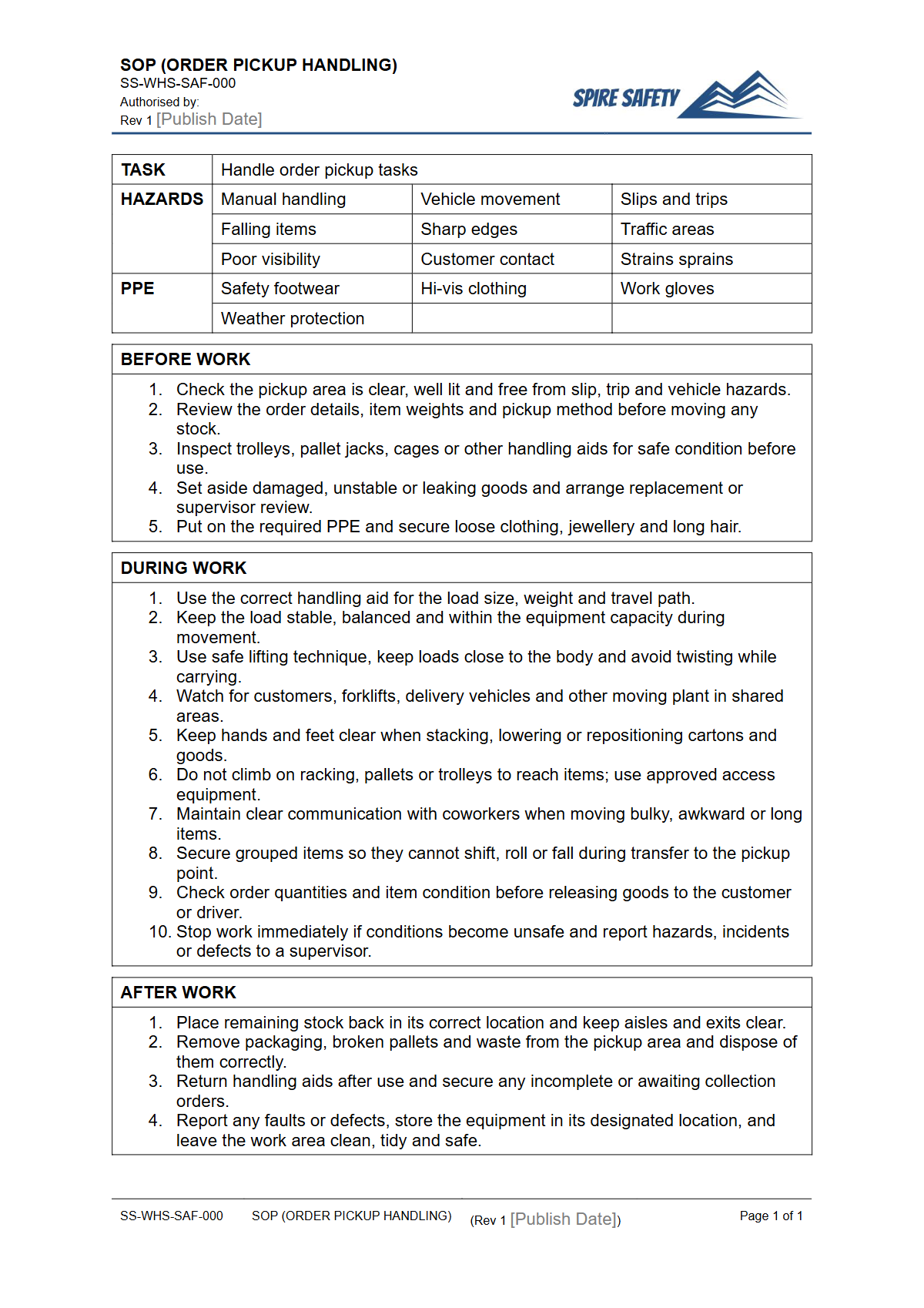
This Free Safe Operating Procedure (Order Pickup Handling) Template provides a structured framework for organisations to document safe work practices for managing customer order collections. The process of retrieving, preparing, and handing over goods to customers or couriers presents numerous WHS risks, including manual handling injuries, slips and trips, and interactions with vehicle traffic.
Using this SOP helps businesses systematically identify these hazards and outline clear, step-by-step controls to protect workers and others in the workplace. A well-developed SOP is a critical component of any effective WHS management system, demonstrating a commitment to proactive risk management.
Video walkthrough
How to use the Free Safe Operating Procedure (Order Pickup Handling) Template
Our template is available for download as a DOCX file for easy editing or as a PDF for immediate use. To effectively implement it, you must adapt its contents to the unique conditions of your environment.
This includes specifying your site layout, the types of products handled, vehicle movement areas, and any specific equipment used. Consultation with your team—the people who perform the tasks daily—is essential to ensure the procedure is practical and reflects actual work practices.
Important: This is a template only. We provide the structure and typical considerations, but you must customise it with your own site-specific details, risk assessments, and control measures.
A generic document that is not tailored to your workplace will not be effective. Once finalised, the SOP should form the basis of worker training and regular toolbox talks. The effectiveness of its implementation can be verified through routine workplace inspections or formal WHS compliance auditing.
When to use it
This Safe Operating Procedure is designed for any business where customers or transport providers collect goods directly from the premises. It formalises the safety protocols for these interactions, which can vary significantly between industries. Common scenarios include:
- Retail 'Click and Collect' services at storefronts or dedicated pickup bays.
- Warehouse or factory-direct sales where customers collect bulky items.
- Hospitality businesses managing takeaway or delivery driver pickups.
- Trade suppliers and distribution centres handing over materials to contractors.
In a complex environment like a busy restaurant, this SOP should be integrated with other task-specific procedures, such as those for kitchen equipment. For example, a business might also require a Free Safe Operating Procedure for a Deep Fryer as part of its overall safety framework.
Who should use it
This template is primarily intended for use by those responsible for workplace safety and operational management. This includes:
- Work Health and Safety (WHS) Managers and Advisors.
- Retail, Warehouse, and Hospitality Managers or Supervisors.
- Small Business Owners who directly oversee daily operations.
- Team Leaders responsible for training staff and monitoring work practices.
These individuals are tasked with developing, implementing, and reviewing safety procedures. They must ensure that all relevant workers are trained on the SOP's content and that the outlined safety measures are consistently followed.
Key Elements in an Order Pickup Handling SOP
An effective SOP for order pickup handling should be clear, concise, and easy for any worker to follow. This template guides you through several critical sections:
- Hazard Identification: Prompts you to list potential hazards like muscular stress from lifting, trip hazards from packaging, or collisions with vehicles.
- Personal Protective Equipment (PPE): Specifies required PPE, such as high-visibility vests for outdoor staff, safety footwear, or gloves for handling certain products.
- Step-by-Step Procedure: A logical sequence of actions from receiving the order request to safely handing over the goods and completing the transaction. This includes steps for traffic control and pedestrian management.
- Emergency Procedures: Outlines actions to take in case of an incident, like a medical emergency, spillage, or traffic accident.
In larger facilities, the order fulfilment process may involve machinery before the final handover stage. It is vital to have separate SOPs for such equipment.
For instance, if goods are moved from storage via automated systems, a FREE Conveyer System SOP would be necessary. Similarly, for handling very large or palletised goods, a procedure for mechanical aids is essential, and you may need a FREE Telehandler SOP Template to cover safe loading practices.
By thoroughly documenting each stage, your organisation can create a robust and reliable system for managing order pickups safely. You can explore our complete free WHS resources library for more templates to support your safety management system.
Common mistakes
Common mistakes to avoid
- Failing to customise the template with site-specific layouts, products, and risks.
- Neglecting to consult with and train workers on the finalised safe operating procedure.
- Overlooking vehicle traffic management in customer car parks or loading zones.
- Forgetting to review and update the SOP after a near miss, incident, or change in process.
Legal references
Legal considerations
The following legal requirements may be relevant to this type of work.
- Work Health and Safety Act (Harmonised) — Provides the primary duties for protecting workers and other people from work health and safety risks.
- Work Health and Safety Regulations (Harmonised) — Sets out requirements supporting the management of workplace hazards and risks.
The following codes may be relevant to this type of work.
- Managing WHS Risks Code of Practice — Provides practical guidance on identifying hazards, assessing risks and applying effective controls.
- Work Health and Safety Consultation, Cooperation and Coordination Code of Practice — Provides practical guidance on consulting workers and coordinating with other duty holders.
- Managing the Work Environment and Facilities Code of Practice — Provides practical guidance on safe work environments, workplace facilities and related controls.
Did you know
Manual Handling Risk
Hazardous manual tasks are a leading cause of workplace injury in Australia, and repetitive lifting, carrying, and loading of customer orders are significant contributing activities across the retail and logistics sectors.
Traffic Management
Implementing clear separation between pedestrians and vehicles in pickup zones, using clear signage and designated walkways, is one of the most effective ways to prevent serious incidents in customer collection areas.
FAQ
Frequently asked questions
01What are the main hazards involved in customer order pickups?
02Does this SOP template cover drive-through services?
03Who is responsible for training workers on the Order Pickup Handling SOP?
04How often should an SOP for order handling be reviewed?
Share this resource
Free Safe Operating Procedure (Order Pickup Handling) Template
Browse Categories
How To Use It
- 1Download and open in Word or PDF.
- 2Replace the placeholders with your business details.
- 3Get it reviewed by a WHS specialist before rollout.
Need it customised?
Our WHS consultants can adapt this template to your site, run a gap analysis, or audit what you already have in place.
Book a Free Consultation WHS consulting servicesor call 1300 156 382
Related templates
- Free Safe Operating Procedure (Ore Sorter) Template
- Free Safe Operating Procedure (Organic Waste Handling) Template
- Free Safe Operating Procedure (Oscillating Tool) Template
- Free Safe Operating Procedure (Outboard Motor) Template
- Free Safe Operating Procedure (Outbound Freight Check) Template
- Free Safe Operating Procedure (Outbound Load Staging) Template