
Free Safe Operating Procedure (Orchard Weed Control) Template
Download our free Safe Operating Procedure for orchard weed control to formalise your safety processes.
Free Safe Operating Procedure (Orchard Weed Control) Template
DOCX • 126 KB + PDF
Updated Oct 2026
No signup required
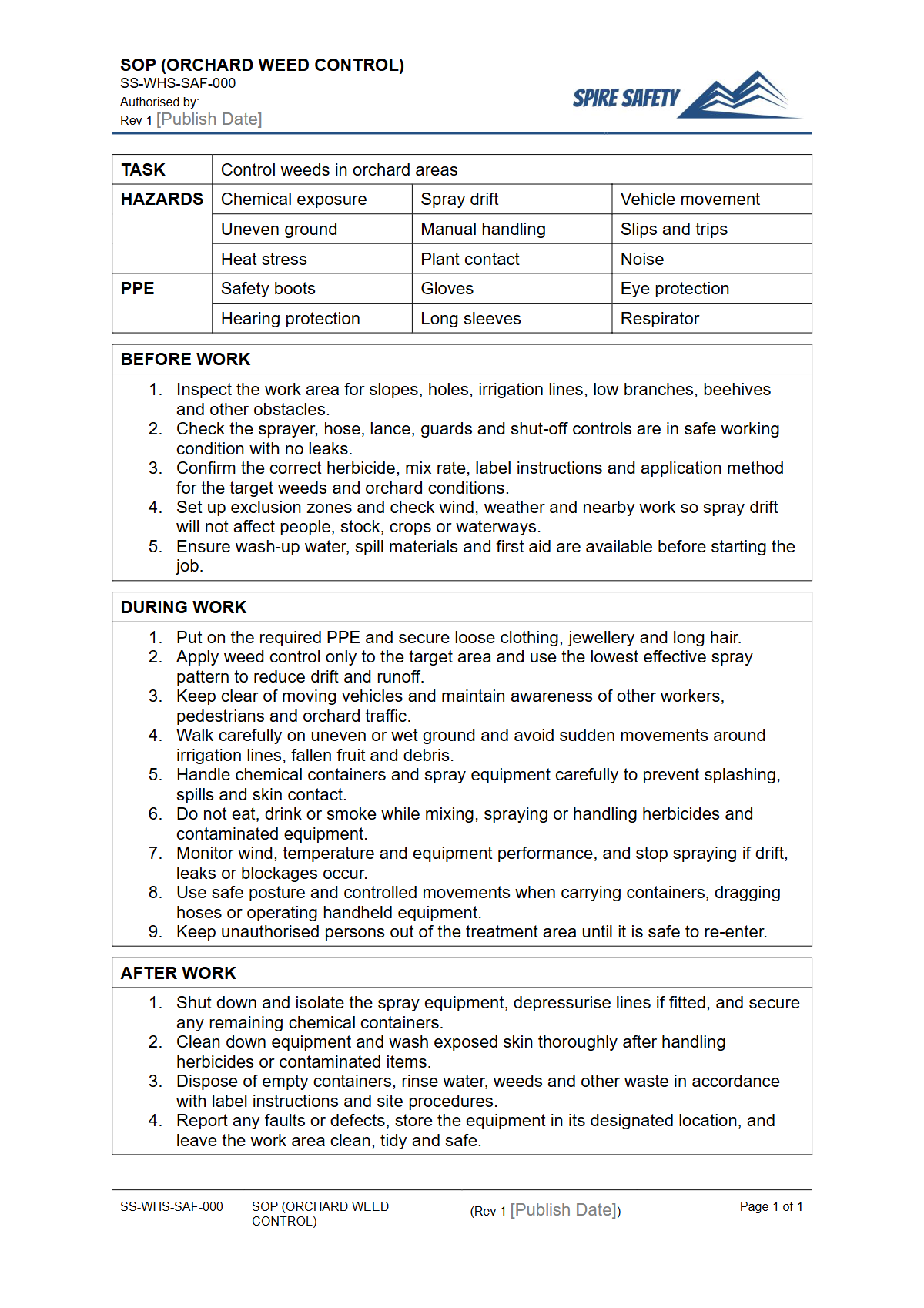
Purpose of the Free Safe Operating Procedure (Orchard Weed Control) Template
Effectively managing work health and safety in an agricultural setting requires clear, documented processes. This free Safe Operating Procedure (Orchard Weed Control) template provides a structured starting point for your business to formalise the steps for safely managing weeds in an orchard environment.
An SOP outlines a logical sequence of tasks, identifies potential hazards at each step, and details the control measures required to eliminate or minimise the risk of injury or illness. For orchard weed control, this includes risks associated with chemical handling (herbicides), the use of machinery such as tractors and spray units, manual handling, and environmental factors like terrain and weather.
Using a detailed SOP helps ensure that all workers, including seasonal and new employees, follow the same safe method for every task. It serves as a crucial training tool and a reference point for daily operations.
Documenting your procedures demonstrates a commitment to a safe system of work, which is a key principle of Australian WHS legislation. Proper management of these tasks is essential, particularly when using equipment like a boom sprayer or other attachments.
For related agricultural tasks, you might also require our FREE Spreader SOP Template to ensure consistency in your documentation.
Video walkthrough
How to use the Free Safe Operating Procedure (Orchard Weed Control) Template
This template is provided in both DOCX and PDF formats for your convenience. The DOCX file is fully editable, allowing you to tailor the content to the specific chemicals, equipment, and conditions found at your workplace.
To use it, download the document and begin customising each section to reflect your operational reality. This includes listing the exact personal protective equipment (PPE) required, detailing emergency procedures, and specifying the pre-operational checks for your machinery.
Important: This is a template only. It must be customised to suit the unique requirements of your workplace.
We recommend a consultation process with your workers and other relevant stakeholders to ensure the SOP is practical, comprehensive, and clearly understood by those performing the task. Once finalised, the SOP should be approved by management, and all relevant workers must be trained on its contents before commencing work. For businesses seeking to integrate these procedures into a broader safety framework, consider our services for developing complete WHS management systems.
What to Include in Your Orchard Weed Control SOP
A robust SOP for this task should cover several key areas. Start with the basics: document title, date of issue, review date, and the specific task it covers. Then, detail the following sections:
- Hazards & Risks: Identify all potential hazards, such as chemical exposure (inhalation, skin contact), mechanical hazards from equipment (entanglement, crush points), ergonomic risks from manual handling, and environmental hazards like slips, trips, and falls.
- Personal Protective Equipment (PPE): List all mandatory PPE, including chemical-resistant gloves, coveralls, respiratory protection, eye protection, and safety boots, as specified in the herbicide's Safety Data Sheet (SDS).
- Pre-Operational Checks: Outline the safety checks required before starting any machinery, such as inspecting hoses for leaks, checking tyre pressure, and ensuring guards are in place. This also includes checking weather conditions.
- Step-by-Step Procedure: Break down the entire task from preparation to clean-up. This includes mixing chemicals, operating the spray unit, and procedures for decontamination of equipment and personnel. Thoroughly cleaning equipment after use is vital, a task that may involve tools like high-pressure washers or compressed air, which also require safe procedures like those in our Free Air Compressor SOP Template.
- Emergency Procedures: Detail the response for incidents like chemical spills, accidental exposure, or equipment failure. Include contact numbers and the location of first aid kits and emergency showers.
When to use this Safe Operating Procedure
An SOP for orchard weed control should be used every time the task is performed, without exception. It forms the basis for pre-start meetings and toolbox talks, allowing supervisors to brief workers on the day's specific risks and control measures.
It is especially critical when new or inexperienced workers are involved, as it provides them with a clear, authoritative guide to performing the work safely. The SOP should also be reviewed and updated regularly—at least annually, or whenever there is a change in equipment, chemicals, processes, or after an incident or near miss occurs.
Professional guidance can help refine these review cycles and ensure documents remain relevant; if you need assistance, consider engaging our general WHS consulting services.
Who should use this Safe Operating Procedure
This SOP should be used by anyone involved in the orchard weed control process. This includes the workers (operators) carrying out the spraying, supervisors overseeing the work, and managers responsible for the overall safety of the orchard.
Workers must be trained on the contents of the finalised SOP to ensure they are competent to perform the task safely. Supervisors use the SOP to monitor compliance and conduct safety observations, while managers use it to verify that safe systems of work are in place and effective. Competency also extends to all plant used on site; for example, if a telehandler is used for loading chemicals or equipment, operators must be trained using a specific document like our FREE Telehandler SOP Template.
Beyond this specific task, maintaining a library of SOPs for all high-risk activities creates a culture of safety and operational discipline. Similar agricultural processes, such as seeding, also carry significant risks and benefit from documented procedures.
If your operations include this, our FREE Planter SOP Template can provide another valuable resource. You can find many other document templates in our free WHS resources library to help build out your safety management system.
Common mistakes
Common mistakes to avoid
- Using a generic template without customising it for the specific machinery, chemicals, and environment of the worksite.
- Failing to consult with and train workers on the finalised SOP, making it ineffective in practice.
- Neglecting to provide, maintain, or enforce the use of the specific Personal Protective Equipment (PPE) listed in the SOP and SDS.
- Forgetting to review and update the SOP after an incident, or when new equipment or chemicals are introduced.
Legal references
Legal considerations
The following legal requirements may be relevant to this type of work.
- Work Health and Safety Act (Harmonised) — Provides the primary duties for protecting workers and other people from work health and safety risks.
- Work Health and Safety Regulations (Harmonised) — Sets out requirements supporting the management of workplace hazards and risks.
The following codes may be relevant to this type of work.
- Managing WHS Risks Code of Practice — Provides practical guidance on identifying hazards, assessing risks and applying effective controls.
- Work Health and Safety Consultation, Cooperation and Coordination Code of Practice — Provides practical guidance on consulting workers and coordinating with other duty holders.
- Managing the Work Environment and Facilities Code of Practice — Provides practical guidance on safe work environments, workplace facilities and related controls.
Did you know
Agricultural Injury Rates
The agriculture, forestry, and fishing industry consistently has one of the highest rates of work-related fatalities and serious injuries in Australia. Machinery and vehicles are a leading cause, highlighting the importance of formalised safety procedures like SOPs.
Chemical Exposure
Long-term, low-level exposure to certain agricultural chemicals can lead to chronic health issues. A detailed SOP that mandates correct PPE and handling techniques is a primary defence against these cumulative health risks.
FAQ
Frequently asked questions
01What is an SOP for orchard weed control?
02Are herbicides and other chemicals covered in a weed control SOP?
03How often should an Orchard Weed Control SOP be reviewed?
04Who is responsible for creating and implementing the SOP?
Share this resource
Free Safe Operating Procedure (Orchard Weed Control) Template
Browse Categories
How To Use It
- 1Download and open in Word or PDF.
- 2Replace the placeholders with your business details.
- 3Get it reviewed by a WHS specialist before rollout.
Need it customised?
Our WHS consultants can adapt this template to your site, run a gap analysis, or audit what you already have in place.
Book a Free Consultation WHS consulting servicesor call 1300 156 382
Related templates
- Free Safe Operating Procedure (Order Picker) Template
- Free Safe Operating Procedure (Order Pickup Handling) Template
- Free Safe Operating Procedure (Ore Sorter) Template
- Free Safe Operating Procedure (Organic Waste Handling) Template
- Free Safe Operating Procedure (Oscillating Tool) Template
- Free Safe Operating Procedure (Outboard Motor) Template