
Free Safe Operating Procedure (Orchard Floor Cleaning) Template
Formalise your safety protocols for maintaining clear and safe orchard floors. Download our free, customisable template to get started on your documentation.
Free Safe Operating Procedure (Orchard Floor Cleaning) Template
DOCX • 126 KB + PDF
Updated Oct 2026
No signup required
Purpose of the Free Safe Operating Procedure (Orchard Floor Cleaning) Template
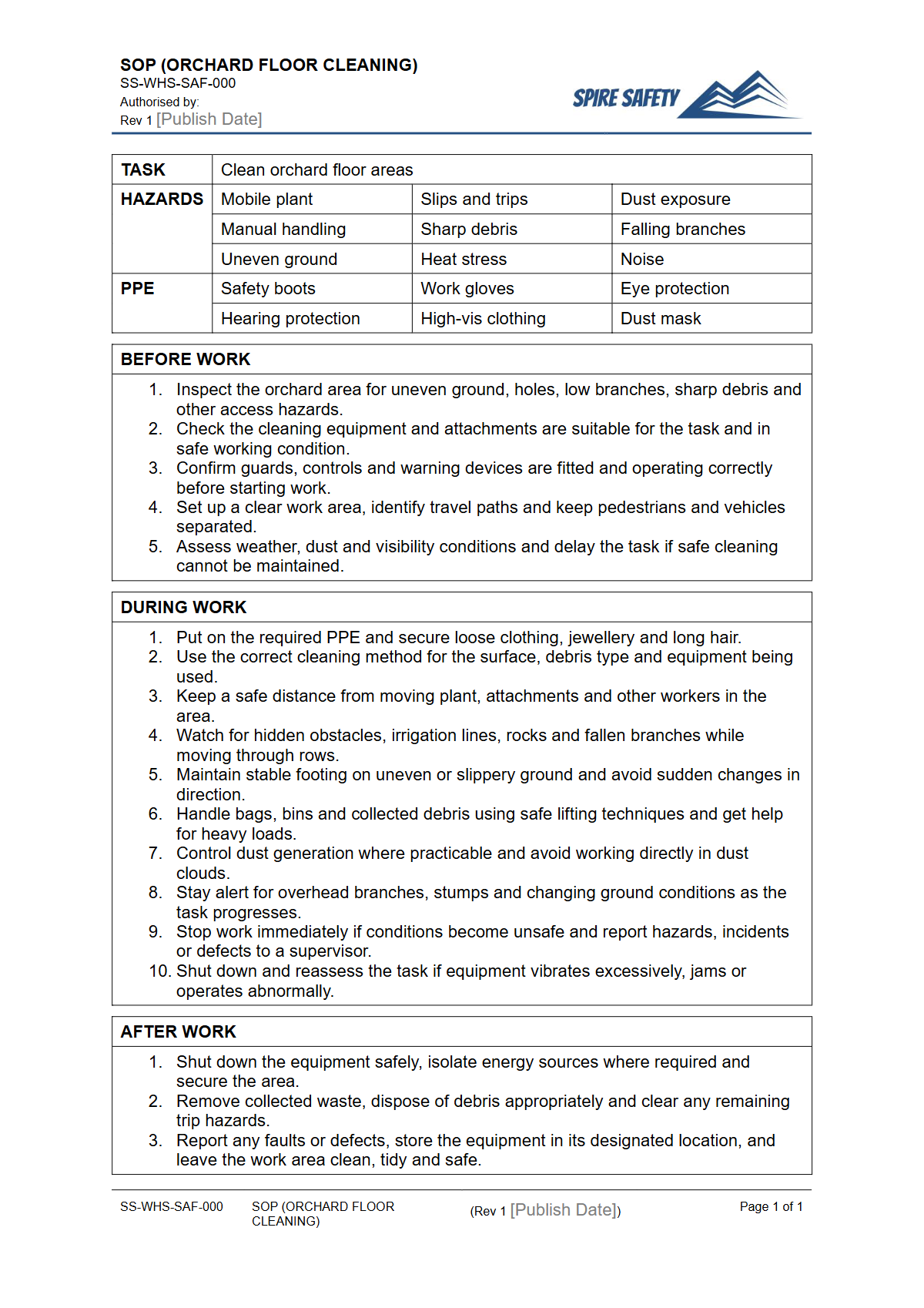
This Free Safe Operating Procedure (Orchard Floor Cleaning) Template provides a structured framework for businesses in the agricultural and horticultural sectors to document a safe system of work for clearing and maintaining orchard floors. The primary goal of an SOP is to manage health and safety risks by clearly outlining step-by-step instructions for a specific task.
For orchard floor cleaning, this involves controlling hazards such as slips and trips on fallen fruit or branches, manual handling injuries, and risks associated with operating machinery like blowers, sweepers, or tractors.
By implementing a documented procedure, you establish a clear standard for worker behaviour and task execution. This not only helps in meeting your duties under WHS legislation but also promotes a consistent, safety-conscious approach across your entire team.
A well-defined SOP is a fundamental component of effective WHS management systems, demonstrating a proactive commitment to workplace safety.
Video walkthrough
How to use the Free Safe Operating Procedure (Orchard Floor Cleaning) Template
This template is available for download in both DOCX and PDF formats. The DOCX file is fully editable, allowing you to tailor the content to the unique conditions of your worksite.
The procedure is structured to guide you through identifying hazards, specifying control measures, and listing the sequence of tasks from pre-operational checks to shutdown and cleanup.
You should methodically work through each section, adding details about the specific equipment used, the layout of your orchard, the types of debris encountered, and the personnel involved. For instance, if your process involves specialised machinery, you may want to reference other relevant documentation, such as a FREE Scraper SOP (Safe Operating Procedure) Template, within your customised procedure.
Important Note: This document is a template and should not be used without customisation. We have provided a structured starting point aligned with Australian WHS principles, but it is your responsibility to ensure the final SOP reflects the specific hazards, equipment, environment, and personnel at your workplace.
A generic procedure is not sufficient to ensure safety.
When to use it
A Safe Operating Procedure for orchard floor cleaning should be an active part of your daily operations. It should be used:
- During training and induction: To ensure all new and existing workers understand the established safe method for completing the task.
- For pre-task planning: As a reference for supervisors and workers before commencing work each day or shift.
- During task execution: As a guide to reinforce correct, safe actions and sequences.
- After an incident or near miss: To review and identify whether the procedure was followed and if it needs revision.
- As part of regular safety audits: To verify that documented procedures match actual work practices. Regular reviews are essential for continuous improvement.
Integrating this SOP into your safety framework helps ensure that risks are consistently managed. For businesses seeking to verify their overall safety performance, undertaking periodic WHS compliance auditing can provide valuable insights and identify areas for improvement.
Key Hazards in Orchard Floor Cleaning
Your customised SOP must identify all foreseeable hazards. These commonly include:
- Slips, trips, and falls: Caused by wet surfaces, rotting fruit, uneven ground, fallen branches, or irrigation equipment.
- Manual handling: Strains and sprains from lifting heavy debris, raking, or carrying equipment.
- Plant and machinery: Risks of entanglement, impact, or noise and vibration exposure from blowers, sweepers, or tractors. Using specific SOPs for each major piece of plant, like our FREE Telehandler SOP Template, is best practice.
- Environmental factors: Exposure to dust, pollen, UV radiation, and adverse weather.
- Biological hazards: Contact with insects, snakes, spiders, or mould on decaying organic matter.
Developing Control Measures
For each hazard you identify, you must document a corresponding control measure. Follow the hierarchy of controls, prioritising higher-level controls like elimination or engineering where possible. Common controls for this task include:
- Personal Protective Equipment (PPE): Mandating steel-capped boots, gloves, high-visibility clothing, and eye or hearing protection.
- Equipment maintenance: Implementing pre-start checks and a regular maintenance schedule for all machinery.
- Work area setup: Clearly delineating work zones, managing vehicle and pedestrian interaction, and designating spots for debris piles.
- Training and supervision: Ensuring all operators are competent and supervised appropriately. This SOP is a great starting point, but you can find more templates in our free WHS resources library to support your other high-risk tasks.
Common mistakes
Common mistakes to avoid
- Failing to customise the template with site-specific machinery, ground conditions, and personnel.
- Not providing adequate training on the finalised SOP to all workers who perform the task.
- Forgetting to schedule and conduct regular reviews, especially after an incident or process change.
- Neglecting to clearly specify the mandatory Personal Protective Equipment (PPE) required for the job.
Legal references
Legal considerations
The following legal requirements may be relevant to this type of work.
- Work Health and Safety Act (Harmonised) — Provides the primary duties for protecting workers and other people from work health and safety risks.
- Work Health and Safety Regulations (Harmonised) — Sets out requirements supporting the management of workplace hazards and risks.
The following codes may be relevant to this type of work.
- Managing WHS Risks Code of Practice — Provides practical guidance on identifying hazards, assessing risks and applying effective controls.
- Work Health and Safety Consultation, Cooperation and Coordination Code of Practice — Provides practical guidance on consulting workers and coordinating with other duty holders.
- Managing the Work Environment and Facilities Code of Practice — Provides practical guidance on safe work environments, workplace facilities and related controls.
Did you know
A Leading Cause of Injury
Slips, trips, and falls are a leading cause of serious injury in the Australian agriculture industry. Uneven ground, unexpected obstacles, and organic debris are major contributing factors.
FAQ
Frequently asked questions
01Is an SOP legally required for orchard floor cleaning in Australia?
02What kind of equipment is this SOP template for?
03How often should our Orchard Floor Cleaning SOP be reviewed?
04Can this SOP be used for worker training purposes?
Share this resource
Free Safe Operating Procedure (Orchard Floor Cleaning) Template
Browse Categories
How To Use It
- 1Download and open in Word or PDF.
- 2Replace the placeholders with your business details.
- 3Get it reviewed by a WHS specialist before rollout.
Need it customised?
Our WHS consultants can adapt this template to your site, run a gap analysis, or audit what you already have in place.
Book a Free Consultation WHS consulting servicesor call 1300 156 382
Related templates
- Free Safe Operating Procedure (Orchard Pruning) Template
- Free Safe Operating Procedure (Orchard Weed Control) Template
- Free Safe Operating Procedure (Order Picker) Template
- Free Safe Operating Procedure (Order Pickup Handling) Template
- Free Safe Operating Procedure (Ore Sorter) Template
- Free Safe Operating Procedure (Organic Waste Handling) Template