
Free Safe Operating Procedure (Orbital Sander) Template
Document the safe use of orbital sanders in your workplace with our structured template. Download your free Safe Operating Procedure to get started today.
Free Safe Operating Procedure (Orbital Sander) Template
DOCX • 126 KB + PDF
Updated Oct 2026
No signup required
Purpose of the Free Safe Operating Procedure (Orbital Sander) Template
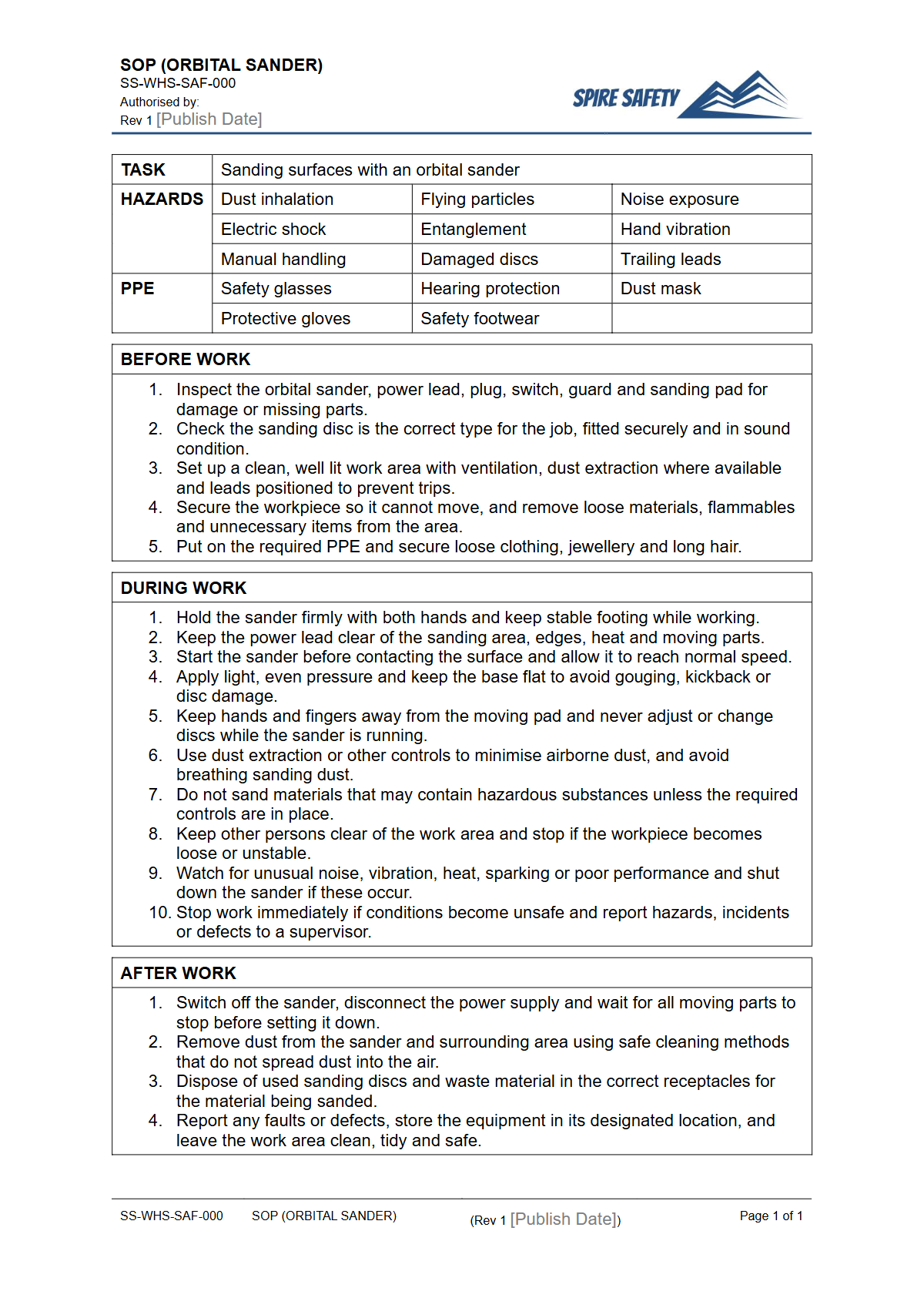
Operating power tools like orbital sanders introduces significant workplace hazards if not managed correctly. This free Safe Operating Procedure (Orbital Sander) Template provides a structured framework for documenting the required steps to ensure worker safety.
An SOP serves as a critical administrative control, outlining a logical sequence of actions, identifying potential hazards at each stage, and specifying the necessary control measures to mitigate risk. It is a fundamental tool for training, task supervision, and promoting consistent, safe work practices across your organisation. Having a documented process is also essential for other equipment, as shown in our free Circular Saw SOP template.
Video walkthrough
How to use the Free Safe Operating Procedure (Orbital Sander) Template
This template is provided in both DOCX and PDF formats for your convenience. The DOCX version is fully editable, allowing you to adapt the content to the specific models of sanders used, the materials being worked on, and the unique environment of your workshop or site.
It is crucial that you customise this document to reflect your workplace's specific risks and control measures, as determined by your risk assessment process. Please note: we are not a law firm. This document is a template and must be customised to your specific operational needs. It does not constitute legal advice. A well-defined SOP is a cornerstone of a robust WHS management system.
Key Hazards Associated with Orbital Sanders
Before using the SOP, it's vital to recognise the hazards associated with orbital sanders. A thorough risk assessment should identify site-specific issues, which commonly include:
- Airborne Dust: Inhaling fine dust particles, especially from MDF, treated timbers, or woods known to be sensitisers, can cause respiratory illness.
- Noise: Prolonged exposure to the high-pitched sound of a sander can lead to permanent hearing damage.
- Vibration: Continuous use can result in Hand-Arm Vibration Syndrome (HAVS), a painful and debilitating condition affecting blood vessels, nerves, and joints.
- Electrical Hazards: Damaged cords, faulty plugs, or use in wet conditions can lead to electric shock or electrocution.
- Entanglement: Loose clothing, hair, or jewellery can become caught in the rotating parts of the tool.
- Ergonomic Strain: Awkward postures, repetitive motions, and excessive force can cause musculoskeletal injuries.
Essential Control Measures
Your customised SOP should detail the control measures your workplace has implemented to manage these hazards. These controls form the core of the safe work method and should be practical and consistently enforced. Similar principles apply to other workshop tools, as seen in our free Air Compressor SOP.
- Dust Management: Utilise sanders with integrated dust collection bags or connect them to an industrial vacuum extraction system. Work in well-ventilated areas.
- Personal Protective Equipment (PPE): Mandate the use of appropriate PPE, including P2-rated dust masks, safety glasses or goggles, hearing protection (earmuffs or plugs), and gloves.
- Tool Maintenance: Implement a regular inspection and maintenance schedule. Pre-start checks should include inspecting the power cord, housing, and sanding pad for damage.
- Safe Work Practices: Train workers to let the tool do the work without applying excessive force, to maintain a secure grip, and to keep power cords clear of the work area.
- Vibration Management: Encourage regular breaks and task rotation to limit continuous exposure to vibration.
When to use it
A Safe Operating Procedure for an orbital sander should be used as a primary reference document in several key situations. It should be the basis for initial worker training and competency assessment before an employee is authorised to use the tool.
It also serves as a valuable resource for pre-start meetings or toolbox talks to refresh knowledge on specific hazards and controls. Following any incident or near-miss involving an orbital sander, the SOP should be reviewed and updated as part of the investigation process. Regular reviews ensure it remains current with new equipment or evolving best practices, and verifying these controls is a key part of routine WHS compliance auditing.
Who should use it
This SOP is intended for all personnel involved with the use and supervision of orbital sanders. This includes the operators who perform the sanding tasks, supervisors who are responsible for overseeing the work and ensuring procedures are followed, and WHS personnel who manage the overall safety framework.
It is also a valuable document for maintenance staff who need to understand safe isolation and testing procedures. For businesses needing support in developing and implementing such procedures, our WHS consulting services provide expert guidance.
Find more helpful documents in our free WHS resources library to support your safety systems.
Common mistakes
Common mistakes to avoid
- Sanding without adequate dust extraction or ventilation, creating a serious respiratory hazard.
- Neglecting to wear appropriate Personal Protective Equipment (PPE), especially dust masks and safety glasses.
- Applying excessive downward pressure on the tool, which reduces effectiveness and increases operator fatigue.
- Failing to conduct a pre-start check of the tool, particularly the power cord and sanding disc integrity.
Legal references
Legal considerations
The following legal requirements may be relevant to this type of work.
- Work Health and Safety Act (Harmonised) — Provides the primary duties for protecting workers and other people from work health and safety risks.
- Work Health and Safety Regulations (Harmonised) — Sets out requirements supporting the management of workplace hazards and risks.
The following codes may be relevant to this type of work.
- Managing WHS Risks Code of Practice — Provides practical guidance on identifying hazards, assessing risks and applying effective controls.
- Work Health and Safety Consultation, Cooperation and Coordination Code of Practice — Provides practical guidance on consulting workers and coordinating with other duty holders.
- Managing the Work Environment and Facilities Code of Practice — Provides practical guidance on safe work environments, workplace facilities and related controls.
Did you know
Vibration Risks
Hand-Arm Vibration Syndrome (HAVS), a potential outcome of prolonged sander use, is permanent but entirely preventable. Managing exposure time is just as critical as using a well-maintained, low-vibration tool.
Invisible Dust Dangers
The finest dust particles (PM2.5) are invisible to the naked eye and can penetrate deep into the lungs. This is why on-tool dust extraction is far more effective than simply sweeping up afterwards.
FAQ
Frequently asked questions
01What is the purpose of a Safe Operating Procedure for an orbital sander?
02Is this orbital sander SOP template ready to use immediately?
03When should workers be trained on this SOP?
04What PPE is typically required when using an orbital sander?
Share this resource
Free Safe Operating Procedure (Orbital Sander) Template
Browse Categories
How To Use It
- 1Download and open in Word or PDF.
- 2Replace the placeholders with your business details.
- 3Get it reviewed by a WHS specialist before rollout.
Need it customised?
Our WHS consultants can adapt this template to your site, run a gap analysis, or audit what you already have in place.
Book a Free Consultation WHS consulting servicesor call 1300 156 382
Related templates
- Free Safe Operating Procedure (Orbital Welder) Template
- Free Safe Operating Procedure (Orchard Floor Cleaning) Template
- Free Safe Operating Procedure (Orchard Pruning) Template
- Free Safe Operating Procedure (Orchard Weed Control) Template
- Free Safe Operating Procedure (Order Picker) Template
- Free Safe Operating Procedure (Order Pickup Handling) Template