
Free Safe Operating Procedure (Oil Spill Skimmer) Template
Effectively manage spill response with our free Safe Operating Procedure (Oil Spill Skimmer) template.
Free Safe Operating Procedure (Oil Spill Skimmer) Template
DOCX • 126 KB + PDF
Updated Oct 2026
No signup required
Purpose of the Free Safe Operating Procedure (Oil Spill Skimmer) Template
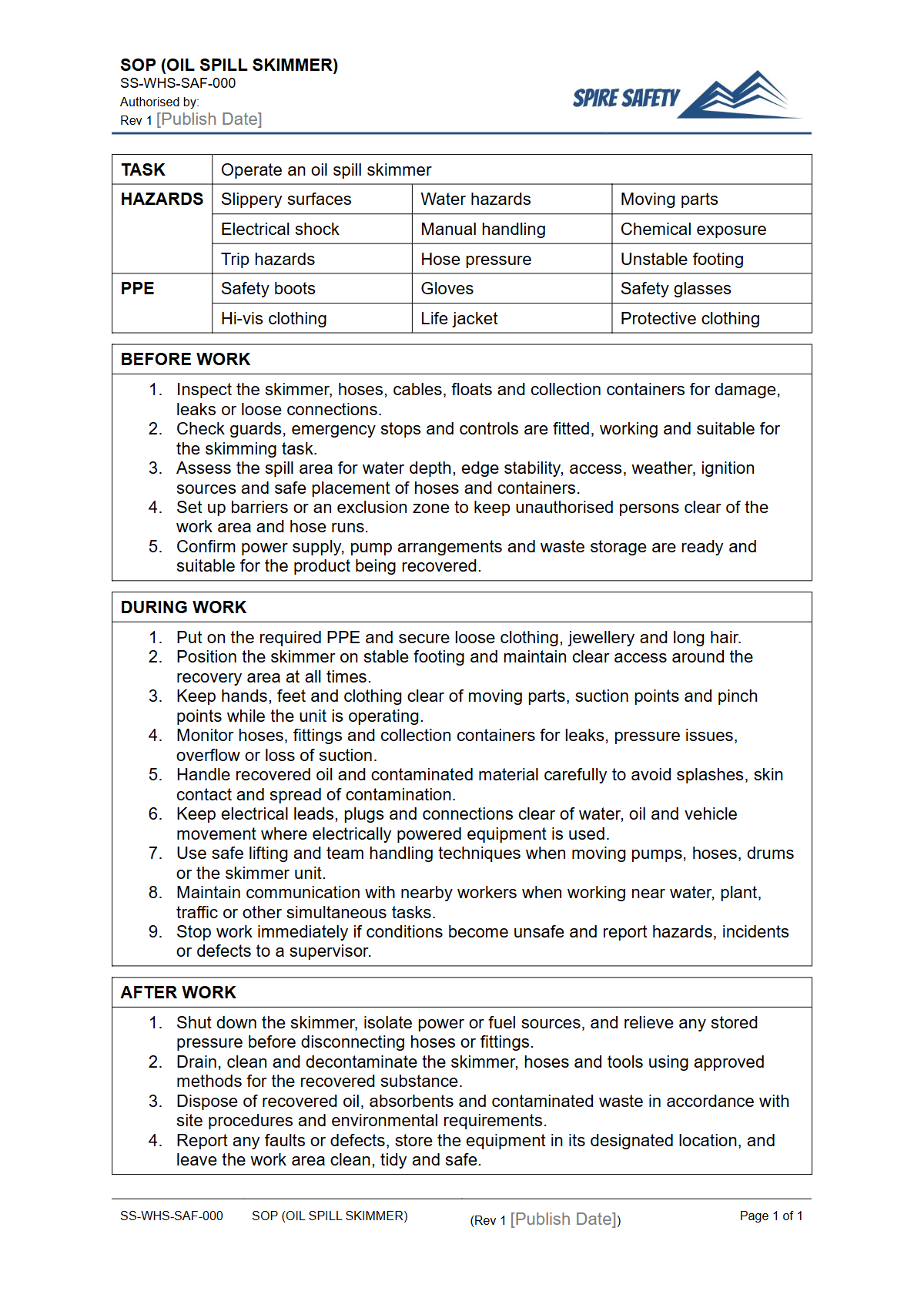
Operating an oil spill skimmer, whether for routine maintenance or emergency response, involves significant risks. This Safe Operating Procedure (SOP) provides a structured framework for documenting the required steps to perform the task safely.
Using this free Safe Operating Procedure (Oil Spill Skimmer) template helps your organisation standardise its processes, minimise risks to personnel and the environment, and demonstrate a commitment to workplace health and safety. A well-defined SOP is a critical component of any effective WHS management system, ensuring that all workers are aware of the hazards and control measures associated with skimmer operation.
Hazards can include exposure to hazardous substances, mechanical entanglement with moving parts, slips on slick surfaces, and manual handling injuries. This template prompts you to identify these risks and outline specific controls, such as correct Personal Protective Equipment (PPE), pre-start checks, and emergency shutdown protocols, helping you meet your duty of care under Australian WHS legislation.
Video walkthrough
How to use the Free Safe Operating Procedure (Oil Spill Skimmer) Template
Download the template in your preferred format (DOCX for easy editing or PDF for reference) and begin customising it to your specific operational context. The document is structured to guide you through the essential components of a comprehensive SOP, from initial preparation to task completion and waste disposal.
It serves as a robust starting point, aligned with the principles of the model WHS framework.
IMPORTANT: This is a template that must be customised for your specific workplace. We recommend a competent person reviews and adapts it to your specific skimmer model, the types of oils or chemicals handled, unique site conditions, and relevant legal obligations.
Generic procedures are insufficient for ensuring safety.
Key Sections to Customise
- PPE Requirements: Specify the exact type of gloves, eyewear, respiratory protection, and protective clothing required for the substances your team will encounter.
- Pre-Operational Checks: Detail the safety and operational checks specific to your skimmer model. This should include inspecting hoses, fittings, power sources, and safety guards. Procedures for other machinery, like those in our Free Air Compressor SOP (Safe Operating Procedure) Template, offer a good example of how detailed these checks should be.
- Step-by-Step Procedure: Write clear, sequential instructions for deploying, operating, and retrieving the skimmer. Use simple language and avoid ambiguity.
- Emergency Procedures: Outline the steps for emergency shutdown, responding to a personal injury, or managing a secondary containment breach.
- Waste Disposal: Describe the process for safely containing, labelling, and disposing of the collected oil and contaminated materials in accordance with environmental regulations.
When to use this Safe Operating Procedure
A formal SOP for oil spill skimmers should be used in several key situations. It is essential during any emergency spill response to guide operators through a high-stress situation with clear, pre-approved instructions.
It should also be used for routine clean-up tasks, such as clearing oil from interceptor pits or water treatment ponds. Furthermore, this document is a vital training tool for inducting new operators and conducting refresher courses for experienced staff, ensuring consistent and safe work practices across the board. The principles of documenting procedures are similar across various types of plant, as seen in our FREE Conveyer System SOP (Safe Operating Procedure) Template.
Who should use this Safe Operating Procedure
This template is designed for use by persons conducting a business or undertaking (PCBUs), WHS managers, environmental officers, and site supervisors responsible for creating and implementing safety documentation. The final, customised SOP should be used by all personnel tasked with operating oil spill skimmers.
This includes maintenance crews, emergency response teams, and any other workers who may be required to use the equipment. It is the PCBU's responsibility to ensure that operators are not only provided with the SOP but are also trained and assessed as competent in its application before undertaking the work unsupervised.
Integrating the SOP into Your Safety System
An SOP is most effective when it is a living document within a broader safety framework. Once customised, it should be formally approved, and a version control system should be established.
Integrate it into your training and induction programs. Regularly scheduled practical drills can reinforce the procedures and identify areas for improvement.
Performing periodic reviews of the SOP, especially after an incident or near miss, is crucial. These activities can be validated through a formal WHS compliance auditing process to ensure ongoing effectiveness and adherence.
Just as with other heavy equipment like a trencher, consistent application is key; you can see a similar structure in our FREE Trencher SOP (Safe Operating Procedure) Template for comparison.
By thoroughly documenting your procedures, you create a safer environment and a more resilient organisation. Explore our complete free WHS resources library for more templates to support your safety management system.
Common mistakes
Common mistakes to avoid
- Using the template 'as-is' without customising it for specific equipment and workplace hazards.
- Failing to provide hands-on, practical training to operators on the finalised procedure.
- Not clearly specifying the correct PPE for the chemicals and substances being handled.
- Omitting clear instructions for the safe containment, labelling, and disposal of collected waste.
Legal references
Legal considerations
The following legal requirements may be relevant to this type of work.
- Work Health and Safety Act (Harmonised) — Provides the primary duties for protecting workers and other people from work health and safety risks.
- Work Health and Safety Regulations (Harmonised) — Sets out requirements supporting the management of workplace hazards and risks.
The following codes may be relevant to this type of work.
- Managing WHS Risks Code of Practice — Provides practical guidance on identifying hazards, assessing risks and applying effective controls.
- Work Health and Safety Consultation, Cooperation and Coordination Code of Practice — Provides practical guidance on consulting workers and coordinating with other duty holders.
- Managing the Work Environment and Facilities Code of Practice — Provides practical guidance on safe work environments, workplace facilities and related controls.
Did you know
Skimmer Types
Oil spill skimmers come in two main types: oleophilic (oil-attracting), which use materials like discs or ropes to which oil adheres, and weir skimmers, which use gravity to spill the floating oil layer into a collection tank.
Efficiency Factors
The efficiency of an oil skimmer is heavily influenced by conditions like wave action, water currents, and the viscosity of the oil. Calm conditions are ideal for maximising oil recovery rates.
FAQ
Frequently asked questions
01What is a Safe Operating Procedure for an oil spill skimmer?
02Is this oil spill skimmer SOP template aligned with Australian WHS laws?
03Who is responsible for customising this Safe Operating Procedure?
04How often should an oil spill skimmer SOP be reviewed?
Share this resource
Free Safe Operating Procedure (Oil Spill Skimmer) Template
Browse Categories
How To Use It
- 1Download and open in Word or PDF.
- 2Replace the placeholders with your business details.
- 3Get it reviewed by a WHS specialist before rollout.
Need it customised?
Our WHS consultants can adapt this template to your site, run a gap analysis, or audit what you already have in place.
Book a Free Consultation WHS consulting servicesor call 1300 156 382
Related templates
- Free Safe Operating Procedure (Orbital Sander) Template
- Free Safe Operating Procedure (Orbital Welder) Template
- Free Safe Operating Procedure (Orchard Floor Cleaning) Template
- Free Safe Operating Procedure (Orchard Pruning) Template
- Free Safe Operating Procedure (Orchard Weed Control) Template
- Free Safe Operating Procedure (Order Picker) Template