
Free Safe Operating Procedure (Office Chair Cleaning) Template
Download our free office chair cleaning SOP to standardise workplace hygiene. This customisable DOCX and PDF template helps outline key safety steps.
Free Safe Operating Procedure (Office Chair Cleaning) Template
DOCX • 126 KB + PDF
Updated Oct 2026
No signup required
Purpose of the Free Safe Operating Procedure (Office Chair Cleaning) Template
Maintaining a clean and hygienic office environment is essential, and this includes furniture like office chairs. While it may seem like a simple task, cleaning office chairs involves potential risks that need to be managed.
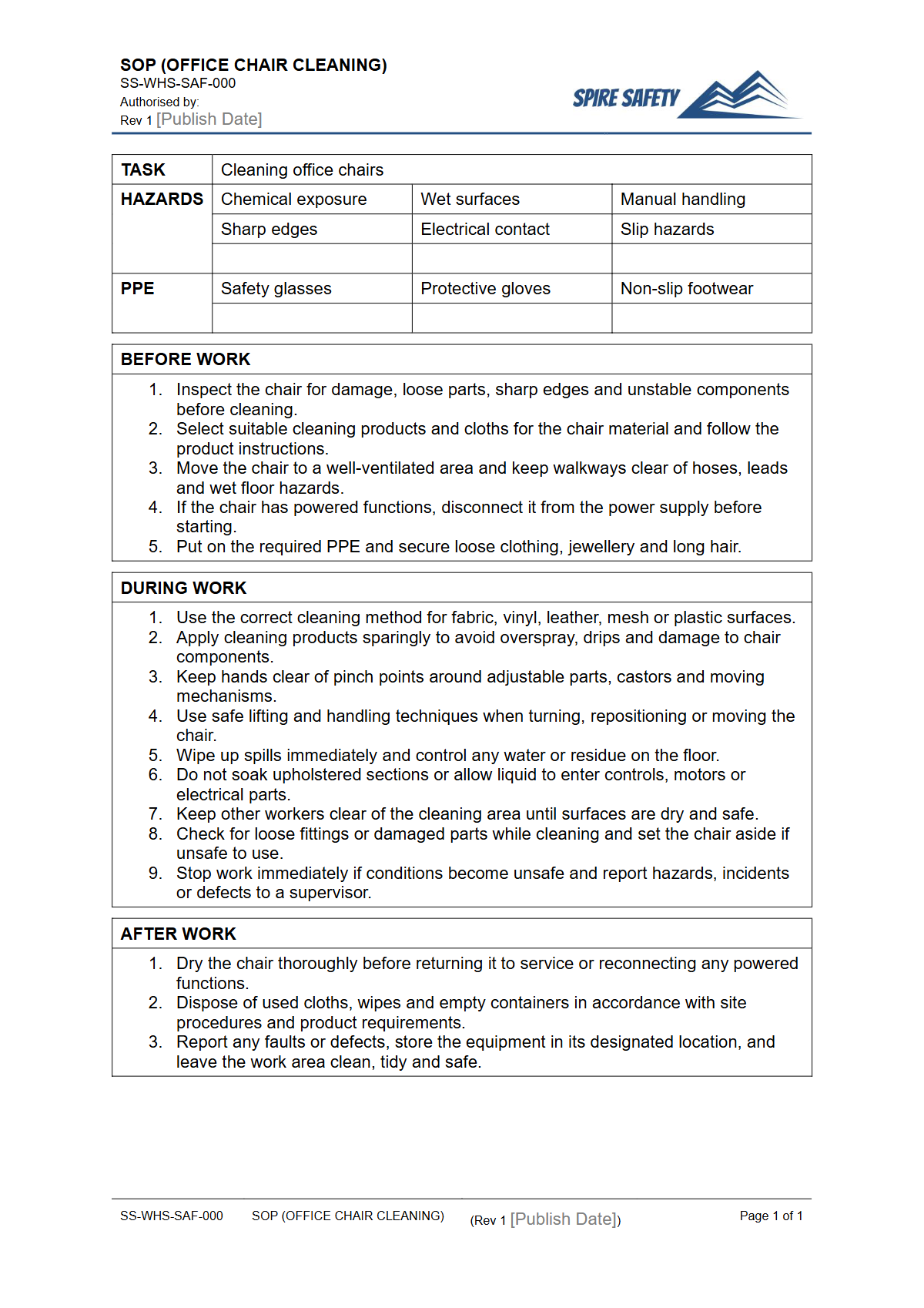
Our Free Safe Operating Procedure (Office Chair Cleaning) Template provides a structured starting point for documenting the required steps to perform this task safely and effectively. It prompts you to consider hazards such as exposure to cleaning chemicals, ergonomic strains from manual handling, and slip risks from spills, ensuring a consistent and safe approach every time.
Video walkthrough
How to use the Free Safe Operating Procedure (Office Chair Cleaning) Template
You can download this Safe Operating Procedure in both DOCX and PDF formats. The DOCX file is fully editable, allowing you to tailor it to your organisation’s specific needs.
It is crucial to remember that this is a template, not a finished, document. To make it effective, you must customise it with the details of your workplace.
This includes identifying the specific types of chairs, listing the exact cleaning products used (and referencing their Safety Data Sheets), detailing required PPE, and outlining any site-specific hazards or emergency procedures. We recommend that a competent person reviews and approves the final SOP before it is implemented.
Key Elements of This Safe Operating Procedure
A thorough SOP goes beyond a simple checklist. This template is designed to capture all the necessary information for a safe system of work. It includes sections for:
- Hazard Identification: Documenting potential chemical, ergonomic, and physical hazards.
- Personal Protective Equipment (PPE): Specifying the required PPE, such as gloves and eye protection, based on the chemicals used.
- Step-by-Step Instructions: A clear, sequential guide from preparation to clean-up.
- Emergency Procedures: Outlining actions for spills, chemical exposure, or other incidents.
This structured approach is fundamental to all good SOPs, whether for administrative tasks or for more complex procedures like our deep fryer cleaning SOP.
Integrating the SOP into Your WHS System
A Safe Operating Procedure is most effective when it is part of a holistic safety strategy. It should not be a document that is written once and filed away.
Instead, integrate it into your operational processes by using it for worker training, new employee induction, and as a reference tool for supervisors. A collection of well-developed SOPs forms a critical part of robust WHS management systems, demonstrating a clear commitment to managing foreseeable risks and fulfilling your duty of care.
Review and Consultation
Workplace environments and procedures change over time. It is vital to review your Office Chair Cleaning SOP regularly—annually, or whenever a new cleaning product, piece of equipment, or process is introduced.
WHS legislation mandates consultation with workers; the cleaning staff who perform this task are a valuable source of feedback on what works and what doesn't. Involving them in the drafting and review process will not only improve the procedure but also increase buy-in and adherence.
If you need support facilitating these processes, engaging with specialist WHS consulting can provide valuable external expertise.
Beyond Cleaning Chairs: Other Workplace Procedures
The principles of identifying hazards, outlining safe steps, and consulting with workers apply to countless tasks in the workplace. Once you have established a procedure for office chair cleaning, you can apply the same methodology to other equipment and activities.
For instance, workshops may require an Air Compressor Safe Operating Procedure to manage the risks of pressurised systems. Building a library of task-specific SOPs creates a safer, more consistent, and more efficient operational environment.
You can explore our free WHS resources library for more templates to build out your safety documentation.
Verifying Implementation
Once the SOP is finalised and workers are trained, how do you ensure it's being followed correctly? Supervisors should conduct periodic observations to verify that the steps are being adhered to and that the procedure remains practical and effective.
For a more formal assessment of your overall safety processes and documentation, organisations often undertake periodic WHS compliance auditing. This helps identify gaps between documented procedures and actual work practices, providing opportunities for continuous improvement.
Common mistakes
Common mistakes to avoid
- Using the template without customising it for specific workplace chemicals and equipment.
- Failing to provide workers with the correct Personal Protective Equipment (PPE) listed in the SOP and SDS.
- Not training workers on the procedure and just leaving the document in a folder.
- Forgetting to consult with cleaning staff when drafting or reviewing the SOP.
Legal references
Legal considerations
The following legal requirements may be relevant to this type of work.
- Work Health and Safety Act (Harmonised) — Provides the primary duties for protecting workers and other people from work health and safety risks.
- Work Health and Safety Regulations (Harmonised) — Sets out requirements supporting the management of workplace hazards and risks.
The following codes may be relevant to this type of work.
- Managing WHS Risks Code of Practice — Provides practical guidance on identifying hazards, assessing risks and applying effective controls.
- Work Health and Safety Consultation, Cooperation and Coordination Code of Practice — Provides practical guidance on consulting workers and coordinating with other duty holders.
- Managing the Work Environment and Facilities Code of Practice — Provides practical guidance on safe work environments, workplace facilities and related controls.
Did you know
Safety Data Sheets (SDS)
In Australia, any hazardous chemical used in a workplace must have a corresponding Safety Data Sheet (SDS) that is readily accessible to workers. The SDS contains crucial information on hazards, handling, and first aid.
The Importance of Consultation
Consulting with workers who perform the task is not just good practice—it's a legal requirement under Australian WHS laws. It leads to more practical and effective safety procedures.
FAQ
Frequently asked questions
01Is cleaning an office chair a hazardous task?
02What PPE is needed for cleaning office chairs?
03How often should we review this SOP?
04Can I use this template for other cleaning tasks?
Share this resource
Free Safe Operating Procedure (Office Chair Cleaning) Template
Browse Categories
How To Use It
- 1Download and open in Word or PDF.
- 2Replace the placeholders with your business details.
- 3Get it reviewed by a WHS specialist before rollout.
Need it customised?
Our WHS consultants can adapt this template to your site, run a gap analysis, or audit what you already have in place.
Book a Free Consultation WHS consulting servicesor call 1300 156 382
Related templates
- Free Safe Operating Procedure (Office Partition Clean) Template
- Free Safe Operating Procedure (Oil Filter Crusher) Template
- Free Safe Operating Procedure (Oil Spill Skimmer) Template
- Free Safe Operating Procedure (Orbital Sander) Template
- Free Safe Operating Procedure (Orbital Welder) Template
- Free Safe Operating Procedure (Orchard Floor Cleaning) Template