
Free Safe Operating Procedure (Nut Runner) Template
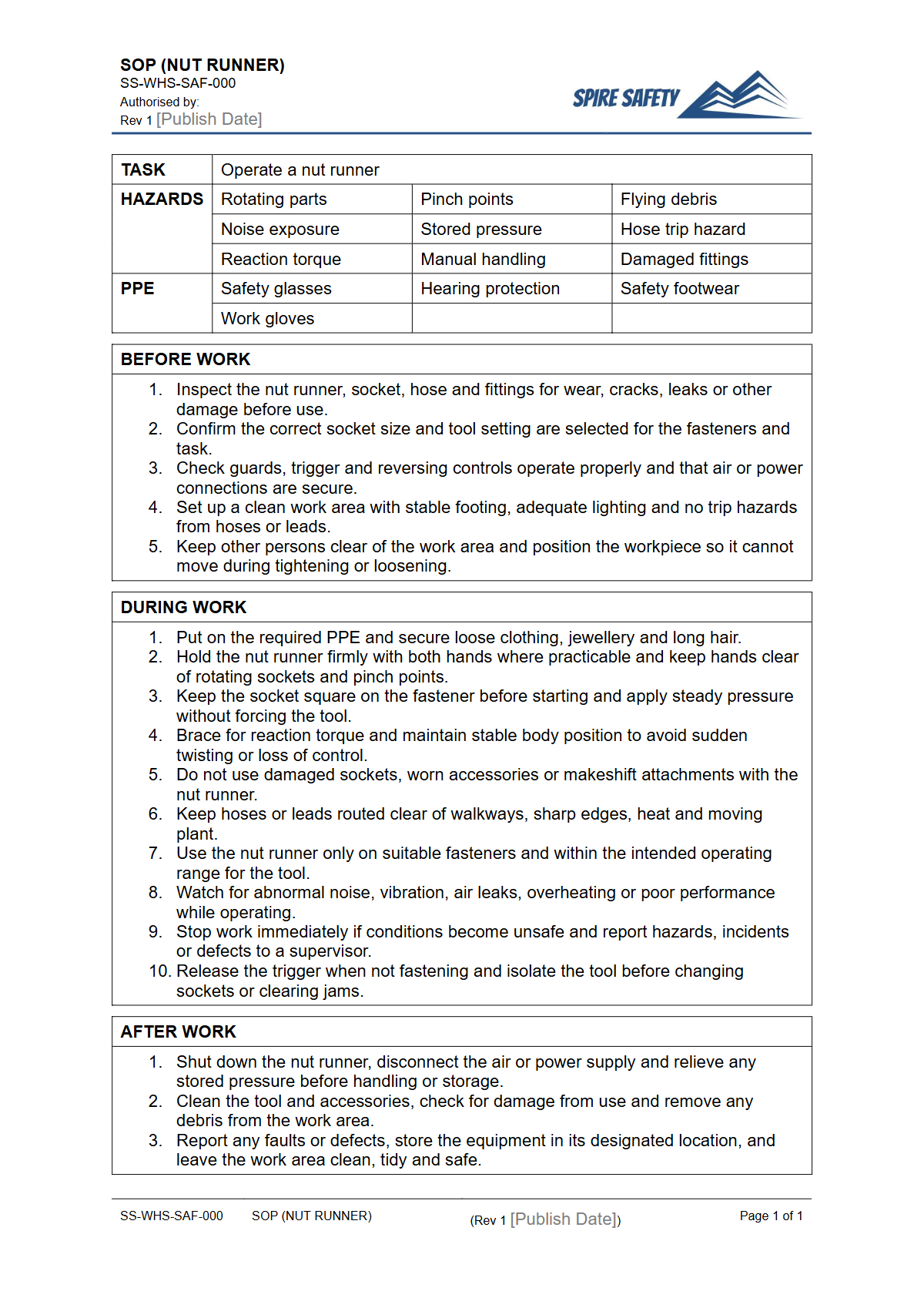
Download our free Safe Operating Procedure (Nut Runner) Template to manage risks from hydraulic, pneumatic, and electric nut runners. Get your DOCX now.
Free Safe Operating Procedure (Nut Runner) Template
DOCX • 126 KB + PDF
Updated Oct 2026
No signup required
Purpose of the Free Safe Operating Procedure (Nut Runner) Template
A nut runner is a powerful tool used for tightening or loosening nuts and bolts with high torque. This power creates significant workplace hazards if not managed correctly.
Our free Safe Operating Procedure (Nut Runner) Template provides a structured framework for documenting the required steps to operate this equipment safely. It guides you in outlining pre-start checks, operational steps, and shutdown procedures specific to your machinery.
Using this template helps demonstrate your organisation's commitment to providing a safe system of work and meeting your WHS duties.
This document is designed to help you identify and control common hazards associated with nut runners, such as high-pressure fluid injection, entanglement, noise, and vibration. It encourages a systematic approach to risk management, ensuring that control measures are clearly communicated to all operators. For pneumatic tools, it is also essential to manage the power source safely, which can be documented using a resource like our Free Air Compressor SOP (Safe Operating Procedure) Template.
Key Hazards Associated with Nut Runners
When customising this SOP, you must assess the risks specific to your environment. Common hazards include:
- High Torque Reaction: The tool can kick back with significant force, causing sprains, fractures, or impact injuries if the operator is not properly braced.
- Entanglement: Loose clothing, hair, or jewellery can get caught in the tool's rotating parts.
- Noise and Vibration: Prolonged exposure can lead to permanent hearing loss and Hand-Arm Vibration Syndrome (HAVS).
- High-Pressure Lines: Hydraulic or pneumatic hoses can fail, potentially causing fluid injection injuries or striking workers.
- Projectiles: A failing socket or component can become a high-velocity projectile, posing a severe impact risk.
Video walkthrough
How to use the Free Safe Operating Procedure (Nut Runner) Template
This template is provided in both DOCX and PDF formats for your convenience. Download the DOCX file to edit and tailor the content directly to your workplace.
Fill in the designated sections with details about your specific nut runner models, site-specific hazards, and the control measures your organisation has implemented. This process ensures the final document is a practical tool, not just a generic piece of paper.
Important: This document is a template and must be customised to reflect the specific equipment, processes, and risks in your workplace. We are not WHS consultants providing advice, and using this template does not supports your compliance efforts.
You must consult with operators and conduct a site-specific risk assessment to ensure the final SOP is comprehensive and effective. A well-drafted SOP is a critical component of robust WHS management systems that actively protect your workers.
When to use it
A Safe Operating Procedure for a nut runner should be used as a primary reference document in several situations. It is essential for training new employees, ensuring they understand the correct and safe method of operation from the outset.
It should also be used for refresher training for existing staff to reinforce safe work practices. The SOP serves as a valuable tool for pre-start meetings or toolbox talks, allowing supervisors to quickly review key safety points before a task begins.
Furthermore, in the event of an incident or near-miss, the SOP provides a benchmark against which current work practices can be reviewed and improved.
Regularly reviewing your procedures against actual on-the-ground practice is a core part of maintaining a safe workplace. This can be formalised through scheduled assessments to verify that documented controls are being consistently applied, a process that can be supported by formal WHS compliance auditing.
Who should use it
This SOP is intended for a range of personnel within an organisation. Machine operators are the primary users, as it dictates the step-by-step process they must follow to perform their tasks safely.
Supervisors and managers must also use the SOP to ensure they are providing adequate supervision and enforcing the documented safety standards. WHS personnel and safety committees will use the document as part of their risk management and training development programs.
Finally, maintenance crews should refer to the SOP to understand the correct procedures for isolating and de-energising the equipment before conducting repairs. If your team lacks the internal expertise to develop and implement these procedures effectively, engaging external WHS consulting services can provide the necessary guidance.
This document complements other machinery-specific procedures, helping to build a comprehensive safety library for your workshop or site. Similar structured approaches can be applied to other common equipment, as shown in our FREE Circular Saw SOP. Consistency across your documentation helps reinforce safe behaviour and simplifies training. For more templates and safety resources, you can browse our complete free WHS resources library.
Common mistakes
Common mistakes to avoid
- Using the wrong size socket or a worn-out socket, which can slip and cause injury.
- Failing to properly brace against the torque reaction bar, leading to sudden tool kick-back.
- Neglecting to inspect hoses and connections for leaks or physical damage before each use.
- Setting the torque output incorrectly, leading to under-tightened or over-stressed fasteners.
Legal references
Legal considerations
The following legal requirements may be relevant to this type of work.
- Work Health and Safety Act (Harmonised) — Provides the primary duties for protecting workers and other people from work health and safety risks.
- Work Health and Safety Regulations (Harmonised) — Sets out requirements supporting the management of workplace hazards and risks.
The following codes may be relevant to this type of work.
- Managing WHS Risks Code of Practice — Provides practical guidance on identifying hazards, assessing risks and applying effective controls.
- Work Health and Safety Consultation, Cooperation and Coordination Code of Practice — Provides practical guidance on consulting workers and coordinating with other duty holders.
- Managing the Work Environment and Facilities Code of Practice — Provides practical guidance on safe work environments, workplace facilities and related controls.
Did you know
Torque Multiplier
Some nut runners are also called torque multipliers because they use an internal epicyclic gearbox to significantly increase the torque applied by the operator, allowing for extremely tight and precise fastening.
HAVS Risk
Prolonged use of vibrating tools like some nut runners can lead to Hand-Arm Vibration Syndrome (HAVS), a painful and disabling condition affecting blood vessels, nerves, and joints that can become permanent.
FAQ
Frequently asked questions
01What is a Safe Operating Procedure (SOP)?
02Is an SOP for a nut runner legally required in Australia?
03What PPE is generally required for using a nut runner?
04How often should a nut runner SOP be reviewed?
Share this resource
Free Safe Operating Procedure (Nut Runner) Template
Browse Categories
How To Use It
- 1Download and open in Word or PDF.
- 2Replace the placeholders with your business details.
- 3Get it reviewed by a WHS specialist before rollout.
Need it customised?
Our WHS consultants can adapt this template to your site, run a gap analysis, or audit what you already have in place.
Book a Free Consultation WHS consulting servicesor call 1300 156 382
Related templates
- Free Safe Operating Procedure (Office Carpet Cleaning) Template
- Free Safe Operating Procedure (Office Chair Cleaning) Template
- Free Safe Operating Procedure (Office Partition Clean) Template
- Free Safe Operating Procedure (Oil Filter Crusher) Template
- Free Safe Operating Procedure (Oil Spill Skimmer) Template
- Free Safe Operating Procedure (Orbital Sander) Template