
Free Safe Operating Procedure (Nursery Pot Handling) Template
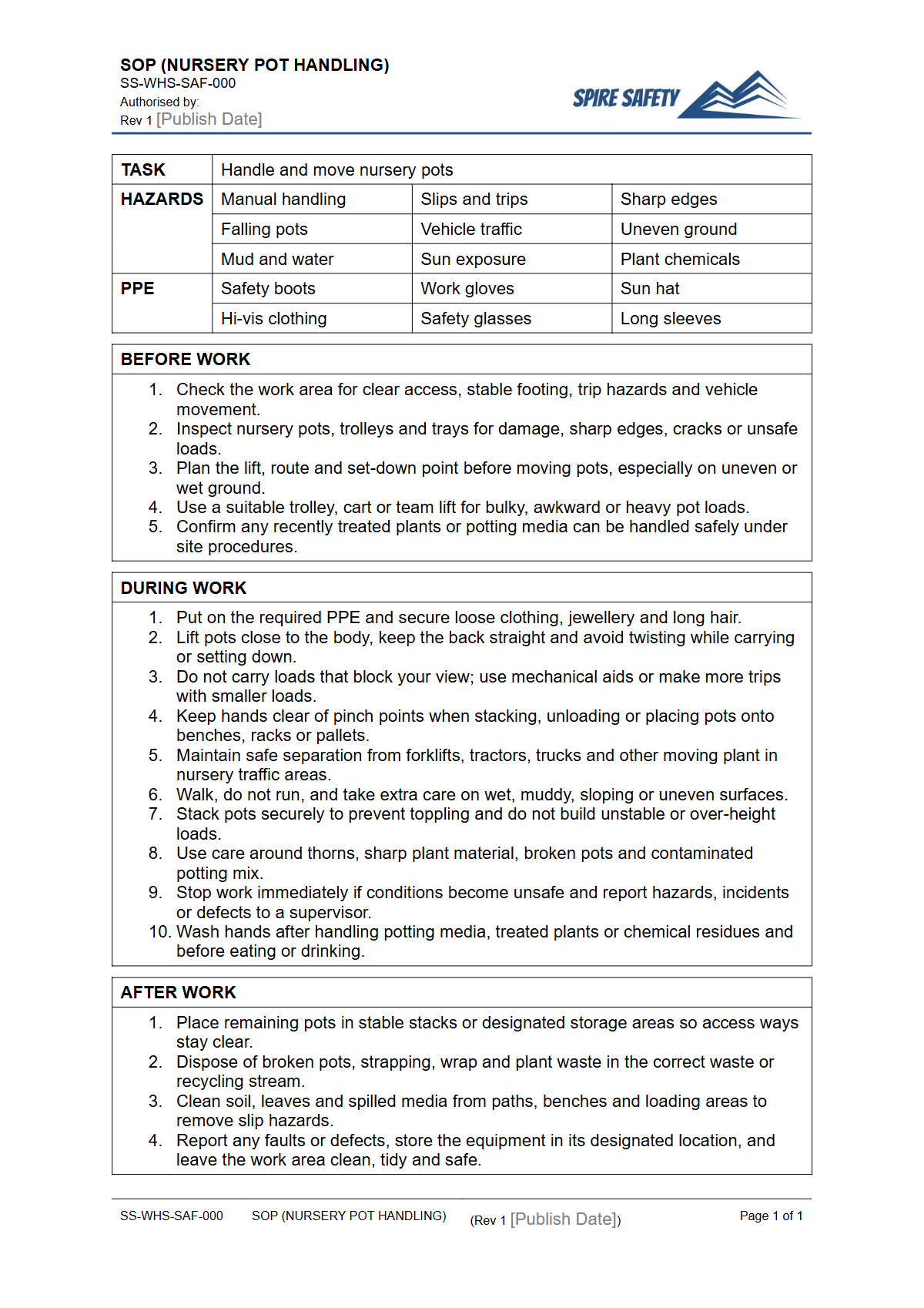
Download our Free Safe Operating Procedure (Nursery Pot Handling) Template to manage manual handling risks in your workplace.
Free Safe Operating Procedure (Nursery Pot Handling) Template
DOCX • 126 KB + PDF
Updated Oct 2026
No signup required
Purpose of the Free Safe Operating Procedure (Nursery Pot Handling) Template
Handling nursery pots, whether manually or with machinery, presents numerous workplace hazards. This free Safe Operating Procedure (Nursery Pot Handling) Template provides a structured framework for documenting the safest way to perform these tasks in your horticultural business.
Its primary purpose is to minimise the risk of musculoskeletal injuries caused by repetitive lifting, awkward postures, and carrying heavy loads. By establishing a clear, step-by-step process, you can standardise safe work practices across your team.
A documented SOP helps ensure all workers understand the expected behaviours and control measures associated with potting, stacking, transporting, and loading nursery pots. It serves as a vital tool for training new staff and conducting refresher courses for existing employees.
Formalising these procedures is a key step in fulfilling your duty of care and can be integrated with other safety documents, such as our FREE Planter SOP (Safe Operating Procedure) Template, to build a more comprehensive safety system.
Video walkthrough
How to use the Free Safe Operating Procedure (Nursery Pot Handling) Template
This resource is available for immediate download as a DOCX file, which is fully editable in Microsoft Word or other compatible programs, and as a PDF for easy printing and distribution. To use it effectively, you must adapt its contents to the specific context of your workplace.
It is not a one-size-fits-all solution.
Important: This document is a template designed as a starting point. We have structured it to align with Australian WHS principles, but you must customise it to reflect the specific hazards, equipment (e.g., potting benches, trolleys, conveyors), materials (pot sizes, soil types), and control measures unique to your operations.
A generic procedure is not sufficient; your final SOP must be based on a thorough risk assessment of your nursery's pot handling tasks. This might also include procedures for equipment like those covered in our FREE Spreader SOP (Safe Operating Procedure) Template.
When to use this Safe Operating Procedure
A well-developed SOP for nursery pot handling should be a living document integrated into your daily operations. It should be used as the primary reference during the induction and training of new nursery hands, ensuring they learn the correct, safe method from day one.
It is also an essential tool for pre-start meetings or toolbox talks, reminding workers of the key risks and controls before they begin their shifts.
Furthermore, this procedure should be reviewed following any incident or near miss involving pot handling to identify gaps and make necessary improvements. It is a critical piece of evidence during safety reviews and forms part of the documentation assessed during a formal WHS compliance auditing process to verify that your safety systems are being implemented effectively.
Who should use it
This template is designed for use by multiple roles within a nursery or horticultural organisation. Primarily, it is for the workers who perform the pot handling tasks daily, providing them with clear and accessible instructions on how to do their job safely.
Supervisors and team leaders should use the SOP to monitor work, enforce safe practices, and deliver on-the-job training and coaching.
WHS managers, safety officers, and business owners will find the template invaluable for developing and implementing their safety protocols. It acts as a foundational component of broader WHS management systems, helping to systematically address one of the most common high-risk activities in the industry and demonstrate proactive risk management.
Key Hazards in Nursery Pot Handling
While manual handling is the most obvious risk, several other hazards must be considered and controlled. These include:
- Musculoskeletal Disorders (MSDs): From lifting heavy bags of soil or stacks of pots, repetitive bending at the waist, and twisting while carrying loads.
- Slips, Trips, and Falls: Caused by spilled soil, water on floors, discarded pots, or uneven ground.
- Ergonomic Risks: Poorly designed workstations, such as potting benches that are too low or high, can force workers into sustained awkward postures.
- Mechanical Hazards: For larger operations, this includes risks associated with conveyors or machinery used to move bulk quantities of pots. Some nurseries use specialised equipment for this, and operators must be competent, similar to how one would need training for plant covered in a FREE Telehandler SOP Template.
Implementing the SOP Effectively
Simply writing the SOP is not enough. Effective implementation involves communicating its contents to all relevant workers and ensuring they understand it.
This can be achieved through practical training sessions where employees can demonstrate the correct techniques. You should also ensure supervisors are equipped to enforce the procedures consistently.
Finally, displaying the SOP in a visible location, like a break room or near the potting area, reinforces its importance. For more templates and safety resources, you can browse our complete free WHS resources library.
Common mistakes
Common mistakes to avoid
- Failing to customise the template to site-specific conditions, pot sizes, and soil weights.
- Neglecting to train workers on the finalised SOP and confirm their understanding through practical demonstration.
- Using the SOP as a 'set and forget' document instead of reviewing and updating it regularly.
- Ignoring ergonomic principles, such as providing height-adjustable workbenches to reduce bending and strain.
Legal references
Legal considerations
The following legal requirements may be relevant to this type of work.
- Work Health and Safety Act (Harmonised) — Provides the primary duties for protecting workers and other people from work health and safety risks.
- Work Health and Safety Regulations (Harmonised) — Sets out requirements supporting the management of workplace hazards and risks.
The following codes may be relevant to this type of work.
- Managing WHS Risks Code of Practice — Provides practical guidance on identifying hazards, assessing risks and applying effective controls.
- Work Health and Safety Consultation, Cooperation and Coordination Code of Practice — Provides practical guidance on consulting workers and coordinating with other duty holders.
- Managing the Work Environment and Facilities Code of Practice — Provides practical guidance on safe work environments, workplace facilities and related controls.
Did you know
The Weight Adds Up
Manual handling injuries account for around 40% of all serious workers' compensation claims in Australia. The agriculture, forestry, and fishing industry is recognised as a high-risk sector for these types of injuries.
FAQ
Frequently asked questions
01What is a Safe Operating Procedure (SOP)?
02Why are manual handling risks so high in nurseries?
03Does this template cover automated potting machines?
04How often should we review our Nursery Pot Handling SOP?
Share this resource
Free Safe Operating Procedure (Nursery Pot Handling) Template
Browse Categories
How To Use It
- 1Download and open in Word or PDF.
- 2Replace the placeholders with your business details.
- 3Get it reviewed by a WHS specialist before rollout.
Need it customised?
Our WHS consultants can adapt this template to your site, run a gap analysis, or audit what you already have in place.
Book a Free Consultation WHS consulting servicesor call 1300 156 382
Related templates
- Free Safe Operating Procedure (Nursery Stock Loading) Template
- Free Safe Operating Procedure (Nursery Tray Cleaning) Template
- Free Safe Operating Procedure (Nut Runner) Template
- Free Safe Operating Procedure (Office Carpet Cleaning) Template
- Free Safe Operating Procedure (Office Chair Cleaning) Template
- Free Safe Operating Procedure (Office Partition Clean) Template