
Free Safe Operating Procedure (Nursery Stock Loading) Template
Formalise safety protocols for loading plants and materials with our Safe Operating Procedure for Nursery Stock Loading. Download your free template today.
Free Safe Operating Procedure (Nursery Stock Loading) Template
DOCX • 126 KB + PDF
Updated Oct 2026
No signup required
Purpose of the Free Safe Operating Procedure (Nursery Stock Loading) Template
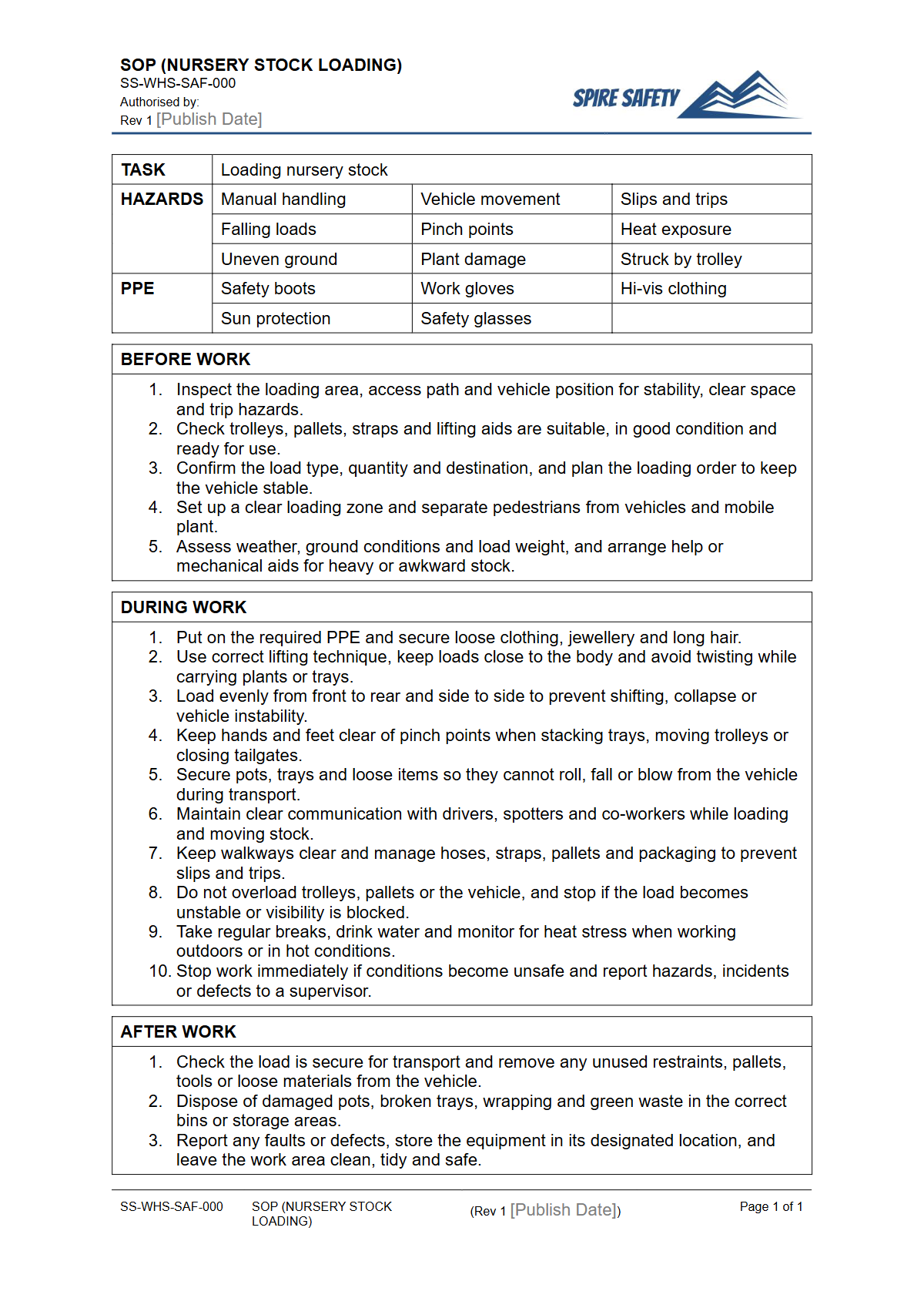
Loading nursery stock, whether it involves trays of seedlings, potted plants, large trees, or bags of soil, presents significant workplace health and safety risks. This free Safe Operating Procedure (Nursery Stock Loading) Template provides a structured framework for documenting the step-by-step process to perform loading tasks safely and efficiently.
By clearly defining the process, you can minimise hazards like musculoskeletal injuries from manual handling, slips and trips on uneven or cluttered ground, and incidents involving vehicle movement.
A documented SOP serves as a vital tool for standardising work practices across your team, ensuring everyone follows the same safe method. It becomes a cornerstone of your training program for new and existing workers, promoting a consistent safety culture within your organisation.
For tasks involving specific machinery like telehandlers to move heavy pallets or large trees, dedicated procedures are essential. Our Telehandler SOP template provides a specific example for managing such machinery.
Video walkthrough
How to use the Free Safe Operating Procedure (Nursery Stock Loading) Template
This resource is available as a fully editable DOCX file for easy customisation, and a PDF for immediate printing and review. The primary goal is for you to adapt the document to the specific context of your nursery or horticultural business.
A generic procedure is not effective; safety documents must be site-specific to be useful.
Important: This template is a structured guide and not a complete, off-the-shelf solution. We have included prompts and guidance within the Word document to help you, but you must adapt the content to your workplace.
This involves detailing your specific site layout, the types of vehicles used (e.g., utes, small trucks), the kinds of stock handled (e.g., seedlings in trays, balled-and-burlapped trees, pallets of potting mix), and the equipment available for loading (e.g., trolleys, forklifts). If you require expert assistance in tailoring this or other safety documents, our WHS consulting services can provide tailored support.
Key Sections to Customise
- Personal Protective Equipment (PPE): Specify the exact PPE required, such as steel-capped boots, high-visibility clothing, and gloves suited to the tasks.
- Pre-operational Checks: Detail the checks workers must perform on vehicles, loading equipment, and the loading zone itself before work commences.
- Step-by-Step Procedure: Break down the loading process into clear, logical steps. Create separate sections for manual loading and mechanical loading if both occur.
- Load Restraint: Include specific instructions on how to secure different types of nursery stock correctly to prevent movement during transport, a critical legal and safety requirement.
- Emergency Procedures: Outline the steps to take in case of an injury, equipment failure, or other emergency during the loading process.
When to use a Safe Operating Procedure
A Safe Operating Procedure for nursery stock loading should be a living document used proactively throughout your operations. It is not a file-and-forget document.
It should be used during the induction and training of all new workers who will be involved in loading tasks. The SOP also serves as an excellent foundation for refresher training sessions and toolbox talks to reinforce safe work habits with your existing team.
This SOP forms a critical component of a broader safety framework. Integrating it into your existing WHS management system ensures a cohesive approach to workplace safety.
Furthermore, the procedure should be a key reference document following any incident or near miss, allowing you to review its effectiveness and make necessary improvements to prevent a recurrence.
Who should use this SOP
This procedure is relevant to several roles within a nursery or horticultural business. The Person Conducting a Business or Undertaking (PCBU), such as the business owner, is ultimately responsible for ensuring safe systems of work are in place.
Managers and supervisors must use the SOP to train, monitor, and direct workers, ensuring the documented procedures are being followed correctly on the ground. Finally, and most importantly, workers who perform the loading tasks must understand and follow the SOP to protect their own health and safety and that of their colleagues.
For larger operations, stock may be moved via automated systems before loading. It's vital to also have documented procedures for this, such as a Conveyer System SOP. The principles of risk assessment and procedural documentation are fundamental across all workplace activities.
Documenting your processes demonstrates a commitment to safety and provides clarity for your entire team. Explore our complete free WHS resources library for more templates and guides to support your safety management efforts.
Common mistakes
Common mistakes to avoid
- Using a generic template without customising it for specific vehicles and stock types.
- Failing to train workers on the finalised SOP and confirm their understanding.
- Neglecting to include detailed procedures for securing loads correctly before transport.
- Not reviewing or updating the SOP after an incident or change in work practices.
Legal references
Legal considerations
The following legal requirements may be relevant to this type of work.
- Work Health and Safety Act (Harmonised) — Provides the primary duties for protecting workers and other people from work health and safety risks.
- Work Health and Safety Regulations (Harmonised) — Sets out requirements supporting the management of workplace hazards and risks.
The following codes may be relevant to this type of work.
- Managing WHS Risks Code of Practice — Provides practical guidance on identifying hazards, assessing risks and applying effective controls.
- Work Health and Safety Consultation, Cooperation and Coordination Code of Practice — Provides practical guidance on consulting workers and coordinating with other duty holders.
- Managing the Work Environment and Facilities Code of Practice — Provides practical guidance on safe work environments, workplace facilities and related controls.
Did you know
Manual Handling Risk
The horticulture industry has one of the higher rates of musculoskeletal disorders. A well-implemented SOP for loading stock is a key administrative control measure to help reduce sprains and strains.
FAQ
Frequently asked questions
01What is a Safe Operating Procedure (SOP) for nursery stock loading?
02Is this nursery stock loading SOP template enough for WHS compliance?
03Who should be involved in developing the final SOP?
04How often should we review our nursery loading SOP?
Share this resource
Free Safe Operating Procedure (Nursery Stock Loading) Template
Browse Categories
How To Use It
- 1Download and open in Word or PDF.
- 2Replace the placeholders with your business details.
- 3Get it reviewed by a WHS specialist before rollout.
Need it customised?
Our WHS consultants can adapt this template to your site, run a gap analysis, or audit what you already have in place.
Book a Free Consultation WHS consulting servicesor call 1300 156 382
Related templates
- Free Safe Operating Procedure (Nursery Tray Cleaning) Template
- Free Safe Operating Procedure (Nut Runner) Template
- Free Safe Operating Procedure (Office Carpet Cleaning) Template
- Free Safe Operating Procedure (Office Chair Cleaning) Template
- Free Safe Operating Procedure (Office Partition Clean) Template
- Free Safe Operating Procedure (Oil Filter Crusher) Template