
Free Safe Operating Procedure (Non-Slip Mat Cleaning) Template
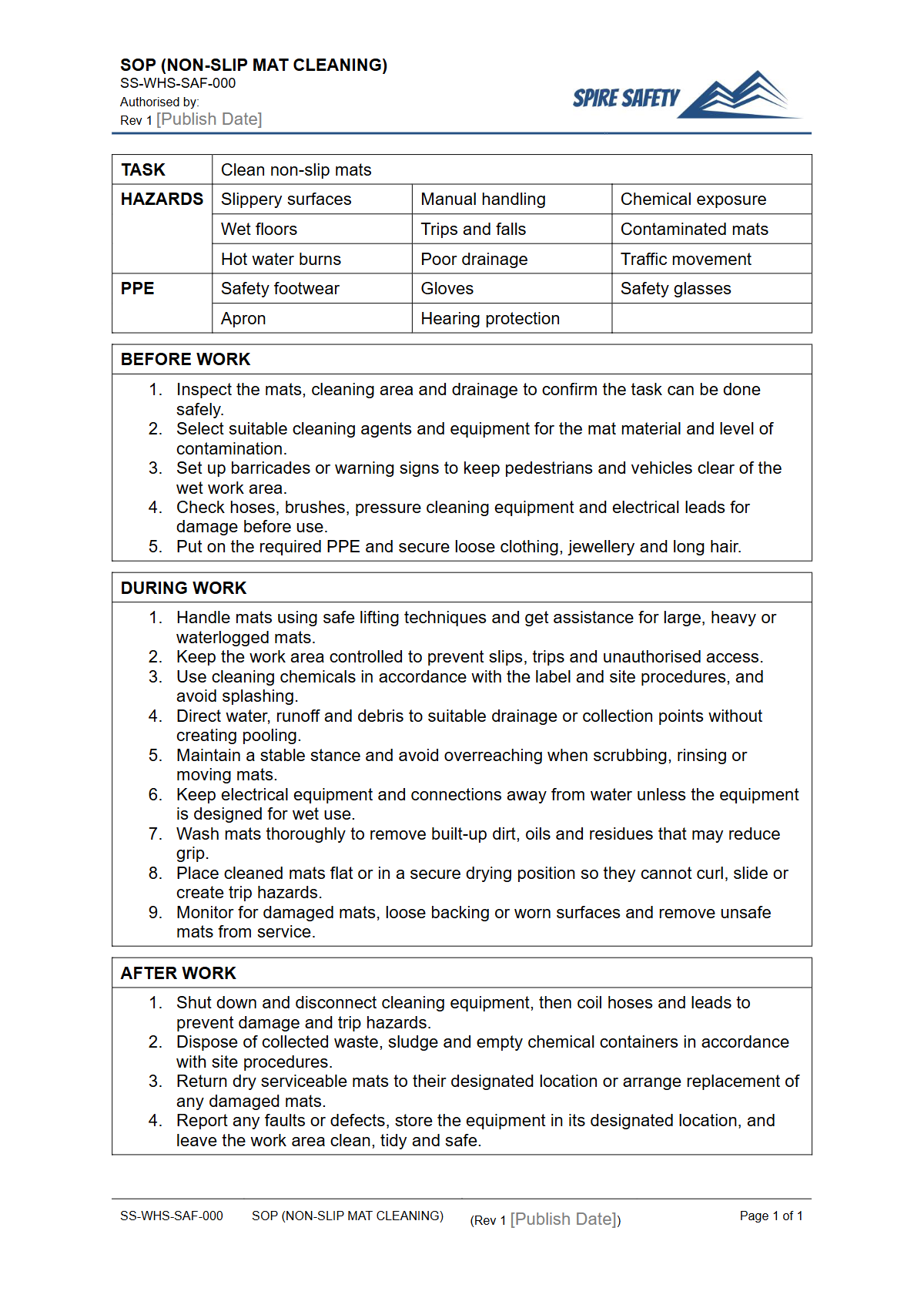
Download our free Safe Operating Procedure (Non-Slip Mat Cleaning) template to formalise your cleaning process.
Free Safe Operating Procedure (Non-Slip Mat Cleaning) Template
DOCX • 126 KB + PDF
Updated Oct 2026
No signup required
Purpose of the Free Safe Operating Procedure (Non-Slip Mat Cleaning) Template
Our free Safe Operating Procedure (Non-Slip Mat Cleaning) template provides a structured document to formalise your cleaning processes. Regular and correct cleaning of non-slip mats is essential for maintaining hygiene and preventing slip, trip, and fall incidents, which are a leading cause of workplace injuries.
This SOP helps a Person Conducting a Business or Undertaking (PCBU) establish and communicate a safe system of work for this routine but critical task. It prompts you to identify specific hazards like manual handling of heavy, wet mats, exposure to cleaning chemicals, and wet, slippery floor surfaces.
By documenting the required personal protective equipment (PPE), step-by-step instructions, and risk control measures, this template acts as a foundational component of your safety framework. Using this document helps demonstrate a commitment to fulfilling your WHS duties by proactively managing risks. Integrating this procedure is a practical step towards building robust WHS management systems.
Video walkthrough
How to use the Free Safe Operating Procedure (Non-Slip Mat Cleaning) Template
This template is designed for immediate use and customisation. Simply download the DOCX file and open it in your preferred word processor.
The document is organised into logical sections including required PPE, pre-operational checks, a step-by-step procedure, and post-cleaning tasks. Fill in the specific details for your workplace, such as the types of mats used, the exact cleaning agents approved for use (referencing their Safety Data Sheets), and the location of cleaning stations and drying racks.
You must adapt this document to your unique operational context. We have provided a comprehensive starting point, but workplace safety is not a one-size-fits-all matter.
Your final SOP should reflect the results of a site-specific risk assessment conducted by a competent person. Once finalised, the SOP should be used to train workers and be made readily available in the work area. Many workplaces that use non-slip mats, such as commercial kitchens, also have other specific procedural needs, which can be addressed with tools like our free Safe Operating Procedure for deep fryer operation.
When to Use This Safe Operating Procedure
A Safe Operating Procedure for non-slip mat cleaning should be developed and implemented before any worker is assigned the task. It serves as a primary training tool for new employees and a refresher for existing staff to ensure consistency and safety in operations.
The SOP should be reviewed regularly, at least annually, or whenever there is a change in equipment, chemicals, processes, or workplace layout.
Furthermore, this procedure must be reviewed as part of any incident or near-miss investigation related to cleaning activities. This ensures that learnings from such events are captured and used to improve safety protocols, preventing recurrence. A formal review process is a key part of maintaining safety standards and can be verified through regular WHS compliance auditing.
Who Should Use This SOP
This template is intended for use by WHS managers, supervisors, and business owners responsible for establishing safe work practices. They are responsible for customising the template and ensuring it is effectively implemented across the organisation.
The finalised SOP is a critical tool for frontline supervisors and team leaders to manage daily tasks, conduct toolbox talks, and ensure workers are following agreed-upon safety protocols.
Ultimately, the end-users of the completed procedure are the workers assigned to clean the non-slip mats. They must be trained on the contents of the SOP to understand the hazards involved and the control measures they are required to follow to protect themselves and others.
For businesses needing expert assistance in defining these roles and embedding safety procedures into their culture, engaging external WHS consulting services can provide valuable guidance and support.
Key Hazards in Non-Slip Mat Cleaning
While seemingly straightforward, cleaning non-slip mats presents several significant hazards that must be managed. A thorough risk assessment, documented in your SOP, should address the following:
Manual Handling Risks
Commercial-grade non-slip mats can be heavy and unwieldy, especially when saturated with water and debris. Lifting, carrying, dragging, or rolling these mats can lead to musculoskeletal injuries, including sprains and strains to the back, shoulders, and arms.
The SOP should specify safe lifting techniques, recommend team lifts for large or heavy mats, or identify mechanical aids where practicable.
Slips, Trips, and Falls
The very process of cleaning creates wet, slippery surfaces. Water and cleaning solutions on the floor pose a significant slip risk to the cleaner and any other person in the vicinity.
Additionally, mats that are rolled or stacked in walkways create trip hazards. Your procedure must include controls like using 'wet floor' signage, cordoning off the cleaning area, and ensuring mats and floors are completely dry before returning them to service.
Chemical Exposure
Industrial-strength detergents, degreasers, and sanitisers can cause skin irritation, chemical burns, or respiratory issues if handled incorrectly. The SOP must specify the exact chemicals to be used, reference the Safety Data Sheet (SDS) for each, and mandate the required PPE, such as chemical-resistant gloves and safety glasses.
It should also outline first aid measures in case of accidental exposure. For more information on managing various workplace hazards, browse our free WHS resources library.
Common mistakes
Common mistakes to avoid
- Using incompatible cleaning chemicals (e.g., harsh degreasers) that can degrade the mat's rubber and reduce its non-slip properties.
- Failing to thoroughly dry both the mat and the floor beneath it before replacement, creating a hidden slip hazard.
- Storing mats rolled or folded for long periods, which can cause them to curl at the edges and become a persistent trip hazard.
- Underestimating the weight of wet mats, leading to workers attempting unsafe single-person lifts and suffering manual handling injuries.
Legal references
Legal considerations
The following legal requirements may be relevant to this type of work.
- Work Health and Safety Act (Harmonised) — Provides the primary duties for protecting workers and other people from work health and safety risks.
- Work Health and Safety Regulations (Harmonised) — Sets out requirements supporting the management of workplace hazards and risks.
The following codes may be relevant to this type of work.
- Managing WHS Risks Code of Practice — Provides practical guidance on identifying hazards, assessing risks and applying effective controls.
- Work Health and Safety Consultation, Cooperation and Coordination Code of Practice — Provides practical guidance on consulting workers and coordinating with other duty holders.
- Managing the Work Environment and Facilities Code of Practice — Provides practical guidance on safe work environments, workplace facilities and related controls.
Did you know
A Common Hazard
According to Safe Work Australia, slips, trips, and falls are the second leading cause of serious workers' compensation claims, highlighting the importance of maintaining floor safety with clean, effective non-slip mats.
FAQ
Frequently asked questions
01What should be included in a non-slip mat cleaning SOP?
02How often should non-slip mats be cleaned?
03Is an SOP legally required for cleaning non-slip mats in Australia?
04What is the difference between an SOP and a SWMS for this task?
Share this resource
Free Safe Operating Procedure (Non-Slip Mat Cleaning) Template
Browse Categories
How To Use It
- 1Download and open in Word or PDF.
- 2Replace the placeholders with your business details.
- 3Get it reviewed by a WHS specialist before rollout.
Need it customised?
Our WHS consultants can adapt this template to your site, run a gap analysis, or audit what you already have in place.
Book a Free Consultation WHS consulting servicesor call 1300 156 382
Related templates
- Free Safe Operating Procedure (Notching Machine) Template
- Free Safe Operating Procedure (Nursery Bench Cleaning) Template
- Free Safe Operating Procedure (Nursery Pot Handling) Template
- Free Safe Operating Procedure (Nursery Stock Loading) Template
- Free Safe Operating Procedure (Nursery Tray Cleaning) Template
- Free Safe Operating Procedure (Nut Runner) Template