
Free Safe Operating Procedure (Notching Machine) Template
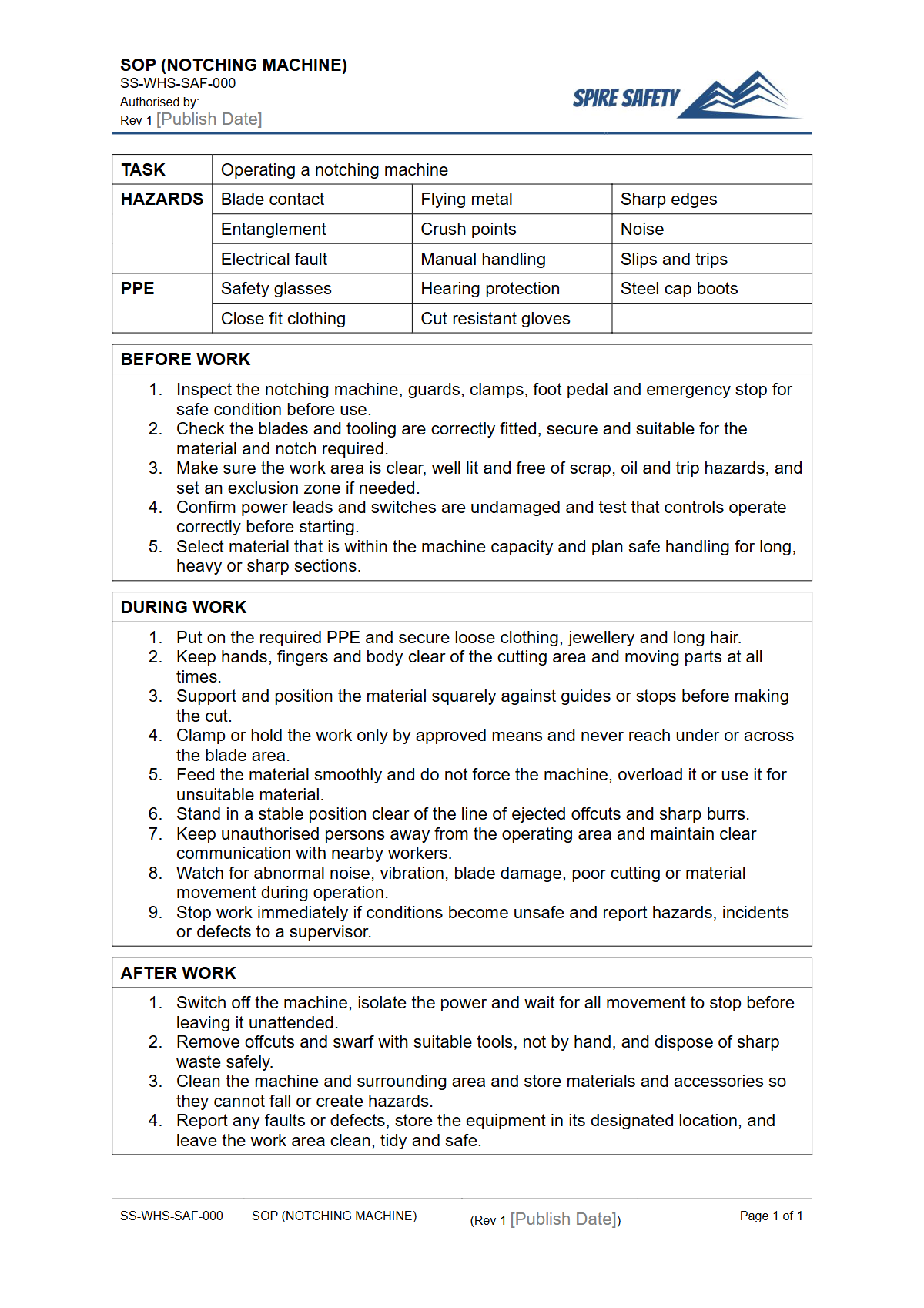
Formalise safety protocols for your workshop with our free Safe Operating Procedure (Notching Machine) Template. Download the DOCX and PDF to get started.
Free Safe Operating Procedure (Notching Machine) Template
DOCX • 126 KB + PDF
Updated Oct 2026
No signup required
Purpose of the Free Safe Operating Procedure (Notching Machine) Template
This free Safe Operating Procedure (Notching Machine) Template provides a structured starting point for documenting the risks and control measures associated with operating a notching machine. Notching machines, used to cut notches in metal pipe or tube, present significant hazards, including entanglement, cutting, and crushing.
A documented SOP is a critical tool for managing these risks, ensuring that all operators follow a consistent, safe method of work. It outlines pre-operational checks, step-by-step operating instructions, and shutdown procedures to minimise the risk of injury.
A well-drafted SOP is a fundamental component of a safe system of work. It serves as a training aid for new operators, a refresher for experienced staff, and a key piece of evidence demonstrating how your organisation manages specific workplace hazards.
Integrating this procedure into your broader WHS management systems helps create a more robust safety culture and provides clarity on expected safe work behaviours for all personnel.
Video walkthrough
How to use the Free Safe Operating Procedure (Notching Machine) Template
Our free Safe Operating Procedure (Notching Machine) Template is provided in both DOCX and PDF formats for your convenience. The DOCX file is fully editable, allowing you to tailor the content to the specific make and model of the notching machine used in your workplace, as well as your unique operational environment and site-specific hazards.
It is crucial that you customise this document to reflect your actual processes.
Important: This template is a guide, not a finished document. You must consult with the machine operators, supervisors, and health and safety representatives during the customisation process.
Review the manufacturer's manual and conduct a site-specific risk assessment to ensure all potential hazards are identified and controlled. Once finalised, the SOP should be used to train operators and be made readily accessible in the work area.
To ensure ongoing effectiveness, it is vital to review and update the SOP regularly, especially after an incident or when processes change.
The download includes:
- A DOCX file that is easy to edit and brand.
- A PDF file for easy distribution and printing.
When to use a Notching Machine SOP
A Safe Operating Procedure for a notching machine should be used every time the equipment is operated. It is not just for inexperienced workers; it provides a consistent safety benchmark for everyone.
The SOP should be a core part of the induction and training process for any new operator. It is also an essential reference document for supervisors overseeing work and for workers who may operate the machine infrequently.
This document is particularly important before starting a job, as it prompts the operator to conduct pre-start checks to ensure guards are in place, emergency stops are functional, and the work area is clear. Like the procedures detailed in our FREE Circular Saw SOP template, following a set sequence of tasks helps prevent complacency and reduces the likelihood of incidents caused by human error.
The SOP should also be consulted when planning maintenance or cleaning activities to ensure the machine is properly isolated and de-energised.
Who Should Use This Template?
This template is designed for use by Persons Conducting a Business or Undertaking (PCBUs), workshop managers, supervisors, and health and safety professionals in industries such as metal fabrication, engineering, and manufacturing. It provides the framework needed to meet their duty of care to provide and maintain safe plant and systems of work. The process of customising and implementing the SOP should involve:
- Managers and Supervisors: To ensure safety standards are established and enforced.
- Operators: To provide practical input on the machine’s operation and to follow the finalised procedure.
- Health and Safety Representatives (HSRs): To participate in the consultation process and verify that risks have been adequately addressed.
Ultimately, anyone responsible for workplace safety where a notching machine is used will find this template a valuable resource. The principles within it are scalable from small workshops to large manufacturing plants.
Regular reviews of such documents are often a key part of formal WHS compliance auditing to verify that documented procedures are being implemented effectively on the workshop floor.
Just as workshops rely on various pieces of equipment, your safety documentation should cover all relevant plant. For example, if your workshop uses compressed air, consider downloading our free Air Compressor SOP to ensure that hazard is also managed.
For more complex operational challenges or guidance on developing a suite of safety documents, engaging with professional WHS consulting services can provide expert support. Spire Safety offers a wide range of templates and guidance in our free WHS resources library to help you build a comprehensive safety system.
Common mistakes
Common mistakes to avoid
- Failing to properly secure the workpiece before starting a cut, leading to ejection or jamming.
- Wearing loose clothing, jewellery, or gloves that can become entangled in rotating parts.
- Neglecting to perform pre-start checks, such as verifying guard positions and emergency stop functionality.
- Attempting to clear jams or make adjustments while the machine is still powered on.
Legal references
Legal considerations
The following legal requirements may be relevant to this type of work.
- Work Health and Safety Act (Harmonised) — Provides the primary duties for protecting workers and other people from work health and safety risks.
- Work Health and Safety Regulations (Harmonised) — Sets out requirements supporting the management of workplace hazards and risks.
The following codes may be relevant to this type of work.
- Managing WHS Risks Code of Practice — Provides practical guidance on identifying hazards, assessing risks and applying effective controls.
- Work Health and Safety Consultation, Cooperation and Coordination Code of Practice — Provides practical guidance on consulting workers and coordinating with other duty holders.
- Managing the Work Environment and Facilities Code of Practice — Provides practical guidance on safe work environments, workplace facilities and related controls.
Did you know
Machine Guarding
Inadequate machine guarding is consistently one of the most common safety breaches found by WHS inspectors in Australia. Fixed physical guards are the most effective type because they are not reliant on operator behaviour to be effective.
FAQ
Frequently asked questions
01What are the main hazards associated with a notching machine?
02How often should a Safe Operating Procedure for a notching machine be reviewed?
03Is training required before an operator can use a notching machine?
04Can this template be used for other types of metalworking machinery?
Share this resource
Free Safe Operating Procedure (Notching Machine) Template
Browse Categories
How To Use It
- 1Download and open in Word or PDF.
- 2Replace the placeholders with your business details.
- 3Get it reviewed by a WHS specialist before rollout.
Need it customised?
Our WHS consultants can adapt this template to your site, run a gap analysis, or audit what you already have in place.
Book a Free Consultation WHS consulting servicesor call 1300 156 382
Related templates
- Free Safe Operating Procedure (Nursery Bench Cleaning) Template
- Free Safe Operating Procedure (Nursery Pot Handling) Template
- Free Safe Operating Procedure (Nursery Stock Loading) Template
- Free Safe Operating Procedure (Nursery Tray Cleaning) Template
- Free Safe Operating Procedure (Nut Runner) Template
- Free Safe Operating Procedure (Office Carpet Cleaning) Template