
Free Safe Operating Procedure (Noise Dosimeter) Template
Download our free Safe Operating Procedure (Noise Dosimeter) template to manage workplace noise risks.
Free Safe Operating Procedure (Noise Dosimeter) Template
DOCX • 126 KB + PDF
Updated Oct 2026
No signup required
Purpose of the Free Safe Operating Procedure (Noise Dosimeter) Template
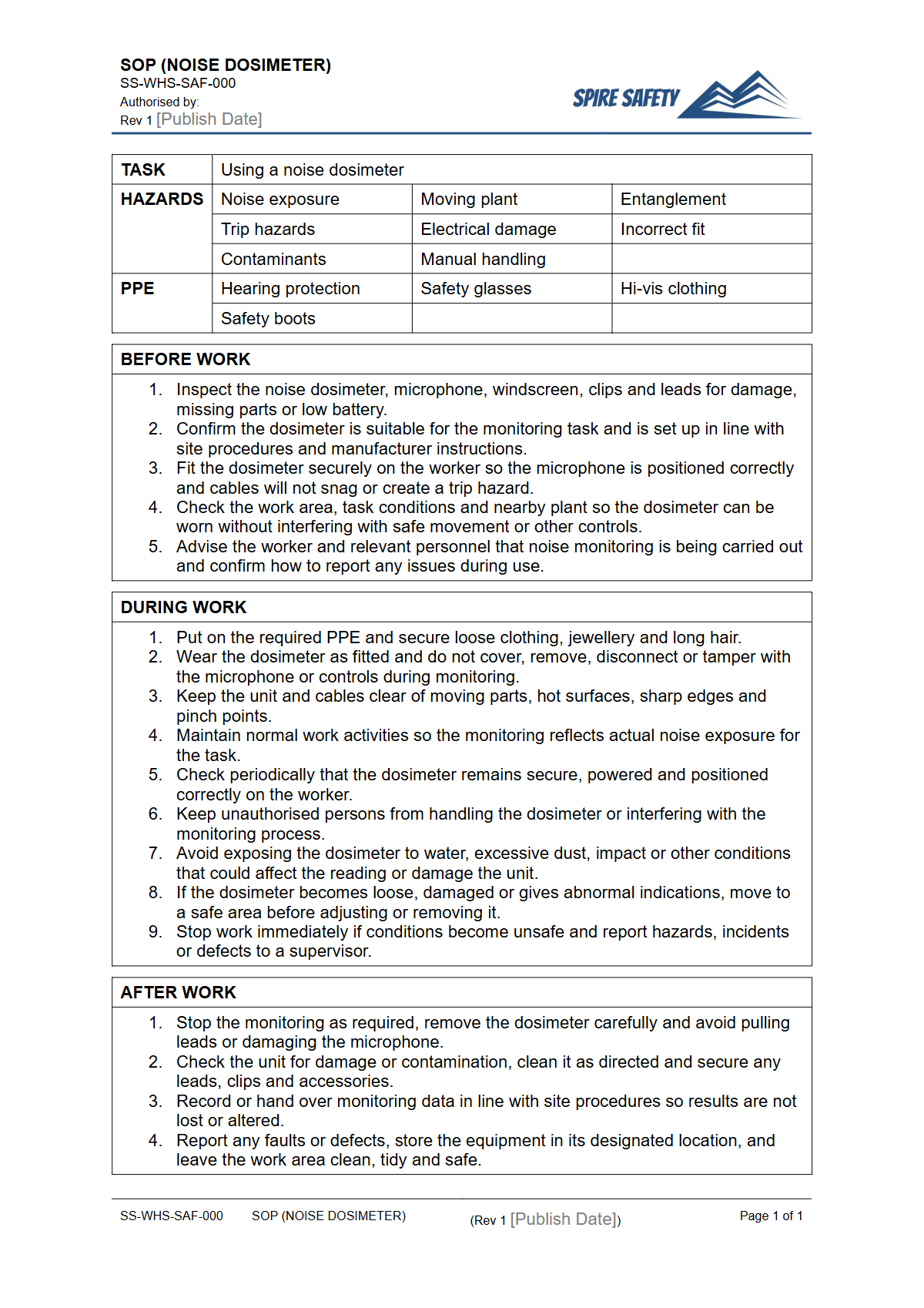
A noise dosimeter is a specialised device used to measure a worker's personal exposure to noise over their work shift. This free Safe Operating Procedure (Noise Dosimeter) Template provides a structured framework for ensuring these devices are used correctly, consistently, and safely.
The primary purpose is to gather accurate data, which is essential for assessing the risk of noise-induced hearing loss and determining the effectiveness of noise control measures. Using a clear SOP helps your organisation meet its duties under WHS regulations to manage hazardous noise risks.
Properly documenting this process is a key component of effective WHS management systems. This SOP guides users through pre-use checks, calibration, correct placement on the worker, instruction, and post-use data handling. Following a standardised procedure minimises variables and improves the reliability of your noise exposure data, forming a solid basis for your hearing conservation program.
Video walkthrough
How to use the Free Safe Operating Procedure (Noise Dosimeter) Template
This Safe Operating Procedure template is provided as a starting point in both DOCX and PDF formats. To use it effectively, download the file and integrate it into your organisation's safety management system.
The procedure should be reviewed and customised to reflect the specific make and model of noise dosimeter you use, the unique aspects of your work environment, and your internal documentation protocols. You should add company-specific details such as your business name, ABN, relevant dates, and the names of persons responsible for each step.
Important: This is a template and must be customised to your workplace. It provides a structured guide aligned with Australian WHS principles, but it is not a complete, ready-to-use document.
We are not liable for any incidents or outcomes resulting from the use of this template. You must ensure the final document reflects your specific equipment, processes, and legislative requirements.
When to use it
A Safe Operating Procedure for noise dosimetry should be used whenever personal noise exposure monitoring is required. This typically occurs in several situations, including after an initial noise hazard identification suggests that workers may be exposed to noise levels exceeding the exposure standard.
It is also used for periodic monitoring to ensure existing noise controls remain effective, or following a significant change in the workplace, such as the introduction of new machinery or different work practices. For example, assessing noise from equipment covered in our Air Compressor SOP template would be a key trigger.
Who should use it
This SOP is intended for use by a 'competent person'—someone with the requisite knowledge, training, and experience to conduct noise monitoring. This may include WHS advisors, occupational hygienists, or specifically trained site supervisors.
Additionally, supervisors of the workers being monitored should be familiar with the procedure to ensure the process runs smoothly and the worker understands their role. The workers wearing the dosimeters are also key participants; the SOP helps ensure they receive clear instructions on why the measurement is being taken and how their behaviour might affect the results, such as not tampering with the microphone.
Key Steps in the Procedure
Our template outlines the critical phases of using a noise dosimeter, which you should adapt to your specific device.
- Pre-Operational Checks: This section covers inspecting the device for damage, ensuring the battery is fully charged, and checking the microphone windshield is clean and correctly fitted.
- Calibration: A crucial step for data accuracy. The SOP details performing a pre-measurement calibration using an acoustic calibrator and recording the results. Using a systematic process is also vital when managing other high-risk tools, as detailed in our free Circular Saw SOP.
- Device Fitment: The procedure explains how to correctly attach the dosimeter to the worker and position the microphone in the 'hearing zone'—typically on the shoulder, midway between the ear and the neck. It also includes instructing the worker on the purpose of the monitoring.
- Post-Operational Tasks: After the measurement period, the SOP guides the user on safely removing the device, performing a post-calibration check to validate the data, and downloading the results for analysis and reporting.
Integrating Noise Data into Your Safety System
The data collected using this SOP is not an end in itself. It must be analysed by a competent person to determine if a worker's noise exposure exceeds the national standard.
The findings should be used to inform your risk assessment and guide the selection of appropriate noise control measures, following the hierarchy of controls. If you require expert assistance in interpreting data or developing a comprehensive noise management plan, engaging specialist WHS consulting services can provide valuable support.
This ensures your actions are effective and aligned with regulatory expectations, protecting your workers from long-term harm.
Monitoring is a continuous process, especially in dynamic work environments with equipment like heavy machinery. For other examples of managing plant, see our free Trencher SOP template. Regular reviews and follow-up monitoring are essential to verify the ongoing effectiveness of your noise management strategy. For more templates and checklists, browse our complete free WHS resources library.
Common mistakes
Common mistakes to avoid
- Placing the microphone in a position where it can be covered by clothing or knocked easily.
- Forgetting to perform both pre-use and post-use calibrations, which invalidates the measurement data.
- Failing to adequately instruct the worker on what the device is for and what behaviours to avoid.
- Relying on a single day's measurement without considering variations in tasks, shifts, or seasonal work.
Legal references
Legal considerations
The following legal requirements may be relevant to this type of work.
- Work Health and Safety Act (Harmonised) — Provides the primary duties for protecting workers and other people from work health and safety risks.
- Work Health and Safety Regulations (Harmonised) — Sets out requirements supporting the management of workplace hazards and risks.
The following codes may be relevant to this type of work.
- Managing WHS Risks Code of Practice — Provides practical guidance on identifying hazards, assessing risks and applying effective controls.
- Work Health and Safety Consultation, Cooperation and Coordination Code of Practice — Provides practical guidance on consulting workers and coordinating with other duty holders.
- Managing the Work Environment and Facilities Code of Practice — Provides practical guidance on safe work environments, workplace facilities and related controls.
Did you know
The Exposure Standard
The Australian workplace exposure standard for noise is an 8-hour time-weighted average of 85 decibels (A-weighted), and a peak noise level of 140 decibels (C-weighted).
Permanent Damage
Noise-induced hearing loss is permanent and irreversible, but it is also entirely preventable. It is one of the most common preventable occupational diseases in Australia.
FAQ
Frequently asked questions
01What is a noise dosimeter used for in an Australian workplace?
02Who is considered a 'competent person' to operate a noise dosimeter?
03How often should workplace noise monitoring be conducted?
04Does using this noise dosimeter SOP make my workplace compliant?
Share this resource
Free Safe Operating Procedure (Noise Dosimeter) Template
Browse Categories
How To Use It
- 1Download and open in Word or PDF.
- 2Replace the placeholders with your business details.
- 3Get it reviewed by a WHS specialist before rollout.
Need it customised?
Our WHS consultants can adapt this template to your site, run a gap analysis, or audit what you already have in place.
Book a Free Consultation WHS consulting servicesor call 1300 156 382
Related templates
- Free Safe Operating Procedure (Non-Slip Mat Cleaning) Template
- Free Safe Operating Procedure (Notching Machine) Template
- Free Safe Operating Procedure (Nursery Bench Cleaning) Template
- Free Safe Operating Procedure (Nursery Pot Handling) Template
- Free Safe Operating Procedure (Nursery Stock Loading) Template
- Free Safe Operating Procedure (Nursery Tray Cleaning) Template