
Free Safe Operating Procedure (Netball Court Cleaning) Template
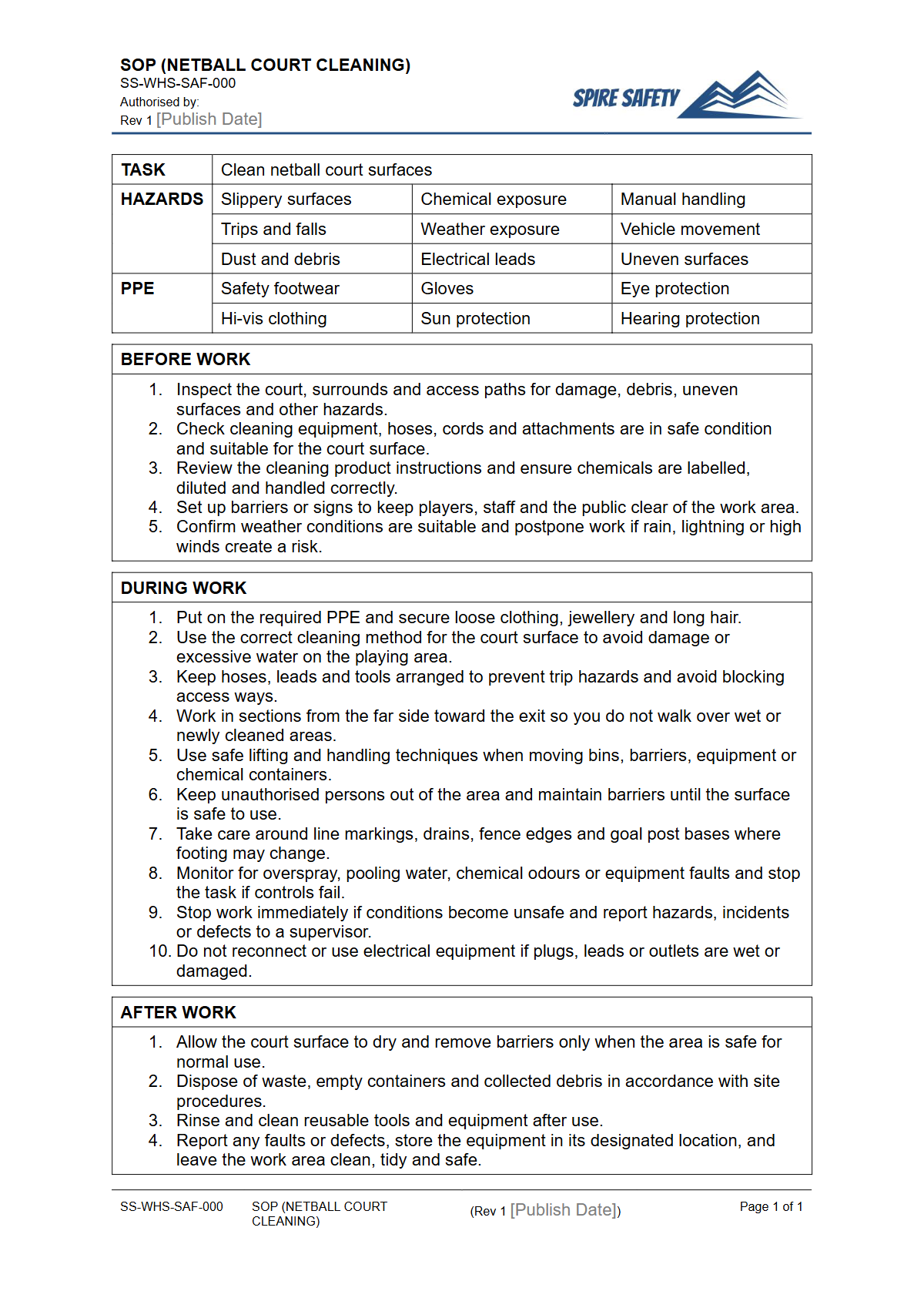
Download our free Safe Operating Procedure for netball court cleaning. This customisable template helps you formalise safety processes and manage associated risks.
Free Safe Operating Procedure (Netball Court Cleaning) Template
DOCX • 126 KB + PDF
Updated Oct 2026
No signup required
Purpose of the Free Safe Operating Procedure (Netball Court Cleaning) Template
Maintaining a netball court involves more than just keeping it looking good; it's a critical task for ensuring player safety and extending the life of the surface. Our Free Safe Operating Procedure (Netball Court Cleaning) Template provides a structured framework for documenting the required steps to perform this task safely and effectively.
This SOP helps organisations meet their work health and safety (WHS) obligations by identifying potential hazards and outlining clear control measures.
Cleaning activities can introduce numerous risks, including slips on wet or mossy surfaces, trips over hoses and equipment, manual handling injuries from using pressure washers or large brooms, and exposure to cleaning chemicals. For outdoor courts, workers may also face risks from UV radiation and environmental factors.
A documented SOP ensures that everyone involved understands these hazards and follows a consistent, safe method of work. Formalising this process is a key component of robust WHS management systems, demonstrating a commitment to proactive risk management.
Key Hazards in Netball Court Cleaning
- Slips, trips, and falls: From wet surfaces, algae or moss growth, cleaning residues, and equipment like hoses and buckets.
- Hazardous Chemicals: Skin irritation, respiratory issues, or eye damage from contact with detergents, algaecides, or other cleaning agents.
- Manual Tasks: Musculoskeletal injuries from handling heavy or awkward equipment, such as high-pressure water blasters, industrial brooms, or leaf blowers.
- Plant and Equipment: Risks associated with powered equipment, including noise exposure, vibration, or unexpected start-up.
- Environmental Factors: For outdoor courts, this includes UV exposure, heat stress, and risks associated with adverse weather.
Video walkthrough
How to use the Free Safe Operating Procedure (Netball Court Cleaning) Template
This Safe Operating Procedure for netball court cleaning is provided as a user-friendly template in both DOCX and PDF formats. The DOCX file is fully editable, allowing you to adapt the content to your specific operational context.
It is designed as a starting point, containing common steps and safety considerations based on Australian WHS principles.
To implement this SOP effectively, you must conduct a site-specific risk assessment and modify the document accordingly. This includes listing the exact personal protective equipment (PPE) required, detailing the specific cleaning chemicals used (and referencing their Safety Data Sheets), and outlining the operation of your unique equipment.
If your process involves powered blowers, for example, your procedure might reference a separate air compressor SOP for that equipment's safe use.
Important: This document is a template and is not a complete safety solution on its own. Before use, you MUST customise this Safe Operating Procedure to reflect the specific hazards, equipment, chemicals, environment, and personnel at your workplace.
This ensures the procedure is relevant and effective in controlling risks unique to your operations.
When to use a Netball Court Cleaning SOP
A Safe Operating Procedure for this task should be used consistently as a reference tool. It is essential for training new employees or contractors, ensuring they understand the safety requirements before commencing work.
It also serves as a valuable refresher for existing staff and a benchmark during performance reviews or safety observations. Furthermore, the SOP should be reviewed and updated whenever a process changes, such as the introduction of new cleaning equipment or chemicals, or following any reported incident or near-miss.
Regular reviews are often a key verification step during a WHS compliance auditing process.
Who should use it
This template is designed for anyone responsible for the safety and maintenance of sporting facilities. This includes:
- Facility Managers and Groundskeepers
- Sports Club Presidents and Committee Members
- WHS/OHS Managers and Advisors
- Cleaning and Maintenance Contractors
- Team Leaders supervising cleaning crews
By implementing a clear SOP, these individuals can effectively instruct workers, manage risks, and demonstrate due diligence. Just as a commercial kitchen requires an SOP for deep fryer operation, specialised maintenance tasks like court cleaning demand their own formalised procedures to ensure safety and consistency. For more templates covering a wide range of workplace tasks, explore our complete free WHS resources library.
Common mistakes
Common mistakes to avoid
- Using the template without customising it for site-specific chemicals, equipment, and environmental conditions.
- Failing to train workers on the finalised SOP and verify their understanding before they undertake the task.
- Neglecting to review and update the SOP after an incident or when new cleaning agents or machinery are introduced.
- Storing cleaning chemicals incorrectly, such as in unlabelled containers or areas where they can react with other substances.
Legal references
Legal considerations
The following legal requirements may be relevant to this type of work.
- Work Health and Safety Act (Harmonised) — Provides the primary duties for protecting workers and other people from work health and safety risks.
- Work Health and Safety Regulations (Harmonised) — Sets out requirements supporting the management of workplace hazards and risks.
The following codes may be relevant to this type of work.
- Managing WHS Risks Code of Practice — Provides practical guidance on identifying hazards, assessing risks and applying effective controls.
- Work Health and Safety Consultation, Cooperation and Coordination Code of Practice — Provides practical guidance on consulting workers and coordinating with other duty holders.
- Managing the Work Environment and Facilities Code of Practice — Provides practical guidance on safe work environments, workplace facilities and related controls.
Did you know
A Slippery Subject
Slips, trips, and falls are a leading cause of serious workplace injuries in Australia, accounting for thousands of workers' compensation claims each year. Maintaining a non-slip surface on a netball court is crucial for both players and maintenance staff.
Surface Integrity
The specific surface texture of a netball court is vital for providing the right amount of grip (traction) and shock absorption. Using incorrect cleaning methods or harsh chemicals can degrade this surface, affecting player performance and increasing the risk of injury.
FAQ
Frequently asked questions
01What is a Safe Operating Procedure (SOP)?
02Why is an SOP so important for cleaning a netball court?
03Does this template cover both indoor and outdoor netball courts?
04Who is responsible for creating and implementing the SOP?
Share this resource
Free Safe Operating Procedure (Netball Court Cleaning) Template
Browse Categories
How To Use It
- 1Download and open in Word or PDF.
- 2Replace the placeholders with your business details.
- 3Get it reviewed by a WHS specialist before rollout.
Need it customised?
Our WHS consultants can adapt this template to your site, run a gap analysis, or audit what you already have in place.
Book a Free Consultation WHS consulting servicesor call 1300 156 382
Related templates
- Free Safe Operating Procedure (Noise Dosimeter) Template
- Free Safe Operating Procedure (Non-Slip Mat Cleaning) Template
- Free Safe Operating Procedure (Notching Machine) Template
- Free Safe Operating Procedure (Nursery Bench Cleaning) Template
- Free Safe Operating Procedure (Nursery Pot Handling) Template
- Free Safe Operating Procedure (Nursery Stock Loading) Template