
Free Safe Operating Procedure (Nail Gun) Template
Develop a clear, step-by-step process for nail gun use with our free template. Download the Safe Operating Procedure for nail guns to improve safety now.
Free Safe Operating Procedure (Nail Gun) Template
DOCX • 126 KB + PDF
Updated Oct 2026
No signup required
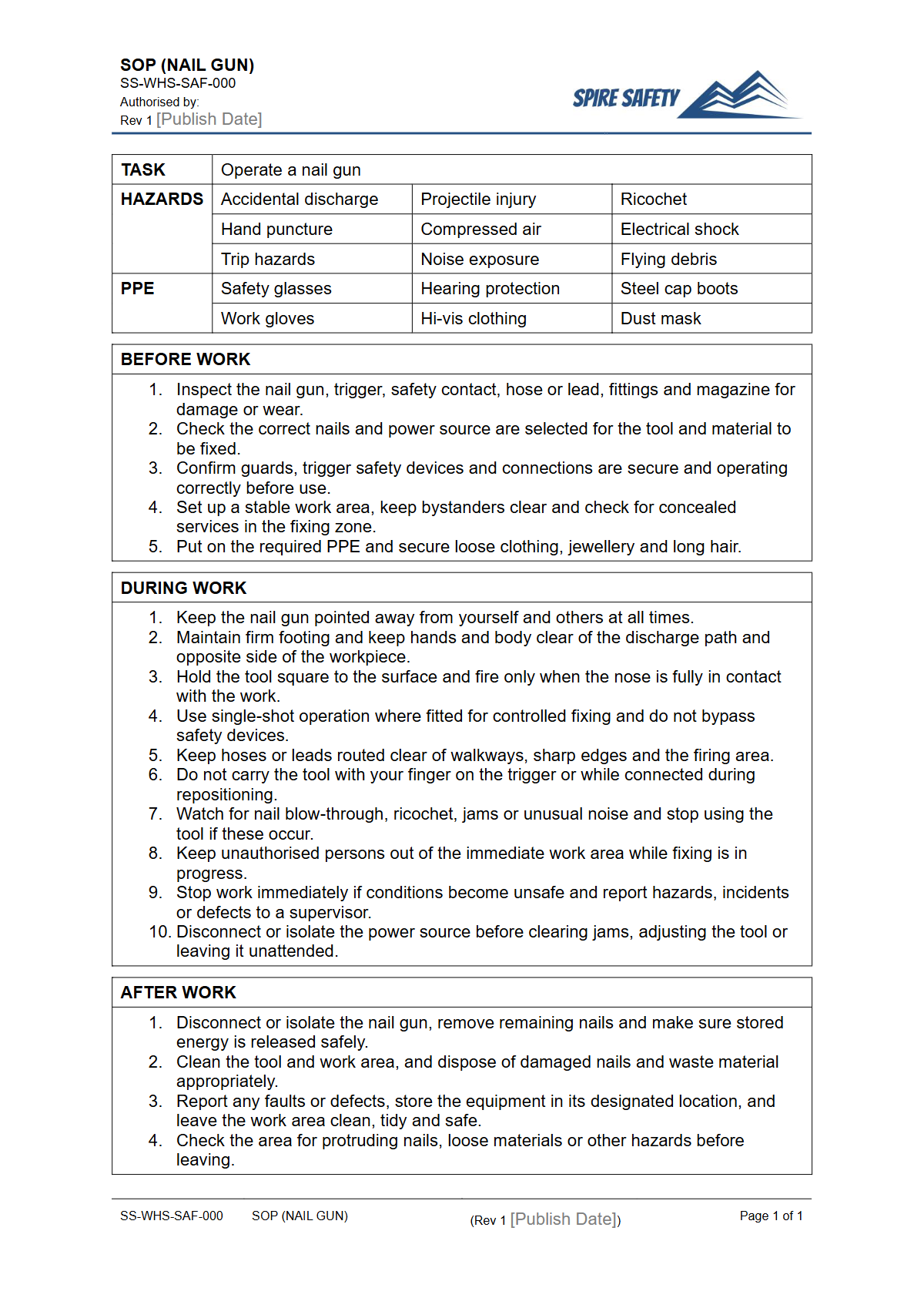
Purpose of the Free Safe Operating Procedure (Nail Gun) Template
Using power tools like nail guns without a documented process presents significant risks. This Free Safe Operating Procedure (Nail Gun) Template provides a structured starting point for your business to formalise the safe use of this equipment.
A well-drafted SOP is a critical tool for managing workplace hazards. It standardises the operating process, ensures all workers receive consistent instructions, and serves as a key reference for training, supervision, and incident investigation.
By clearly outlining pre-start checks, operational steps, and emergency responses, you create a safer environment for everyone.
Implementing clear, documented procedures is a fundamental aspect of effective safety management. These documents form the backbone of a proactive safety culture and are an essential component of strong WHS management systems, helping your organisation meet its duty of care and continuously improve workplace health and safety.
Video walkthrough
How to use the Free Safe Operating Procedure (Nail Gun) Template
This template is available for download in both DOCX and PDF formats. The DOCX version is fully editable, allowing you to tailor it precisely to your workplace's needs.
The goal is to create a practical, user-friendly document that reflects the specific hazards and control measures relevant to your operations. While it is aligned with the model WHS framework, it is not a substitute for a site-specific risk assessment.
Important: This document is a template and must be customised. We have provided a comprehensive framework, but it is your responsibility to adapt the content to reflect the specific nail gun models you use, the materials you work with, the tasks your team performs, and the unique environment of your worksite.
You should conduct a thorough risk assessment and consult with your workers before finalising and implementing the procedure. Regular reviews, potentially as part of a professional WHS compliance auditing program, ensure the SOP remains current and effective.
Key Components of Your Nail Gun SOP
A robust SOP for power tools should be comprehensive. When customising this template, pay close attention to the following sections:
- PPE Requirements: Specify the exact personal protective equipment required, such as AS/NZS certified safety glasses or goggles, hearing protection, and safety footwear.
- Pre-Operational Checks: Detail the daily checks operators must perform, including inspecting air hoses for damage, ensuring safety mechanisms are functional, and checking for secure battery connections on cordless models.
- Step-by-Step Instructions: Provide a clear, sequential guide for operating the nail gun. Cover loading nails, selecting the correct firing mode (e.g., sequential vs. contact), positioning the tool correctly against the workpiece, and managing jams or misfires safely.
- Emergency Procedures: Outline the immediate steps to take in case of an injury, such as a nail penetration wound. Include first aid instructions and emergency contact information.
Many workplaces use a variety of high-risk plant and equipment, each requiring its own procedure. For pneumatic nail guns, an Air Compressor SOP is also essential to manage the associated risks of pressurised air.
Similarly, for other common workshop or construction tools, a specific procedure like our free circular saw SOP template should be developed.
When to use a Nail Gun SOP
A Safe Operating Procedure is not a document that sits on a shelf. It should be actively used in day-to-day operations.
It is a critical resource during worker induction and training, ensuring new team members understand the correct and safe way to use the equipment from day one. Supervisors should use it as a reference for monitoring work and conducting safety observations.
The SOP should also be reviewed as part of any incident investigation involving a nail gun. Furthermore, it's wise to integrate its use with other site safety documents.
For example, on a construction site, this procedure complements other equipment-specific documents like a free Telehandler SOP, contributing to a comprehensive site safety plan.
Who should use it
This Safe Operating Procedure is intended for a range of personnel within an organisation. Primarily, it is for the operators of nail guns, providing them with clear, accessible instructions to perform their work safely.
Supervisors and managers must also be thoroughly familiar with the SOP to effectively train their teams, enforce safe work practices, and lead by example.
WHS personnel and safety committees will use the document as part of the broader risk management framework. They are often responsible for drafting, reviewing, and updating the procedure in consultation with workers.
For smaller businesses, the owner or Person Conducting a Business or Undertaking (PCBU) holds the ultimate responsibility for ensuring safe systems of work are in place, making this template a valuable tool for demonstrating compliance. You can explore more procedural documents in our library of free WHS resources.
Common mistakes
Common mistakes to avoid
- Disabling or bypassing the safety contact tip on the nose of the gun.
- Using a free hand to hold a workpiece in place near the firing line.
- Using a 'contact' or 'bump' firing mode for precision work where it's not necessary.
- Failing to disconnect the air supply or battery before clearing a jam.
Legal references
Legal considerations
The following legal requirements may be relevant to this type of work.
- Work Health and Safety Act (Harmonised) — Provides the primary duties for protecting workers and other people from work health and safety risks.
- Work Health and Safety Regulations (Harmonised) — Sets out requirements supporting the management of workplace hazards and risks.
The following codes may be relevant to this type of work.
- Managing WHS Risks Code of Practice — Provides practical guidance on identifying hazards, assessing risks and applying effective controls.
- Work Health and Safety Consultation, Cooperation and Coordination Code of Practice — Provides practical guidance on consulting workers and coordinating with other duty holders.
- Managing the Work Environment and Facilities Code of Practice — Provides practical guidance on safe work environments, workplace facilities and related controls.
Did you know
Contact vs. Sequential Triggers
Nail guns have two main trigger types. Sequential triggers, which require the safety tip to be depressed before the trigger is pulled for each nail, are significantly safer than contact ('bump') triggers, which can fire whenever the tip and trigger are pressed at the same time.
Ricochet Risk
A nail can travel at speeds over 400 metres per second. If it strikes a metal fixture, knot in wood, or another nail, it can easily ricochet, making certified safety glasses essential protection against severe eye injury.
FAQ
Frequently asked questions
01What is a Safe Operating Procedure for a nail gun?
02Is training required to use a nail gun in Australia?
03What are the most common nail gun injuries?
04How often should a nail gun SOP be reviewed?
Share this resource
Free Safe Operating Procedure (Nail Gun) Template
Browse Categories
How To Use It
- 1Download and open in Word or PDF.
- 2Replace the placeholders with your business details.
- 3Get it reviewed by a WHS specialist before rollout.
Need it customised?
Our WHS consultants can adapt this template to your site, run a gap analysis, or audit what you already have in place.
Book a Free Consultation WHS consulting servicesor call 1300 156 382
Related templates
- Free Safe Operating Procedure (Nail Salon Cleanup) Template
- Free Safe Operating Procedure (Nature Strip Mowing) Template
- Free Safe Operating Procedure (Needle Scaler) Template
- Free Safe Operating Procedure (Netball Court Cleaning) Template
- Free Safe Operating Procedure (Noise Dosimeter) Template
- Free Safe Operating Procedure (Non-Slip Mat Cleaning) Template