
Free Safe Operating Procedure (Nail Salon Cleanup) Template
Formalise your cleanup processes to manage chemical and biological hazards in your salon. Download our free Safe Operating Procedure template to get started.
Free Safe Operating Procedure (Nail Salon Cleanup) Template
DOCX • 126 KB + PDF
Updated Oct 2026
No signup required
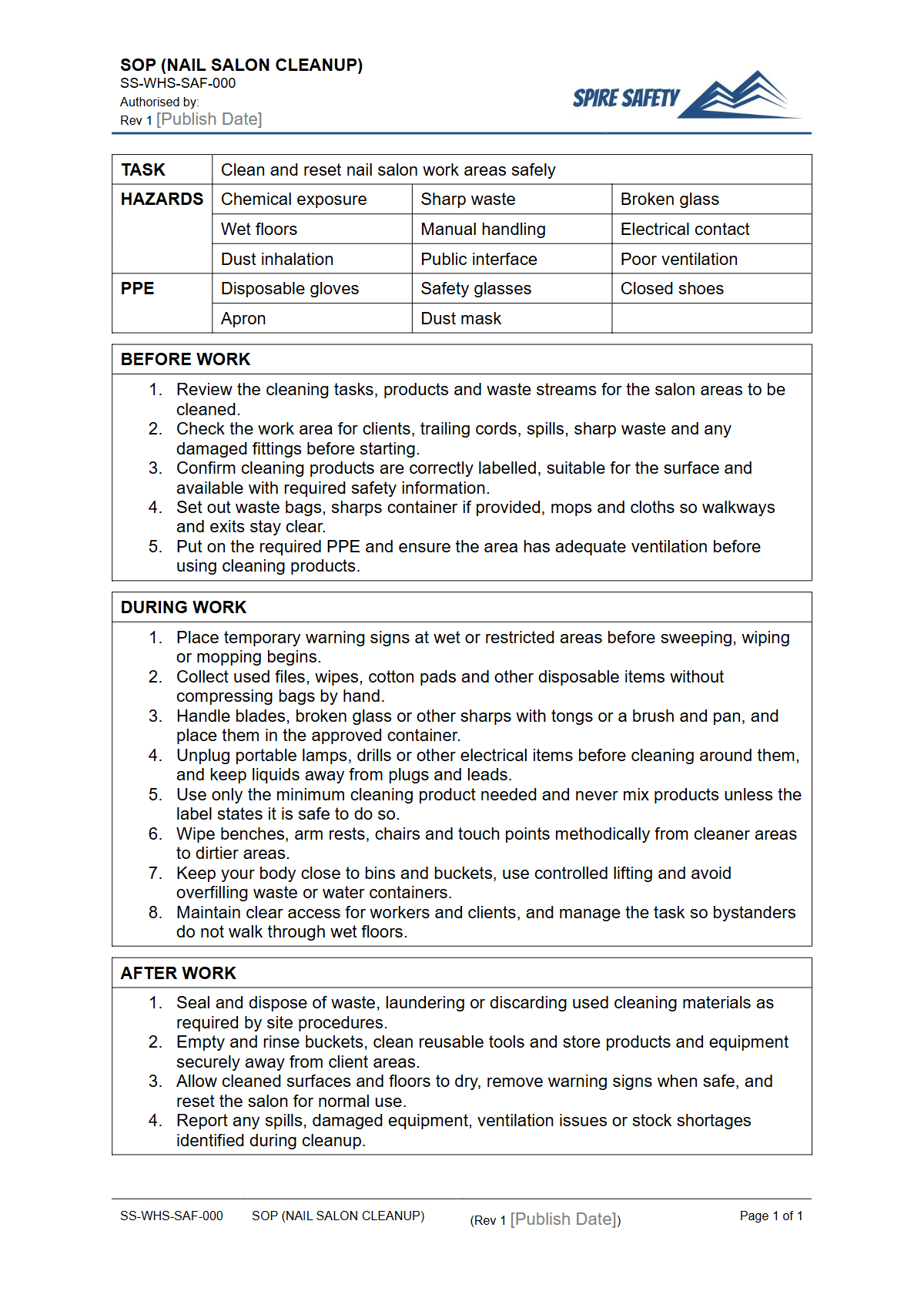
Purpose of the Free Safe Operating Procedure (Nail Salon Cleanup) Template
A nail salon environment contains numerous health and safety risks, from chemical exposure and airborne dust to biological hazards. This free Safe Operating Procedure (Nail Salon Cleanup) template provides a structured framework for documenting the required steps to clean and sanitise work areas, tools, and equipment effectively.
Implementing a clear SOP helps your business meet its primary duty of care by minimising risks to both staff and clients.
Documenting your cleanup process is a fundamental part of a robust WHS management system. It demonstrates a commitment to safety, ensures consistency in practice, and provides a clear reference for training new employees. This procedure covers key areas such as the handling and disposal of hazardous chemicals, disinfection protocols for tools and surfaces, and managing waste to prevent cross-contamination.
Meeting WHS Obligations
Under Australian WHS laws, a Person Conducting a Business or Undertaking (PCBU) must manage risks to health and safety. For nail salons, this includes risks from hazardous substances like acetone and acrylic monomers, as well as infectious agents.
A documented cleanup SOP is a practical way to control these risks. Regular reviews of your safety documents, sometimes as part of a formal WHS compliance audit, ensure your procedures remain effective and aligned with current standards and workplace practices.
Video walkthrough
How to Use the Free Safe Operating Procedure (Nail Salon Cleanup) Template
This template is provided in both DOCX and PDF formats for your convenience. The DOCX file is fully editable, allowing you to tailor it directly to the specific layout, equipment, and chemical products used in your salon.
To use it, simply download the file, add your company branding, and fill in the designated sections with your site-specific details.
Important: This is a template only. To be effective, you must customise this document with your own workplace-specific information, including the types of cleaning agents used, the equipment involved, and your emergency contacts.
We are not responsible for the outcomes of you using this template. Consultation with your team during customisation is essential to ensure the procedure is practical and understood by everyone who will use it.
While this SOP focuses on cleanup, you may require procedures for other tasks. For instance, businesses in other service sectors might require a deep fryer SOP for kitchen operations.
The principle of documenting high-risk tasks remains the same across all industries.
When to Use This Safe Operating Procedure
This Safe Operating Procedure should be followed consistently during all cleaning activities within the salon. It is not just for end-of-day cleaning. Key times to implement the procedure include:
- Between every client appointment to sanitise tools and workstations.
- At the end of each workday for a comprehensive clean of the entire salon.
- Immediately following a spill of chemicals, products, or biological materials.
- During scheduled deep-cleaning days.
Integrating this SOP into daily routines helps build a strong safety culture. If you require assistance developing a full suite of safety documents for your business, consider engaging professional WHS consulting services.
Who Should Use This SOP
This SOP is intended for all personnel involved in or responsible for cleaning and hygiene within the nail salon. This includes:
- Nail Technicians: Responsible for cleaning their own workstations, tools, and equipment between clients.
- Salon Managers or Owners: Responsible for ensuring the procedure is implemented, staff are trained, and resources (like PPE and cleaning supplies) are available.
- Apprentices and Trainees: As a critical part of their safety training and competency development.
- Dedicated Cleaning Staff: For end-of-day and deep cleaning tasks.
Effective implementation relies on proper training. All relevant staff must be instructed on the steps within the SOP, the location of cleaning supplies and PPE, and the specific hazards associated with the chemicals they use.
You can explore our free WHS resources library for other tools that can support your safety management efforts.
Common mistakes
Common mistakes to avoid
- Using a generic template without customising it for the specific chemicals and equipment in the salon.
- Failing to adequately train all staff on the finalised procedure and the location of safety equipment.
- Not providing or enforcing the use of the specific Personal Protective Equipment (PPE) listed in the SOP.
- Storing cleaning chemicals improperly, such as in unlabelled containers or mixing incompatible substances.
Legal references
Legal considerations
The following legal requirements may be relevant to this type of work.
- Work Health and Safety Act (Harmonised) — Provides the primary duties for protecting workers and other people from work health and safety risks.
- Work Health and Safety Regulations (Harmonised) — Sets out requirements supporting the management of workplace hazards and risks.
The following codes may be relevant to this type of work.
- Managing WHS Risks Code of Practice — Provides practical guidance on identifying hazards, assessing risks and applying effective controls.
- Work Health and Safety Consultation, Cooperation and Coordination Code of Practice — Provides practical guidance on consulting workers and coordinating with other duty holders.
- Managing the Work Environment and Facilities Code of Practice — Provides practical guidance on safe work environments, workplace facilities and related controls.
Did you know
Invisible Hazards
Nail dust can contain particles of acrylic, gel, and human skin, which are fine enough to be inhaled deep into the lungs. Proper ventilation and the use of masks are critical controls to prevent respiratory issues.
Chemical Absorption
Many chemicals used in nail salons, such as acetone and primers, can be absorbed through the skin. Wearing the correct type of gloves (e.g., nitrile) is essential to prevent skin irritation, allergies, and long-term health effects.
FAQ
Frequently asked questions
01What is the difference between an SOP and a SWMS?
02How often should we review our nail salon cleanup SOP?
03Do I need a separate procedure for chemical spills?
04Is this template suitable for mobile nail technicians?
Share this resource
Free Safe Operating Procedure (Nail Salon Cleanup) Template
Browse Categories
How To Use It
- 1Download and open in Word or PDF.
- 2Replace the placeholders with your business details.
- 3Get it reviewed by a WHS specialist before rollout.
Need it customised?
Our WHS consultants can adapt this template to your site, run a gap analysis, or audit what you already have in place.
Book a Free Consultation WHS consulting servicesor call 1300 156 382
Related templates
- Free Safe Operating Procedure (Nature Strip Mowing) Template
- Free Safe Operating Procedure (Needle Scaler) Template
- Free Safe Operating Procedure (Netball Court Cleaning) Template
- Free Safe Operating Procedure (Noise Dosimeter) Template
- Free Safe Operating Procedure (Non-Slip Mat Cleaning) Template
- Free Safe Operating Procedure (Notching Machine) Template